Rhode Island’s workforce challenges are no longer confined to unemployment rates or post-pandemic churn.
Instead, educators and industry leaders say the pressure point has shifted earlier – into high schools, into credential programs and into the first semesters of college – as employers demand graduates who can contribute immediately.
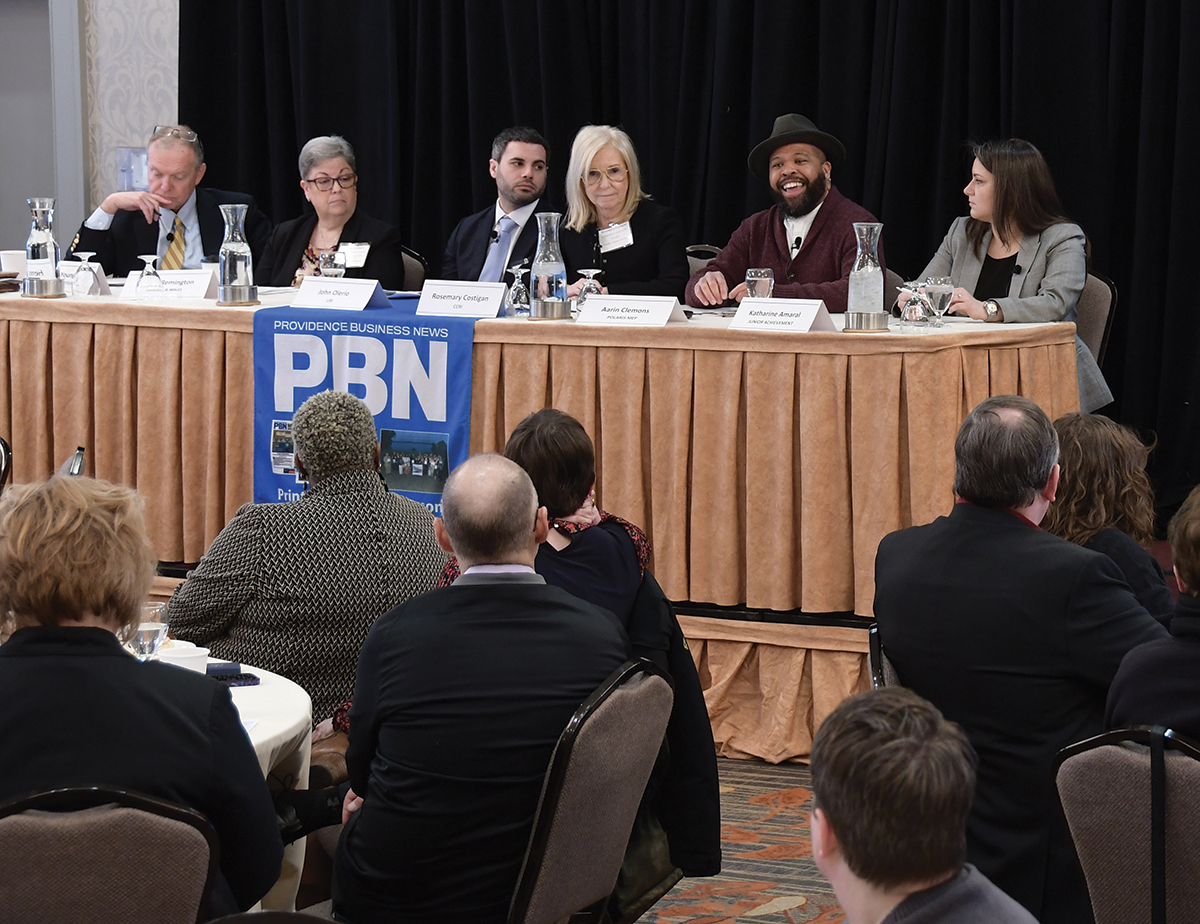
Speakers during the second panel discussion at Providence Business News’ 2026 Workforce Development Summit on Feb. 19 said deeper alignment between education and industry is no longer optional. It is becoming foundational to the state’s economic competitiveness.
Rosemary A. Costigan, president of the Community College of Rhode Island, said employers increasingly expect students to graduate not just with degrees but with industry-recognized credentials and hands-on experience already part of the coursework.
“We are embedding industry-recognized credentials into our programs,” she said. “Students are earning those along the way, not after the fact.”
That shift, panelists said, reflects a broader recalibration in hiring expectations. Employers have less appetite for extended training after hiring new workers, and they are looking for people who can step in with both technical competence and professional readiness.
Henry Young, assistant provost at New England Institute of Technology, said businesses are clear about what they need.
“They want graduates who can contribute on day one,” Young said.
Beyond technical skills, panelists emphasized communication, professionalism and workplace awareness, considered “soft skills,” that are increasingly being developed through paid internships and experiential learning rather than traditional classroom instruction alone.
Donna Remington, senior director of experiential education and career services at Johnson & Wales University, emphasized the equity gap in experiential learning, arguing that unpaid internships exclude many first-generation and lower-income students from critical career pathways.
“Pay them,” she said.
Experiential learning, Remington said, should not be viewed as optional enrichment but as an essential bridge between education and employment.
Katharine Amaral, director of programs and community partnerships at Junior Achievement of Rhode Island, said career exposure must begin even earlier, particularly for students who may not have professional networks at home.
“Students don’t know what they don’t know,” Amaral said. “If they’re not exposed to careers early, they can’t aspire to them.”
Through partnerships with schools and employers, organizations such as Junior Achievement are introducing middle and high school students to industries ranging from finance to manufacturing, attempting to demystify career pathways before students make postsecondary decisions.
Aarin B. Clemons, workforce manager at Polaris MEP, said manufacturers in particular are working more closely with schools to ensure students understand modern production environments, which differ significantly from outdated perceptions of factory work.
“There is still a stigma around manufacturing,” he said. “But these are high-tech, high-skill careers.”
Panelists described advisory boards and industry partnerships as critical tools for keeping curriculum aligned with evolving employer needs. Rather than updating programs every several years, institutions are now in a more continuous dialogue with businesses.
John Olerio, executive director of the Office of Strategic Initiatives at the University of Rhode Island, said that the feedback loop has become essential as technology reshapes skill requirements.
“We can’t design programs in isolation,” Olerio said. “Industry has to be part of the conversation from the beginning.”
That collaboration extends beyond curriculum design to structured work-based learning, apprenticeships and dual-enrollment opportunities that allow high school students to earn college credit while gaining exposure to in-demand sectors.
Costigan noted that alignment is particularly important as the labor market evolves and employers compete for a limited pool of workers.
“We have to be responsive,” she said. “We can’t afford long gaps between what employers need and what we deliver.”
Panelists agreed that while Rhode Island’s labor market is stable, that alone won’t produce the workforce development the state needs.
Instead, the emerging model relies on earlier intervention, embedded credentials, paid experiential learning and sustained employer engagement.
Young said that the shift reflects a broader recognition that workforce development is not a discrete phase that begins after graduation.
“It’s a continuum,” he said.
For educators and employers alike, the message was clear: Preparing the workforce of the future means reaching students sooner, aligning training more closely with industry, and ensuring that opportunity is accessible to those who might otherwise be left out.