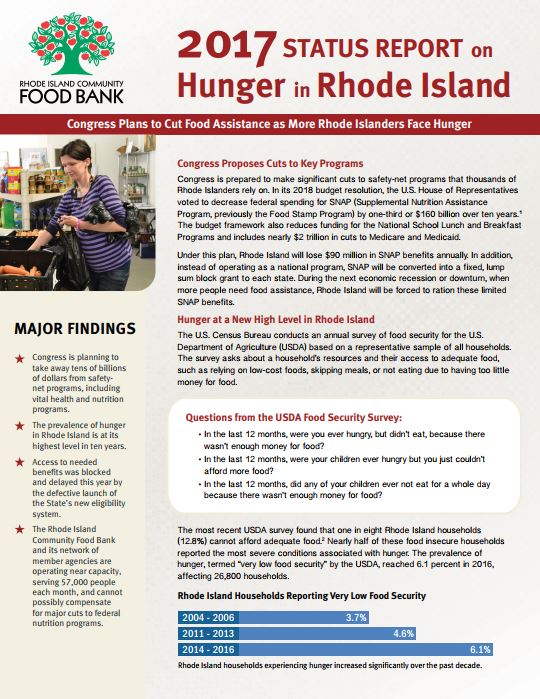
PROVIDENCE – The prevalence of hunger is at a 10-year high in Rhode Island, according to the Rhode Island Community Food Bank’s 2017 Status Report on Hunger in Rhode Island released Monday.
From 2014 to 2016, 6.1 percent of households reported “very low food security” to the U.S. Department of Agriculture, a 2.4 percentage-point increase from 10 years prior, from 2004 to 2006.
Seifert Systems Invests in Energy Efficiency to Strengthen Operations
For manufacturers, energy is more than just another operating expense. It plays a critical role…
Learn More
The report also said Rhode Island has the highest poverty rate in New England, with 12.8 percent, which accounts for 130,000 residents with income below poverty. The poverty rate rose 0.8 percentage points from 2007 to 2016, though declined from 13.9 percent in 2015.
Enrollment in the Supplemental Nutrition Assistance Program in Rhode Island was 170,098 in 2016. Rhode Island enrollment peaked in 2013 at 180,357. However, enrollment has still increased 92,048 from 2007 to 2016. The report also said since the implementation of RI Bridges, the integrated eligibility system for multiple health and social service programs – also known as the Unified Health Infrastructure Project, or UHIP – enrollment in SNAP benefits declined 12 percent, which the report indicates is at least partially caused by the state’s computer rollout issues with UHIP.
In the 2015-16 school year, the number of children receiving free or reduced-price lunch was 54,000, an increase of 8,000 students from the 2006-07 school year. The number of students receiving school breakfast increased by 10,000 in that time to 28,000 in the 2015-16 school year.
The report also noted enrollment in the Special Supplemental Nutrition Education Program for Women, Infants and Children, known as WIC, decreased by 3,000 from 2007 to 2016 to 23,000. The percent of eligible households in the state declined 17 percentage points in that time.
The Rhode Island Community Food Bank warned that proposed changes in federal funding would imperil the Ocean State’s ability to help those who rely on these programs.
“Just as the state’s economy is getting its footing again, Congress is set to dismantle vital programs that support thousands of Rhode Islanders,” the report noted in its summary.
The report also estimated that if the most recent 2018 budget resolution in the U.S. House of Representatives is approved, Rhode Island would lose $90 million in SNAP benefits annually, as well as decreased federal funding for school lunch programs.
“Cuts to SNAP and school meals will make it harder for low-income families to afford adequate food and result in higher demand for food assistance. Charitable food programs, including the Food Bank and its member agencies, cannot be expected to make up for the loss of millions of dollars in federal benefits,” the report concluded.
Chris Bergenheim is the PBN web editor.