
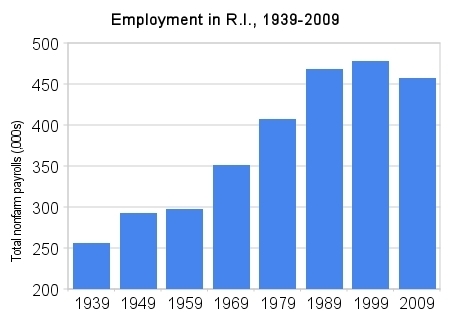
PROVIDENCE – For the first time since World War II, Rhode Island had fewer jobs at the end of the last decade than it had at the start, according to figures released Friday.
There were 457,800 jobs in Rhode Island last month, the U.S. Labor Department reported. That was down 4.3 percent, or 20,700, from the 478,500 jobs the state had a decade earlier, in December 1999, government records show.
Seifert Systems Invests in Energy Efficiency to Strengthen Operations
For manufacturers, energy is more than just another operating expense. It plays a critical role…
Learn More
Thus, the decade ended last month marked the only 10-year period during which Rhode Island lost jobs in records dating back to 1939-1949.
Employment in Rhode Island was also down when looked at over the last two decades. The state had 468,100 jobs in December 1989, which was 2.2 percent more than it had last month, 20 years later.
The previous worst decade for job growth here had been the 10 years ended in 1959, when employment grew by 1.4 percent. But the decade that followed saw the most robust 10-year growth in the state of the last 70 years, as employment surged 18.1 percent through 1969.
The decline in employment from 1999 to 2009 occurred despite a small increase of 0.5 percent in Rhode Island’s total population over roughly the same period. The number of residents in the state rose from 1,048,319 in 2000 to 1,053,502 in 2009, according to the U.S. Census Bureau.
One important caveat is that the end of a decade is an arbitrary point in time to measure employment, in terms of the economy. For example, the most recent 10-year period began at the end of a long economic boom, in January 2000, but ended in the worst recession since the Second World War.
Rhode Island was not the only state that saw a net loss of jobs over the last 10 years. Employment fell by nearly 2 percent in Massachusetts and more than 15 percent in hard-hit Michigan, according to The Boston Globe.











This is not very meaningful because 1999 was close to the high point of the dot.com bubble, and 2009close to the low point of the sub-prime bubble. To be more meaningful, comparisons should be made at the same point of the business cycle, typically peak-to-peak or trough-to-trough. Given what’s transpired, I bet many states experienced a net job loss between 1999 and 2009.
You give this caveat, but it should apply equally to previous decades. The fact that it doesn’t is the most interesting thing about the article. It reflects the continual deterioration of the world economy and the United States’ position in it, as well as the weakened position of labor and the detrimental effects of neoliberal policies.