
PROVIDENCE – Rhode Island’s top energy officials released a report on Wednesday recommending the state transform how it regulates the power sector.
The plan, if executed, could radically change how Rhode Islanders consume and pay for electricity.
Selling Luxury Real Estate Requires More Than Exposure
By Emilio DiSpirito IV License Partner | Private Office Advisor Engel & Völkers Oceanside www.DiSpiritoteam.com…
Learn More
“The traditional regulatory framework will not continue to serve the public interest,” according to the report. “It will continue to push consumer prices upward without a corresponding increase in value for customers.”
The report, dubbed the Rhode Island Power Sector Transformation, is the result of an eight-month long effort by the R.I. Office of Energy Resources, the R.I. Division of Public Utilities and Carriers and the R.I. Public Utilities Commission, along with multiple interested parties and stakeholders.
The group was tasked with addressing topics “related to Rhode Island’s future electricity system.” The findings were detailed in a 90-page report of data, analysis and recommendations.
Some of the recommendations, which range from changing how utility companies are compensated, to requiring new electrical meters more compatible with new and future technologies, could help inform an upcoming debate surrounding how Rhode Island ratepayers should be charged for electricity.
National Grid Rhode Island, the state’s largest utility company, is slated to present a so-called “rate case” next month, which is essentially an argument for how rates are assessed on commodities such as electricity and gas.
Rhode Islanders are acutely aware of electricity prices, especially this year, as monthly rates increased 20 percent in October.
State officials are eyeing the upcoming rate case – which hasn’t happened since 2012 – as an opportunity to implement several of the recommendations detailed in the report.
“[It] represents a strategic opportunity to modernize the utility business model, deploy advanced meters, enhance distribution system planning and pursue beneficial electrification,” according to the report.
National Grid Rhode Island is a subsidiary of National Grid PLC, a London-based energy company, and has a great deal of leverage in the Ocean State. After the state deregulated its energy market in 1996, National Grid entered the state and bought up most of the competition.
The utility serves about 500,000 residential and commercial customers in Rhode Island.
Timothy Horan, president of National Grid Rhode Island, said the utility worked closely with the state agencies on the report, calling it a “comprehensive path forward.”
But he stopped short of endorsing it outright.
“National Grid is in a unique position to help the state realize the ambitions of regulators and policymakers – to build a nation-leading model for energy transformation,” Horan said in a statement.
State officials, however, are bullish the utility – which has experience working on grid-modernization projects in other states and in England – is onboard with the common goal that it needs to happen.
“They are clearly onboard with the fact that the grid needs modernization,” said Carol Grant, OER commissioner. “There are probably recommendations and ways they would go about it differently.”
The report breaks its recommendation down into three goals: To control long-term costs, to give customers more choice, and to build a more-flexible electrical grid that can integrate an increasing amount of renewable-energy generation.
Distributed generation, or electricity generated where it’s consumed (think solar panels atop a home), has been a hot-button issue in the energy sector in recent years. In Rhode Island, it’s raised a host of issues ranging from environmental concerns to socioeconomic equity.
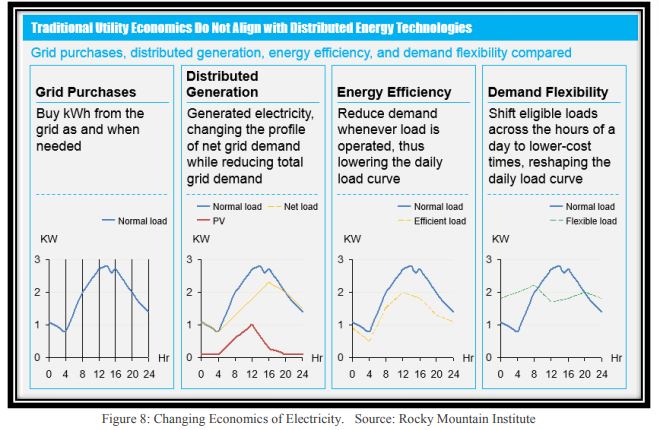
A large part of the report urges National Grid to incorporate more renewable-energy generation.
“Clean-energy technologies are becoming more affordable,” according to the report. “Our utility rules should allow customers to access solutions to manage their energy production and use.”
Macky McCleary, DPUC administrator, said allowing for the influx of more renewable-energy generation could help the state meet its long-term greenhouse gas emission-cutting goals. It also fits nicely with an initiative of Gov. Gina M. Raimondo, who has called for the procurement of 1,000 megawatts of renewable energy by 2020, he added.
“The other side of the coin from the 1,000 megawatts is the question of how to prepare the grid for such a high-penetration of renewable energy,” McCleary said.
The report also proposes changing how National Grid is compensated, recommending pay be tied to performance – a model closely resembling how CEOs are compensated at publicly traded companies.
“We recommend shifting the traditional utility business model away from a system that rewards the utility for investment without regard to outcomes towards one that relies more upon performance-based compensation,” according to the report.
State officials also argue technological advances in the energy sector is something that should planned for now.
The report calls for new “advanced meters,” which would be compatible with distributed generation, and allow third-party vendors to provide new services, “similar to how cell phones allow third-party application development,” according to the report.
McCleary said this must be done thoughtfully, as a worst-case scenario would involve installing the new meters only to rip them out five years later after becoming obsolete. He pointed to Ohio as having experienced such a problem.
The last time National Grid installed meters statewide was between 1999 and 2003. McCleary said meters have a useful lifetime of about 18 years. New meters could also unlock future revenue sources from third-parties, the report argues.
“These platforms must appropriately be monetized by the utility by charging third parties for access and services,” according to the report.
Allowing such access, of course, opens a can of worms related to privacy rights, which is already informing public debate. The report calls on the utility to proactively manage cybersecurity.
The report, which can be found in its entirety here, will likely serve as a reference for the state in upcoming policy decisions. And state officials argue the reform is necessary to protect ratepayers in the long-term.
“The cost of electricity will continue to increase if nothing changes,” according to the report. “A new regulatory framework will fundamentally change the trajectory of costs both by avoiding system costs and by forcing the utility to find value from our electric distribution system, creating additional revenue streams.”
Eli Sherman is a PBN staff writer. Email him at Sherman@PBN.com, or follow him on Twitter @Eli_Sherman.