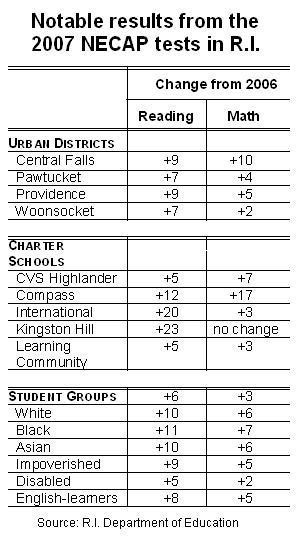
PROVIDENCE – Elementary and middle school students showed improvement in reading, writing and math scores on a statewide standardized test for the second consecutive year, state education officials announced today.
In the New England Common Assessment Program (NECAP) tests taken in October by students in grades 3 to 8, 65 percent of Rhode Island students were deemed proficient in reading, an increase of 3 percentage points; 54 percent were considered proficient in math, up 1 point; and 48 percent were proficient in writing, up 1 point.
Rhode Island's Market Has Changed. Developers, Builders, Investors and Sellers Must Change With It.
By Emilio DiSpirito IV License Partner | Engel & Völkers Oceanside Leader | The DiSpirito…
Learn More
“I am particularly pleased that these improvements in test scores are seen across the whole state, including our urban school districts,” Robert G. Flanders Jr., chairman of the R.I. Board of Regents for Elementary and Secondary Education, said in annoucing the results this morning at the State House. “I am also pleased to note that – with the significant improvements this year – we are keeping pace with the two other states in our testing system, New Hampshire and Vermont …. Obviously, however, we still have a long way to go, particularly in the math and writing results.”
Over the three-year span when the tests have been administered, Rhode Island students have gained 6 points in reading and 4 points in mathematics, according to the R.I. Department of Elementary and Secondary Education. Writing scores have declined by 3 points, though the Rhode Island scores have matched or surpassed writing scores in New Hampshire and Vermont, the department said.
“Being serious about standards and expectations, about curriculum, about support for teachers, and about professional development is clearly making a difference in student results,” said Peter McWalters, the state commissioner of elementary and secondary education.
“We should all be very proud that we have seen significant improvement in student achievement at each of these grade levels, among all student groups including disadvantaged and minority students, and in nearly all school districts,” said Gov. Donald L. Carcieri, adding: “Some of our strongest gains are in our urban districts and in our charter schools.”
Additional information from the R.I. Department of Elementary and Secondary Education and its Office of Assessment and Accountability is available at www.ride.ri.gov.