Emma Durand’s first success as an innovator came while she was still an undergraduate studying mechanical engineering at Massachusetts Institute of Technology.
She contacted Steve Jobs, whose company Apple Inc. was then known mainly to industry insiders, with an idea that would eliminate problems computer manufacturers faced with adapting keyboards to different languages. He later wrote a check for development and licensing of her idea to Apple.
Today, Durand holds 40 U.S. patents, with 24 of them licensed to Fortune 100 companies. Through the years she has helped launch five companies, and at each of them served as either president or chief technology officer. Currently, she holds both positions at Isis Biopolymer Inc., a Providence company that’s developing an enhanced version of the transdermal patch used to deliver medicinal drugs. The twist: this one’s the “smart” patch, equipped with a thin microprocessor and a small battery to deliver measured doses of medicine on a specific schedule.
“It’s a programmable patch,” said Durand, the brain behind the brainstorm. “A physician can call a Wi-Fi site and remotely program the device to deliver analgesics or stimulants or diabetes medication or anything else, and he can remotely interrogate it as well.”
That combination of vision, drive and entrepreneurship has made the Rhode Island native a leader as both an engineer and an executive.
“She’s an off-the-charts genius,” said attorney Joshua Celeste of the Providence law firm Duffy & Sweeney, who serves as corporate counsel to Isis and who has worked with Durand on several other ventures.
“She’s a voracious reader who’ll wake up at four in the morning to study white papers before going to work,” Celeste said. “Her background is engineering, but she’s applied it to many different things. Right now, it’s medicine, and she’s completely comfortable talking with doctors in medical terms.”
A glance at Durand’s resume shows how her quick grasp of many subjects has made her an entrepreneurial success. Through the years she founded Sublimation Systems Inc. the pioneer of four-color printing of dyes; Key-Tech Inc., the pioneer of engineered plastic decoration and assembly; and Poly-Flex Circuit Inc., a pioneer in flexible circuit boards. Larger companies eventually purchased each of those enterprises.
She also used her expertise with marketing intellectual technology to co-found EvaluTech LLC, a business set up at the end of the Cold War to help the U.S. Navy license declassified technology originally developed for submarines. The Rhode Island company shut down after two years because the Pentagon decided to discontinue the program.
Durand’s best-known product to date has been the Mosquito Magnet, a high-tech, pest-control device. American Biophysics Corp., a North Kingstown outfit, originally manufactured a device that was used by scientists to survey insect populations. When Durand came on board as chief technology officer, she transformed the research tool into an automated mosquito-extermination machine that could be set up in any backyard, and sales soared.
Even as she worked on the Mosquito Magnet, Durand was mulling her next venture. She was studying the transdermal patch: at that time, its use was limited, chiefly because there was no way to regulate dosage. She envisioned a way to change that.
“What held me back were the prices of microprocessors and batteries,” she said. “They were very expensive. But around 2005 the prices collapsed, and that was my opportunity.”
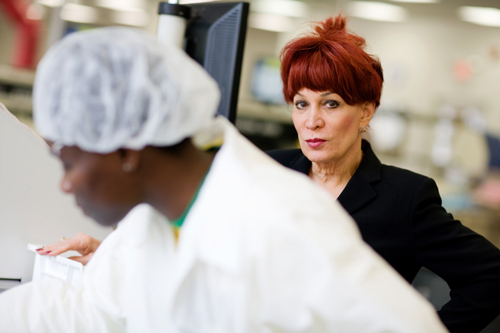
The company was born three years ago, with a small office in Warwick. Today, 83 people work at the new Richmond Street operation. Two clinical studies are now under way, led by researchers at Hasbro Children’s Hospital and Rhode Island Hospital. And Isis is already manufacturing a patch for a cosmeceutical outfit that uses the device to administer anti-wrinkle treatments. It’s sold over the counter at CVS and other drugstores.
“She has a brilliant mind, not only for engineering, but also for understanding the needs of the market,” said Shawna Gvazdauskas, chief commercial officer at Isis.
And Gvazdauskas says that as the company’s top executive, Durand has won praise for her management style as well. “The majority of the employees here at Isis Biopolymer previously worked for her at other companies,” she said. “They follow her from company to company. It’s a testimony to her ability.” •