 CLICK HERE. / " title="FOR A LARGER VERSION of this graphic, CLICK HERE. /"/>
Dismal.
That is the only way to describe the state of small business in the United States, according to the “2010 Mid-Year Economic Report” issued by the National Small Business Association, which represents more than 150,000 small businesses nationwide.
The report “shows a small business community that is continuing to struggle under a lagging economy and the ongoing credit crunch, and unable to create any significant new jobs,” said the introduction to the 12-page report, available online at www.nsba.biz.
The major problem – as it has been since the national recession began almost two years ago – is the inability of small business owners to obtain the financing that they need from the usual sources such as bank loans and credit card accounts.
“Access to credit continues to evade small businesses, as the highest percentage of small business owners since NSBA has been conducting this survey report an inability to garner adequate financing to run their businesses,” the report said.
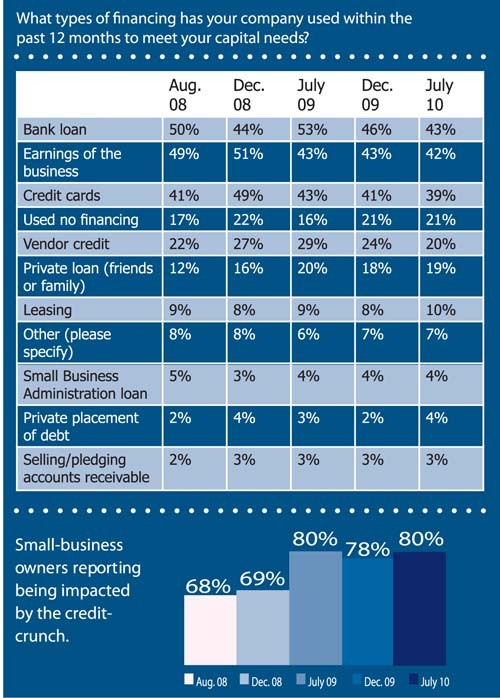
The survey of 400 NSBA members, conducted online from June 23 through July 14, found that only 59 percent of small businesses are able to obtain adequate financing, a drop from 78 percent in August 2008, 67 percent in December 2008, 62 percent in July 2009 and 61 percent in December 2009.
“Although a majority are able to secure financing, it cannot be glossed over that 41 percent – which translates into more than 12 million – of the nation’s small businesses are not able to get adequate financing,” the report said. Some 80 percent – four out of five small business owners – report that their company has been adversely affected by the credit crunch.
“I’m working on a situation right now where a bank is not willing to finance a loan, and it’s putting [that] company right out of business, and it really should not be,” said Grafton “Cap” Willey IV, chairman of NSBA in 2007 and a current member of the NSBA board of trustees. He is also managing director of the Newport office of CBIZ Tofias and Mayer Hoffman McCann P.C.
Vendors and suppliers are tightening their credit, Willey said, and in some cases will not ship inventory until an account is made current so small businesses truly are getting caught in the middle between suppliers’ demands and the credit crunch. “They’re getting squeezed,” he said.
“Today, more small businesses are unable to get financing than at any time in the last 17 years,” said Todd McCracken, president of the NSBA. “Given the direct correlation between access to capital and job growth, unless small business owners are able to secure financing, we will continue to see high unemployment.”
The NSBA survey revealed that, in the last six months, there has been a decrease in small business use of nearly every financing mechanism, from traditional bank loans to credit cards to vendor credit, with 21 percent of small businesses using no financing options at all.
Credit cards had been the major source of small business financing, the NSBA said, but now “many small businesses are hesitant to take on credit-card debt given the volatility associated with them.” The average interest rate small businesses pay is 16 percent, the report said, with half paying more than 15 percent and 23 percent paying 20 percent or more.
In the interest of fairness, Willey pointed out that some banks in Rhode Island “are trying to help,” particularly those who regularly work with the U.S. Small Business Administration, such as Coastway Community Bank and Bank Rhode Island. “You can’t fault the bigger banks, because they have a lot of regulations coming down on them,” Willey said, “and the Rhode Island economy is not something people are looking positively at.”
Other highlights of the 2010 mid-year NSBA report include:
• Despite a slight increase in optimism just six months ago, small businesses today report decreases in nearly every indicator, including business confidence, revenue, job growth and growth projections.
• Only 11 percent of small businesses hired new employees in the last 12 months, and the net number of employers who cut jobs was 25 percent. Most employers project no growth in staffing for the coming year.
• Traditionally upbeat entrepreneurs have a far more negative outlook today than they have in the last several years, the report said. Nearly half do not believe there will be any growth opportunities for their business in the coming year and more than one-third – 41 percent – are worried about the ongoing viability of their companies.
• Most small-business owners, 59 percent, expect the overall U.S. economy to be flat in the coming year and 29 percent expect recession conditions.
• With regard to policy, confusion over the new health care law plagues a significant majority of small businesses. Only 10 percent said their businesses would qualify for the small-business health care tax credit, with 52 percent unsure about their eligibility. Only 21 percent said they have a clear understanding of the new law; 79 percent said they have no idea how their businesses would be affected.
• The new 1099 reporting requirements mean small businesses on average will have to file 172 1099 forms, up from the 20 forms they currently file. •