NEW YORK – U.S. stock-index futures rose this morning, bouncing back from last week’s selloff, despite bad news from ailing Lehman Bros. Holdings Inc.
Last week, the Dow Jones Industrial Average lost 3.39 percent to close at 12,214 points; the Standard & Poor’s 500 Index lost 2.83 percent over the week to close at 1,359.5; and the Nasdaq composite index lost 1.91 percent to close at 1,988.75 points.
The greater part of the week’s losses came on Friday, when the Dow lost 395 points, or 3.13 percent – the index’s fifth-steepest decline since 1991, Biryini Associates Inc. of Stamford, Conn., wrote in a note to investors yesterday, according to Bloomberg News – amid the panic that followed an $11-per-barrel rise in the price of oil.
As of 8:59 this morning, however, Dow futures expiring in June had risen 50 points to 12,264; S&P futures added 6 points to 1,365.5 percent; and Nasdaq 100 Index futures rose 8.25 points to 1,997, Bloomberg said. Oil prices also moderated slightly in pre-market trading, with light sweet crude dipping to $136.99 per barrel from Friday’s record $138.58.
“When you get these steep sell-offs on one day, you typically get some recovery the next,” Mike Ryan, head of wealth-management research for the Americas at UBS Financial Services Inc. in New York, told Bloomberg Television. “We’re likely to get some bounce back.”
Little economic news is expected today that might perturb the market. Although Lehman Brothers’ futures fell after the company reported second-quarter losses of nearly $3 billion and said it plans to raise $6 billion in new capital, other financial shares appeared unaffected. And the report was balanced by sunnier news from McDonald’s, which said U.S. and European sales rose in May, as well as increases in energy futures.
The only major economic news on the calendar today is the National Association of Realtors’ pending home sales index for April, due at 10 a.m., which analysts predict will be essentially unchanged from the month before.
UPDATE:
Seifert Systems Invests in Energy Efficiency to Strengthen Operations
For manufacturers, energy is more than just another operating expense. It plays a critical role…
Learn More
Pending home sales rose 6.3 percent nationwide in April, indicating the housing market may be on the verge of a turnaround, the NAR said in its 10 a.m. report. (READ MORE)
But most U.S. stocks fell this afternoon, erasing an earlier rally that had pushed the S&P up 0.7 percent and the Dow up 1.0 percent, after two Federal Reserve officials indicated rate hikes may be on the horizon, Bloomberg News said.
“Tighter monetary policy” may be required globally, to avert the threat of inflation, Timothy Geithner, president of the Federal Reserve Bank of New York, told a New York audience today. Richard Fisher, president of the Fed Bank of Dallas, agreed. Inflation is “something that I think a lot of monetary authorities will have to come to grips with,” Fisher told CNBC during an interview today. “The question is, how and when.”
At 2:08 p.m., the Dow was up 22.31 points, or 0.2 percent, at 12,232.12 in New York trading, after earlier rising 122 points; the S&P was down 6.18 points, or 0.5 percent, at 1,354.5; and the Nasdaq was down 35.01 points, or 1.5 percent, at 2,438.55 points.
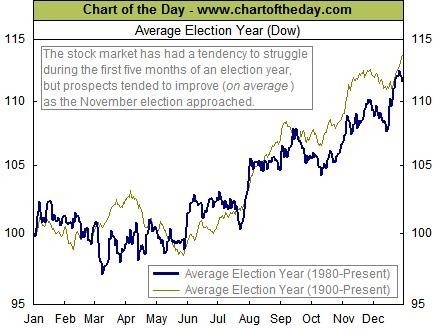
This year’s rocky beginning for U.S. stocks is typical of a presidential election year: Historically, markets have tended to struggle in the first five months, before beginning a rally that continues through the November election. Whether that typical rally will follow, however, remains unclear.