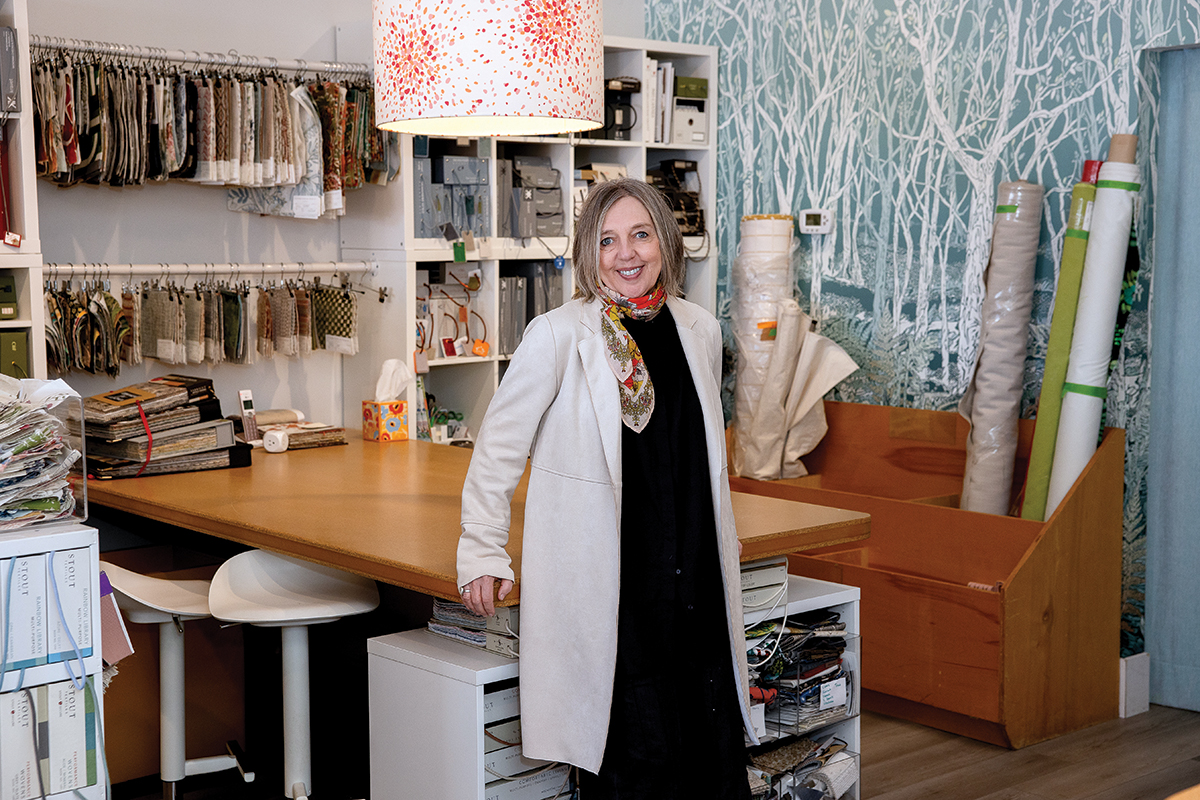
Packing up and moving to a new country when you don’t speak the language isn’t most people’s idea of a good time. But for Line Daems, it’s had a lifelong positive effect.
Daems migrated from Belgium to Germany to Paris, and finally to Providence more than two decades ago, where she settled with her husband and her children.
“Moving has made me flexible and creative,” she said. “Learning languages makes me a better problem-solver. I get inspiration and creativity from visiting other countries.”
Along with English, she speaks Flemish, her native language that’s a variant of Dutch, as well as French and German.
Today, Daems owns Kreatelier LLC, a fabric concept and design store with its distinctive rainbow-striped awning on Hope Street in Providence. On one side of the small space, shelves are crammed with colorful fabrics and samples used in upholstering chairs and sofas, as well as for curtains and window shades. On the other side, it’s elegant pillows, home-related tchotchkes and racks of soft, draped women’s tunics and casual dresses.
Daems grew up in Antwerp, the daughter of a school secretary and an electrical engineer.
“Antwerp is a beautiful city in the Flemish part of the country,” she said. “Americans aren’t familiar with it, but it’s known for fashion and the Royal Academy of Fine Arts, which launches new and upcoming designers.”
Both her parents, who still live in Belgium, were creative and channeled that inspiration into arts and crafts.
“I grew up with that at our home,” Daems said. Her mother also ran an atelier, a studio for teachers of pottery, batik and weaving, and Daems’ parents dyed oversized woven pieces that they hung on the walls of their home.
Despite her creative background, however, Daems didn’t study art in school. Instead, she trained as an intensive care nurse.
“I loved it. It’s the most important job in the world,” she said. “It’s very satisfying because you feel you’re doing something worthwhile for others.”
At 21, she left Antwerp and spent 10 years in Germany, where her two children were born, then six years in Paris. She came to Rhode Island in 2002, when her now-former husband got a job at Pfizer Inc. in Connecticut.
She enrolled her children in the French American School on the East Side of Providence and took home décor classes at Rhode Island School of Design. She always liked decorating and she started learning about fabrics and designing residential spaces. She and a friend decorated for their kids’ school events, and they realized there was no design business willing to take on relatively small home décor projects.
“Home designers charge by the hour and it’s expensive,” she said. Having discovered a business need, they took a leap and opened Kreatelier in 2007.
The theme of the store is fabric. The client base is all ages and income levels but skews female, with lots of referrals and walk-ins.
Daems notes that it’s important that the retail side of the business and the home design services work together.
“All the retail items we sell are made of fabric. We use leftover material in our gift bags. We have a small selection of clothes, and they’re curated and very sustainable. We know our clients believe in that,” she said.
Of her staff of four, two have been with her for 12 years.
“A business like ours, we depend on our team. I wouldn’t be where I am without them,” she said.
Unlike some retail businesses, Daems says, Kreatelier prospered during the pandemic.
“We made masks. There were 12 people working on them, using pretty fabrics,” she said. “We were also able to do home décor services. The store was closed, but we were very busy. We made 40,000 masks for the city during the shutdown. It was our best year ever. After that, we were able to expand.”
After many years in business, Daems says she’s learned the rhythm of the community along Hope Street.
“It sustains me,” she said.
But like many small retailers, Daems says the most challenging part of her business is managing cash flow in this economy, and working with projections based on previous trends. Last year, tariffs increased the level of difficulty.
Dealing with tariffs has gotten easier now that companies can anticipate them, but she says everything is 30% more expensive. The result: she’s decided to buy less as people are spending less.
And despite the economic turbulence of the last few years, Daems says managing the ups and downs and challenges of a small business is still a great creative outlet that brings her joy.
“You need to know your inventory and what services people need. It’s not quite like reinventing yourself, but it’s constant change,” she said.