The pace-setting growth in Rhode Island’s high-tech wages earlier this decade was either a statistical blip or a short-lived phenomenon, a new industry study has found.
From 2005 to 2006, wages for high-tech workers in Rhode Island grew by 6.7 percent, to $77,376 when adjusted for inflation, a trade group said in its annual Cyberstates report last year. That gave Rhode Island the second-fastest rate of growth in the nation.
But this year’s Cyberstates report, released last week by TechAmerica, found that in 2007 the average high-tech wage in Rhode Island fell to $69,552 – a 10.1 percent year-over-year decline. The state’s entire high-tech payroll fell even more, by $163 million, or nearly 11 percent, according to the report, which is based on data from the U.S. Bureau of Labor Statistics.
The plunge in high-tech pay in Rhode Island in 2007 was by far the worst reported by any state; the second-biggest drop in average wages, in Vermont, was only 3.7 percent. No other state saw tech wages decline by 2 percent or more.
Still, in 2007 an average high-tech worker in Rhode Island made 75 percent more than the state’s average private sector wage of $39,800, the report said. That was down from 94 percent more in 2006.
The state’s average high-tech wage ranked 26th nationwide in 2007, making it the median U.S. high-tech wage when Washington, D.C. and Puerto Rico are included. The previous year, the average high-tech wage here was 17th highest.
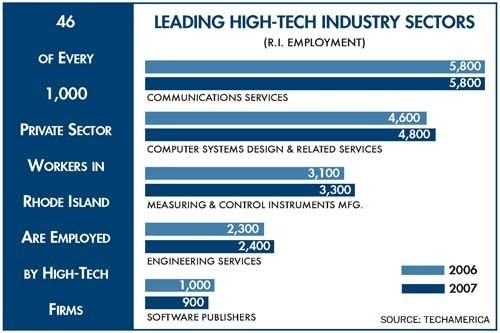
In all, the high-tech industry employed 19,168 people in Rhode Island in 2007, down slightly from the year before but up 3 percent from 2002, the report said. The state’s high-tech job growth ranked 22nd in the nation over the past five years.
Tech-industry observers in the state said they were uncertain what had caused the dramatic change in wage figures. Kathie Shields, executive director of the trade group Tech Collective, said her group is analyzing the figures. Federal statisticians changed some of their occupational definitions in 2007, and that may have impacted the numbers, she said.
State data provides some clues as to why the wage numbers changed so drastically in a single year.
The drop was particularly steep in the category of computer-systems design and related services, which added 361 more jobs but saw its average wage drop from $103,872 to $86,962 between 2006 and 2007. The reverse occurred in the computer and communications hardware category, where 296 jobs were eliminated but the average wage rose from $50,345 to $66,437.
Technology jobs in other sectors, such as defense or health care and life sciences, could also have impacted the numbers. In addition, Josh James, director of research and industry analysis at TechAmerica, said some companies may have changed the way they reported information in 2007. He said the data-collection process used by the trade group was the same for both years, though the group was involved in a recent merger. (TechAmerica was formed by the recent merger of two industry groups, AeA and the Information Technology Association of America.)
One piece of good news for Rhode Island was a 5.4 percent increase in the number of high-tech “establishments” in the state, a term that encompasses both the founding of new companies and the opening of new offices by existing businesses. In 2007, the state had the 19th-highest rate of high-tech establishment growth, raising the total number to 1,657.
Thorne Sparkman, managing director of the state-backed Slater Technology Fund, which invests in startup companies, said those figures fit with a trend he has noticed in Rhode Island, which “is a slow but steady growth in the technology community.”
Since he moved here in the late 1990s, “there are more entrepreneurs and more software engineers than before,” Sparkman said. He added: “While I might describe that as a progression from low to less-low, it is happening.” •