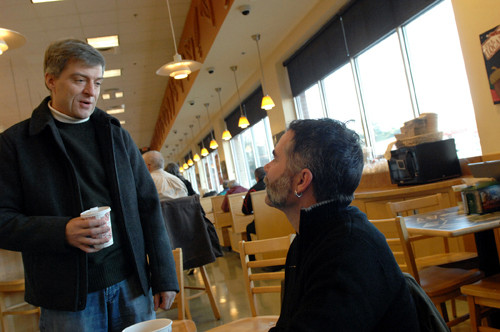
Lorne A. Adrain owns a Providence insurance practice focused on estate planning and manages to find the time for an array of philanthropic efforts.
He is co-founder of Social Venture Partners Rhode Island, started National Neighborhood Day, began KindMark to create software that advances philanthropy, wrote four books whose royalties go to charity and recently began Better Providence, an effort to give citizens a greater voice in government, among other ventures.
Entrepreneurs like Adrain are generally recognized as a vital element of any area’s economic prosperity. But there is another, less obvious reason why entrepreneurs can be considered essential to the well-being of any particular community. They give more to charity than other business representatives, a recent study concludes.
The Fidelity Charitable Gift Fund and Ernst & Young sponsored the study, “Entrepreneurs & Philanthropy: Investing in the Future,” which found roughly nine in 10 – or 89 percent – of entrepreneurs donate money both personally and through their companies to support charitable causes, while 70 percent also donate their time.
Other key findings:
• The majority (61 percent) of respondents say that being an entrepreneur makes them more inclined to give to char•ty.
n Companies led by entrepreneurs allocate more than twice the percentage of profits to charity than many of America’s largest companies, a median 3 percent compared to a median 1.2 perc•nt.
n Business benefits aside, entrepreneurs cited as their major reason for charitable giving the fact that it enables them, as leaders, to integrate their personal philosophies for giving into the corporate culture. More than half, 55 percent, personally select the charities their companies support.
“I never thought of that question before,” said Adrain, who owns Lorne Adrain Insurance, of entrepreneurs giving more to charity. “But … when I think about all of the things I’ve been involved in … [and] about the people I’ve had the good fortune to be surrounded with, the vast majority are entrepreneurs.”
Allan Tear, co-founder of Betaspring, a Providence company that helps innovative startups, isn’t sure if entrepreneurs give more to charity than other business representatives, suggesting instead that they “give differently.”
“They tend to combine money donations with time and connections,” Tear said of himself and fellow entrepreneurs. “I don’t see money as their most valuable donation. It’s time, it’s ideas, it’s connections.”
Tear estimates that he spends roughly one day each week on average donating his time to nonprofits either by freely dispensing advice, serving on their boards or attending meetings related to civic and philanthropic causes.
He works with the Awesome Foundation in Providence, which grants limited funding to unusual local causes with no strings attached, for instance, and he regularly takes part in Open Coffee, a Betaspring open house held every other Tuesday morning at the coffee shop of Whole Foods Market on North Main Street in Providence.
At Open Coffee, he explained, anyone can come in and talk to Betaspring personnel about technology and business ideas.
The key question, of course, is what makes entrepreneurs more generous than others, if the study is correct.
“No entrepreneur creates a successful venture without the earnest help of a great many people. … As such, I think entrepreneurs are reminded every day that a great deal of humanity, luck and hard work went into creating their successful enterprises,” said M. Cary Collins, trustee professor of entrepreneurship in the College of Business Administration at Bryant University in Smithfield.
“Giving back to the community that helped you create successful work is part and parcel of entrepreneurship,” Collins said.
Collins defined an entrepreneur, versus a regular businessperson, as someone who faces a decided element of risk in what they establish. “An entrepreneur is someone who pursues an idea or innovation fully understanding that he/she does not have all the resources at hand to accomplish that pursuit,” he said. “He/she begins the work with what they have at hand while working to secure the additional resources.”
Tear and Kelly Ramirez, executive director of Social Venture Partners Rhode Island, believe that entrepreneurs seek out unusual philanthropic causes to support rather than the usual charities, such as the United Way Rhode Island, that most people donate to. The Awesome Foundation, for instance, is comprised of 10 entrepreneurs who each personally donate $100 every month for a $1,000 prize to a deserving artist or activist.
Tear and Adrain dismissed the notion that entrepreneurs give to charity to improve their own business prospects.
Adrain said most people he knows are simply committed to helping others and the community. “I don’t sense it’s out of obligation, but it’s out of interest and desire, and it’s very pure,” he said. “Once you get involved in something, anything, you find it feels good to contribute and you see a positive change in people’s lives, so you want to do it again.”
“I don’t see it [charity work] as a way for entrepreneurs to make their own businesses successful,” Tear said. “All entrepreneurs rely on a web of trust relationships, anyway.”
The Fidelity/Ernst & Young study was conducted online by Harris Interactive between Sept. 17 and Oct. 6, when 146 entrepreneurs from across the country responded. The report also relied on independent research, including by the Chronicle of Philanthropy. The study can be found at charitablegift.org. •