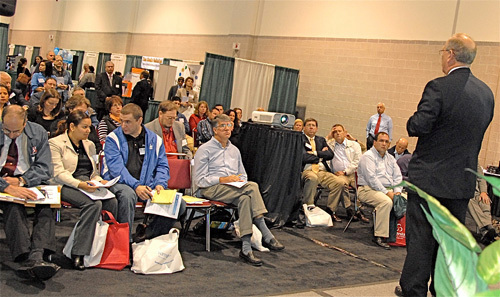
Remaining “cash positive” and spending too much time on mundane daily chores are among the top worries of business owners, according to a survey conducted earlier this month at the Business Expo sponsored by the Greater Providence Chamber of Commerce.
“What Keeps You Awake At Night” was the title of the survey that Tom Stocker, principal of Boardroom Advisory Group LLC in East Greenwich, on his own initiative distributed to attendees at the May 5-6 Business Expo held at the R.I. Convention Center. Boardroom Advisory Group is a consultant firm for small- and mid-market business owners.
Neither Stocker nor Laurie White, Chamber president, were surprised that 92 percent of the business owners surveyed cited “remaining cash positive” as their major concern. “Cash flow is far and away the No. 1 issue for small business,” White observed last week.
But both Stocker and White said they were a bit taken aback that the same percentage of business owners – 92 percent – said they are most worried about “spending too much time on day-to-day activities,” in the words of the survey, and too little time considering the big picture.
Stocker said he expected that “finding new sales opportunities” or “stopping sales from declining” would have been of greater concern. Some 89 percent of those surveyed cited the former as their major concern and 81 percent, the latter. “That indicates to me that sales are stabilizing,” Stocker told Providence Business News.
He suggested that concern over day-to-day duties is connected to cash flow because business owners do not have ready funds to hire and are under-staffed, often left to deal with daily crises on their own.
“It is important that, at least once every quarter, business owners and key staff go off-site and take a look at where you are,” White said. “It’s important to get out of that ‘fire drill’ mode and spend time in quiet reflection and really think about what you need to do to stay on track.”
“I don’t spend enough time thinking about my business, I spend more time putting out fires,” she confessed to PBN. Leonard said she enjoyed taking the survey at the expo because it was an “interactive” way for her to contribute to the event by offering her opinions. She said she cited “staying cash positive” as her top concern.
Overall, 57 percent of respondents were business owners; 84 percent of whom own businesses with under $1 million in revenue.
Other top concerns for business owners were: securing additional capital, 70 percent; reducing operating costs, 70 percent; creating better business metrics, 62 percent; losing a major customer, 60 percent; and operating in a “fire drill” culture, 60 percent. Respondents were given a choice of three answers: very concerned, somewhat concerned, and not concerned.
Of those survey participants who are not business owners, Stocker said respondents reflected most of the same concerns as owners, with one exception: a majority, 63 percent, said they are worried about layoffs.
A key concern for all is when the economy will recover.
Stocker described the survey results as “cautiously optimistic,” with 68 percent of all respondents expecting improvement before the start of the second half of 2010, and 36 percent anticipating recovery in 2009.
The cautious optimism, White suggested, could be a result of recent gains in the stock market that “have helped people feel more ebullient,” combined with a general sense that government stimulus programs are beginning to work.
At her printing business, Leonard said she can see “bright signs” of a turnaround at the same time that “ups and downs” continue, so “it’s hard to know what that all means. Even those [businesses] that are doing OK are nervous because so many others are not,” Leonard said. •