
PROVIDENCE – The road to economic recovery after the COVID-19 crisis will be a long one, especially in New England where a dependence on tourism has led to higher unemployment rates, according to Beata Caranci, senior vice president and chief economist for TD Bank.
Caranci painted a bleak picture – regionally, nationally and globally – across various measurements of economic well-being in a presentation hosted by TD Bank and the New England-Canada Business Council on Wednesday.
ISO 9001:2026: A Practical Opportunity to Build for What’s Next
For Rhode Island manufacturers, ISO 9001 has been much more than a certificate on the…
Learn More
Whether V, U, or W-shaped, recovery will be a slow process with long-lasting scars from the wound inflicted by coronavirus, Caranci warned. Exactly how long it takes for the United States to return to a “functioning” economy at pre-COVID-19 levels depends largely on whether and how severe a second wave of the virus is, though TD Bank’s forecast anticipates it will take until at least late 2021.
Also, by the end of 2021, the bank projects a 6.3% national unemployment rate – slightly lower than the 6.5% average based on the latest Federal Open Market Committee – and a 4.3% real GDP increase – not quite enough to offset the anticipated 4.5% contraction in 2020.
Due to its reliance on tourism, Rhode Island will see a more severe GDP contraction – estimated at 6.3% through 2020 – the most severe decrease in the region, according to TD Bank. Still, Rhode Island and its regional counterparts may benefit from higher consumer confidence relative to other states, according to Caranci.
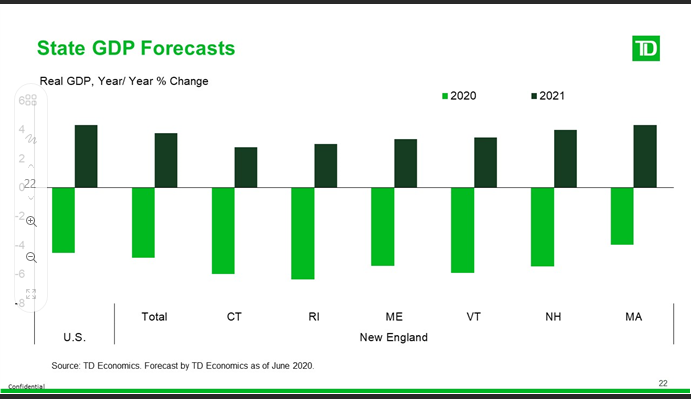
She attributed the potential for a stronger rebound in consumer spending in New England to the “fantastic job of bending the curve” relative to other regions where COVID-19 cases are rising quickly.
New England also may benefit from continued emphasis on remote work, which might counter the negative impacts of population loss if people choose to move away from hotspots like New York to the relative safety of New England, Caranci said.
Just as recovery periods vary across states, certain industries will also see longer lasting ramifications, with service industries like restaurants and entertainment harder hit than manufacturing, technology and health care.
In that sense, Massachusetts’ reputation as a leader in biotech and life sciences may bring about a faster recovery, particularly because these industries are also connected to intellectual property investments, which have not slowed nearly as much as those in equipment and physical structures, Caranci said.
Nancy Lavin is a PBN staff writer. You may reach her at Lavin@PBN.com.