The state’s tax-revenue picture isn’t all bad.
Rhode Island fiscal experts last week concluded that tax revenue would fall $130.5 million below forecasts for this fiscal year as the local economy continues to limp along, leaving state leaders to figure out a way to close the shortfall. But at the same time, tax officials say they are having success in another area: collecting back taxes, penalties and interest.
The R.I. Division of Taxation says it is using a relatively new computer system to sort through streams of data from various sources to track down individuals and businesses that haven’t paid or have underpaid various taxes.
Since state officials started using the system – known as a data warehouse – officials have collected more than $4 million in back taxes that may not have been collected otherwise, according to R.I. Tax Administrator David Sullivan.
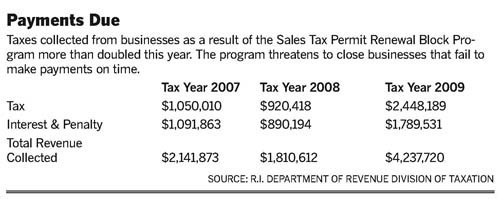
In addition, Sullivan said, his division’s threats last summer to close businesses that didn’t pay overdue sales taxes has proved to be a success. The effort – called the Sales Tax Permit Renewal Block Program – brought in an additional $4.24 million in taxes, interest and penalties as of Nov. 2, double what similar efforts have brought in previous years.
Despite that headway, tax collectors would be hard-pressed to lift the state out of its deepening fiscal troubles.
Already grappling with a projected multimillion-dollar deficit for the current fiscal year, state fiscal advisers at last week’s Revenue Estimating Conference projected revenue will fall $130.5 million below what was expected – bringing the total deficit to about $200 million, officials said.
In August, Gov. Donald L. Carcieri unveiled a controversial plan to save about $70 million this year that included shutting down government for 12 days and withholding auto-tax payments from cities and towns, among other things.
After a court battle over the shutdown days, Carcieri eventually reached a deal with public sector unions that featured some savings through unpaid work days and the postponement of a raise.
The General Assembly has not yet given the governor permission to withhold $32.5 million of the motor vehicle excise tax payments to local communities. Legislative leaders have said they will take up the matter in the upcoming session, which begins in January.
While the proposal drew complaints from local leaders, it appears state leaders may be forced to take more drastic action to balance the $7.81 billion state budget now that revenue estimates look so bleak.
Carcieri made it clear in statements last week that he will focus his attention on state aid to cities and towns.
“The fulcrum of lifting the state out of this deficit will be determined by how we pay for municipal services,” he said following the revenue conference. “We cannot afford to have a fiscal tug of war between the state and municipalities.”
The governor maintained that tax increases wouldn’t solve the problem.
“In addressing these budget shortfalls, we need to avoid overtaxing, overspending, and trying to do more in government than we can afford,” the governor said last week.
It’s in this context that the Division of Taxation has appeared to step up its enforcement of the state tax code.
Because of the state’s recent establishment of its “data warehouse,” Sullivan said his division has sent 10,000 tax notices in the last 12 months to individuals and businesses that either didn’t pay income or corporate tax, or didn’t pay enough. That’s double the amount of notices that would typically have been issued.
The data-mining system, installed by Pembroke, Mass.-based Revenue Solutions Inc. for $2.5 million 18 months ago, has paid for itself almost twice over already by bringing in $4.24 million in taxes and penalties.
About twice the size of a standard desktop computer, the system can search information from multiple sources, including the Internal Revenue Service, the R.I. Secretary of State’s office, the R.I. Department of Motor Vehicles, even voter registration records, to track down tax scofflaws.
Officials point out that more than 70,000 businesses are registered with the secretary of state’s office, but a much smaller number of business tax filings are received each year.
“We use any information we can get our hands on,” Sullivan said. “It has generated some interesting cases.”
“We’ve gotten the attention of some people,” Sullivan said.
That’s certainly true with the state’s threats over the summer to close more than 1,200 businesses that had failed to submit overdue sales tax payments, and other business taxes.
As a result of those notices, state officials were able to collect $2.45 million in taxes, and another $1.79 million in interest and penalties.
According to the Division of Taxation, 884 of those businesses paid in full or resolved their accounts, while another 57 are on payment plans.
Another good byproduct: Sullivan said more companies are keeping up with their sales tax payments now.
But there have been repercussions in difficult economic times.
The state said 107 companies went out of business before receiving the final notice, while another 152 never paid because they were either shut down or operate out of state.
It was unclear what kind of effect those business closures had on the state’s unemployment rate, which stood at 13 percent last month.
Bill Vernon, state director of the National Federation of Independent Business for Rhode Island, said he fielded numerous complaints from businesses when the notices first went out, but the complaints have since petered out.
He said he understood the need for the state to enforce tax laws. “But there’s a fine line you have to walk,” he said.
Some federation members in Massachusetts say Bay State officials are conducting more audits of businesses to ensure they’re paying the proper amounts of sales tax.
“The states are looking for revenue, but it’s not conducive to doing business,” Vernon said.
Sullivan doesn’t think that Rhode Island should increase the number of audits. But he said he thinks of the state’s current efforts as “leveling the playing field” by ensuring that everyone is paying their fair share of taxes.
“It actually makes for a better business environment because we’re treating everyone the same,” he said. •