
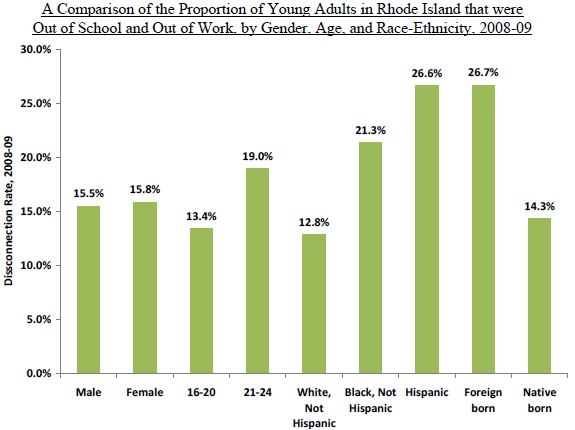
 Click here to view a larger version.) / " title="AMONG YOUNG Rhode Islanders, roughly 15 percent were neither working nor in school in 2008 and 2009, a study found. (Click here to view a larger version.) /"/>
EAST PROVIDENCE – Rhode Island’s work force development efforts face several challenges – including a high unemployment rate among young people and a low ratio of students obtaining a college degree – an economist and the state’s top higher education official said Tuesday at Sullivan & Co. LLP’s economic outlook breakfast.
Ray M. Di Pasquale, acting commissioner of higher education and president of the Community College of Rhode Island, said statistics show that four out of five Rhode Island students who start high school do not obtain a college degree. Those figures are unnerving considering some projections say the majority of new jobs in the next decade will require an advanced education, he said.
Beyond Cash Donations: How New Forms of Giving Are Transforming Not-for-Profit Accounting
Evolving Funding Landscape for Not-for-Profits Not-for-profit organizations are being asked to do more with less,…
Learn More
Di Pasquale noted that state educators are overhauling the secondary school system to increase college enrollment among Rhode Island high school graduates, but the changes won’t be immediate.
“Think how long it’s going to take for all those reforms to really kick in,” he told the gathering of 150 business leaders, which was held at the Squantum Association, a private club. “We will see the results, but not immediately.”
Paul E. Harrington, an economist at the Center for Labor Market Studies at Northeastern University in Boston, said joblessness among Rhode Islanders ages 16 to 24 has skyrocketed, even among those with college degrees, as older workers have either put off retirement or returned to the work force during the recession.
While Rhode Island’s overall unemployment rate stood at 12.3 percent in May, down from a peak of 12.7 percent last winter, the unemployment rate for 16- to 24-year-olds was estimated at 18 percent, according to a study Harrington released earlier this month.
“When kids quit working and job access disappears, it’s a little bit like a school closing,” Harrington said. “That early work experience has lots of positive long-term employment and earnings impact…. Future productivity growth in the state will be diminished.”
Harrington noted that young people have adjusted to the tight job market by returning to school. CCRI, for example, said its total enrollment jumped to 18,000 in the spring, the highest it has been in recent years.
But Di Pasquale said these students are different.
“They’re coming back, but they don’t want a degree,” Di Pasquale said. “They’re saying, ‘Give me a short-term training program. Give me something that is going to get me a job today.’ ”
“It’s something we’re going to have do deal with,” he said.
The change has already led to some retooling at CCRI. The school recently started offering a short-term pharmacy technician certificate program. Nine hundred people showed up to register on the first day, many more than expected.
“We eventually had to close the doors,” Di Pasquale said.












Some solutions:
Continue to cut financial support for the Community College of Rhode Island, with its many affordable programs leading to good jobs. In fact raise the tuition by a big amount.
Continue to make CCRI students pay $55 for a monthly RIPTA pass while Brown and PC students ride free,