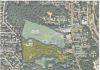
While site remediation on the 2-acre former Providence Barrel site in Smithfield is wrapping up, the remediation of soil on nearby residential properties is just getting under way and is expected to run through September.
Two contaminant materials were found initially at the Oak Street site: lead in the soil and a few “semivolatile” organic materials that could be toxic in high enough levels. Those organic materials could spread into houses through groundwater, said U.S. Environmental Protection Agency Onsite Coordinator Ted Bazenas.
He said it’s fairly common that adjacent sites – in this case about 20 residential properties that sit on about 8 acres – are also contaminated.
The spreading of contaminants works like this: Aided by groundwater, the organic material seeps through the soil and into basements to create toxic gases in the nearby houses. The semivolatile organics – in this case perchloroethelene and trichloroethylene – have to be present in high enough levels in the soil or groundwater that they can migrate into the air in a house.
The decision to move the site work into the residential area came during December 2007, when the EPA and the R.I. Department of Environmental Management (DEM) were planning the Providence Barrel site remediation. EPA scientists tested 10 samples of soil and indoor air from nearby homes.
When the results were announced, they showed that contaminants were spreading, although not at “dangerous” levels, Bazenas said. “They showed that although there still is some organics in the soil gas, they were not migrating into the houses,” he added.
But in some areas the contaminant levels in the soil near houses were three or four times the state-mandated limits, he said.
“The levels [outside] could, in some cases, be high enough to be a health concern,” Bazenas said, adding that at other locations the levels were well below that. “And although they’re not that high, they are above the state standard for residential property – that number is based on the exposure of children to soil with lead in it.”
Some might have argued that a full soil remediation in the area might not have been necessary – other methods might have been used, Bazenas said. But “in the interest of protecting public health” the EPA decided to clean up the entire area, he said.
“The primary reason that we called the EPA in is that we were concerned that if the trichloroethylene was spreading through the neighborhood it could actually be vaporizing into people’s homes,” said DEM Principal Environmental Scientist Cynthia Gianfrancesco, whose agency isn’t overseeing site work but is acting as the local contact for the EPA on the project.
The expanded scope of the remediation pushed the completion date back to the end of September – it could otherwise have been finished last week – and increased the total cost to about $1 million, Bazenas said.
On the Providence Barrel site, much of the work involved simply digging up the vacant site’s topsoil, which was “devoid of vegetation and exposed to the elements,” according to the EPA description of the project.
Remediation of an abandoned property is “pretty straightforward,” said Bazenas, but “once you get out onto a residential properties, the people living there have pets, they have work hours and access issues, there are renters and absentee owners, there’s landscaping.”
It’s not necessarily more difficult to remove the soil, but it is more complicated getting access, he said. He added that smaller equipment has to be brought in and that sometimes costs more than working with larger equipment.
For such a remediation, the business that was responsible for the contamination would usually be accountable for cleanup funding – and coordinating the remediation – but in this case that was impossible, Gianfrancesco said.
“If there’s a viable company, then yes” they would pay for the remediation, she said. But the current owners bought the property at a tax sale and aren’t responsible for the contamination “and the parties that caused the contamination no longer are in existence, so we can’t fine them.”
The site is the former home of the Providence Barrel company, which operated between 1972 and 1980 as a 55-gallon drum-reclamation facility. Many of the barrels that were cleaned there had been used to transport chemicals, Gianfrancesco said.
“They need to wash them, rinse them and may have to do some work – spray paint them – to make them look like new barrels again,” Gianfrancesco said. “And historically management of the rinsed material and residue from those drums wasn’t always managed well.”
The site on Oak Street is in the mixed-use Esmond neighborhood.
The remediation is the result of a site study completed by the DEM and EPA’s Superfund Technical Assessment and Response Team during October 2005. The EPA issued an action memo on March 10, personnel and equipment were moved to the site April 21 and remediation began shortly after, Gianfrancesco said.
When the removal of the soil was complete on the site midway through August, the contaminant levels weren’t high enough to warrant “post-excavation treatment,” Bazenas said. That soil isn’t classified as “hazardous waste,” he said.
“We have been able to just ship it to a landfill,” he said, “for them to use it as sanitary cover or whatever uses they have at a landfill. It doesn’t need to be shipped away as hazardous waste.” •


No posts to display
Sign in
Welcome! Log into your account
Forgot your password? Get help
Privacy Policy
Password recovery
Recover your password
A password will be e-mailed to you.
- Featured Event -