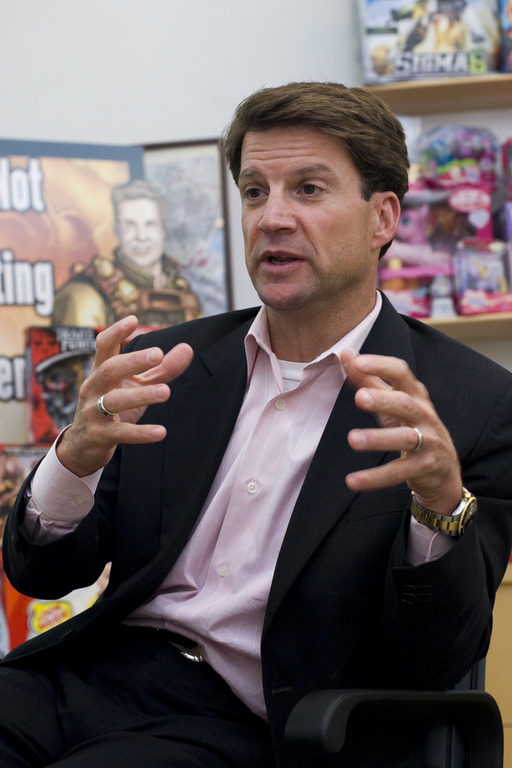
Brian Goldner is an executive producer of “Transformers,” a live-action movie being released July 4 by DreamWorks Pictures and Paramount Pictures in association with Hasbro. Goldner also has overseen Hasbro’s acquisition of a Marvel license, giving Hasbro the rights to produce toys and games for several Marvel properties, including Columbia Pictures’ “Spider-Man 3.”
PBN: How did Transformers become a major motion picture?
GOLDNER: Simultaneously we had Steven Spielberg, who had always thought there was a great idea there about a Transformers movie – he’s been a fan for many, many years – at DreamWorks, and Paramount, who were then partners on some films but were not one company as they are today. They came together literally over a weekend and decided, OK, we can do this together as a project. DreamWorks was the creative leader, Paramount would be the international distribution partner, and we brought the producers together … and we had to go out and find a director. Our writer was a guy named John Rogers – he was the first writer, and he came up with sort of the basic tent pole for the movie. Then we brought in two other writers … who wrote “Mission Impossible 3” and had just written “The Island” for Michael Bay, and would work with DreamWorks. … We had the entire team come out to Rhode Island and spent some time together and really went through Transformers school, the whole Transformers mythology. … And after that weekend Michael agreed to come on board and be our director, and that’s when things really started to progress. This was back in 2005.
Rhode Island's Market Has Changed. Developers, Builders, Investors and Sellers Must Change With It.
By Emilio DiSpirito IV License Partner | Engel & Völkers Oceanside Leader | The DiSpirito…
Learn More
PBN: Will we see other movies spun from Hasbro brands?
GOLDNER: Well, in fact, we have a couple of scripts in development for G.I. Joe, so we’re working on that now. We have a deal with Paramount today to work on that and develop a movie. We have some early ideas in the works for a few other brands. Clearly the game show environment is another place we’re looking at for a lot of our brands, and certainly our games brands.
PBN: Can you talk a bit about the recent financial performance of Hasbro, and where the company is headed in the next years?
GOLDNER: We will always have the strategy of reinventing our core brands at the very heart of what this company is about. So, we’re going to continue to drive that growth of 3 to 5 percent over the long term as our objective for our core business, both in our toys and games business. And then added to that are really three major planks that help to drive our overall business. The first is our geographic expansion and going into emerging markets. Both rethinking how we’re currently doing business in some of our major markets like Europe … but also in emerging markets, countries like Brazil, China, Russia, India. … The second area is in digital gaming – we’ve been working on a strategic plan for some time in that digital gaming space. … And then the third area is the whole idea of creating the appropriate immersive brand experience for each of our brands, whether it be My Little Pony and the 80-city tour stage show that we’ve put on now, or Transformers in a movie or G.I. Joe or an animated TV series for certain brands, or a My Little Pony DVD, whatever it might be.
PBN: As you globalize and push into new markets, are you pushing your long-established brands in the U.S. or creating new brands and stories that resonate in other cultures?
GOLDNER: We’ve been spending a lot of time, and we have since the beginning, looking at consumer insights … not only for U.S. consumers but consumers all over the world. Can we understand the local and indigenous insights of that culture? What we’ve come to understand is there are a lot of universal truths out there, albeit there are also some local insights. We think our brands can work and be adapted for those different markets. Monopoly is sold in 86 countries all over the world. PlayDough is sold in 60 some-odd countries.
PBN: How is the rising price of oil affecting Hasbro’s manufacturing costs, given that oil is a major ingredient of plastic?
GOLDNER: Resin costs are really very much of a trailing indicator in terms of the price of gasoline. It does not work in the same way in terms of the volatility in oil prices; it’s much more of a long-term trend, and in fact resin costs have not been up significantly over the last year. It hasn’t demonstrated the kind of volatility we’ve seen in gas prices or home heating oil prices. And while we may see certain increases over time, the actual input costs of resin as a percentage of our total cost of goods is relatively small. Listen, we are a company that thinks about everything. We are looking at transportation costs, we are looking at factory expenses, we look at vendors in the Far East and ensuring that those vendors are not only making an inexpensive product, or a value-oriented product, but also a quality product done in the right way. So it’s really that whole picture of the kinds of products we want to put into the market.
PBN: Can you assess the business climate in Rhode Island?
GOLDNER: Here’s the thing I think is important – we’re on a path that I think many companies are on. … From being historically known as a manufacturer of toys and games to a company that’s known for its intellectual property and brands. … So in order to be a company that’s able to attract people that aren’t just about a manufacturing qualification or an engineering qualification – although those are important – but also people who are immensely creative in design and development and entertainment, I think we have to be a state that is extremely progressive in helping companies to attract great employees. What does that mean? Great education, lower taxes, the ability to make a reasonable living and therefore live in reasonable, comfortable way. I think we’ve made some progress, and I think we could make a lot more going forward.
Interview: Brian Goldner
POSITION: Chief operating officer, Hasbro Inc.
BACKGROUND: Hasbro’s COO since 2006, Goldner leads the company’s North American operating segment and its European business across both toys and games, and directs Hasbro’s worldwide product development. Before being named COO, Goldner was president of Hasbro’s U.S. toy division. Prior to joining Hasbro in 2000, Goldner served in management roles at Bandai America, J. Walter Thompson, Lowe and Partners, and Leo Burnett Advertising.
EDUCATION: A.B. in government, 1985, Dartmouth College; Executive Education Program, 2004, Amos Tuck School, Dartmouth College.
RESIDENCE: Barrington
AGE: 44