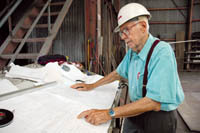
Luther H. Blount is still building boats. And no, approaching 89, he isn’t planning on retiring anytime soon. It’s crossed his mind. He’s had some health issues, including surgery this past March.
“But I’ve bounced back,” said Blount. “I’m back doing what I used to do.”
And what he does is build all kinds of boats. He is best known for building passenger ferries, but he has also built commercial fishing vessels; dinner boats; harbor tugs; tankers; barges; mini-cruise ships; party fishing boats; research boats; glass-bottom boats and so many others.
Blount remembers fondly his educational experiences studying mechanical engineering at The Wentworth Institute in Boston, where, he said, it wasn’t just about the books. They fostered a hands-on approach to learning.
For Blount, it worked out well.
PBN: What are you working on these days?
BLOUNT: We’re building parts for the oil barges and the ATB tug – the 15,000-horsepower tug over at SENESCO. They’re building the boat there and we’re building some of the parts.
Beyond Cash Donations: How New Forms of Giving Are Transforming Not-for-Profit Accounting
Evolving Funding Landscape for Not-for-Profits Not-for-profit organizations are being asked to do more with less,…
Learn More
PBN: Do you build primarily passenger ferries?
BLOUNT: Well, I build just about any kind of boat there is. We’ve centered on passenger boats because in the beginning I was about the only shipyard that had a naval architect. For a passenger boat, you have to build according to the U.S. Coast Guard and various rules. They’re very stringent. It’s easy to build a fishing boat or a tug. There aren’t as many rules, though they are starting to apply to those too.
PBN: Is complying with these rules expensive?
BLOUNT: For the cruise boats that we have around the country, it costs us about $100,000 just to fit them with the equipment they have to have. The kinds of things required on the big boats … the way the laws are drawn up by Congress, they’ve caught us up in it too. We’re building the small ones, but we put in the same things.
PBN: How many of the vessels that you have built are in service right now?
BLOUNT: 318.
PBN: How long do they last?
BLOUNT: Well, the first one I built for New York is still going. Miss Liberty. She’s 53 (and the oldest continuing operating ferry in the United States).
PBN: Where is she docked?
BLOUNT: They pick up at Battery Park, but they have a pier in Brooklyn, just across from the Battery.
PBN: What is the consumer looking for – those consumers you are reaching?
BLOUNT: We take them to places they can’t go. Even the average small cruise ship can’t get under the bridges we can. We can go all the way up into the Lakes through the Erie Canal. And we can go down from Chicago through the Chicago River into the Mississippi, via the Illinois River. There again, you have to get down to about a 14-foot clearance.
PBN: Where is your favorite place to take a cruise?
BLOUNT: That’s hard for me to answer. Do you know how I got into this business? My first boat that I built I had to deliver it to Buffalo. I thought I would have to go all the way around Nova Scotia to go down the Saint Lawrence River. But they told me to go right up through the Erie Canal. They had a guy go with me. It was the middle of July. I got up to Albany. I was amazed. It was a terrific experience. And then I started selling more boats up there. I would get people from around here to go up there with me and help out, with cooking … I’d pay their way back and forth and we would sleep in sleeping bags on the deck. It was a terrific experience. So I wanted to do it with a small boat of mine. I built a small yacht and used that. And after a year or so, someone wanted to buy it. So I built another one. I built about five of them during that period of my life. So I started going up into Canada for a vacation. Then I realized that New England and the maritime provinces of Canada were really an island. You can come down from the Saint Lawrence and go up a river into Lake Champlain and at one end of Lake Champlain you can go down the Hudson back into New York. You can go right around. Nobody had figured that out.
PBN: How long does it take to build one of your cruise ships?
BLOUNT: About a year.
PBN: Are these passenger boats and smaller cruise ships popular all over the country?
BLOUNT: Yes, it’s all about the leisure business. When I came on the scene, back around 1950, there weren’t that many small boats taking people around. The only one in the whole country doing it was Circle Line in New York.
PBN: You’ve lived in Rhode Island your entire life?
BLOUNT: Right here.
PBN: I know you’re especially proud of The Harbor Queen, which has started offering dinner cruises, sunset cruises and other excursions in Newport.
BLOUNT: We have gone way overboard. It’s upscale. You’ve never been on a boat with as much stuff in it. It docks at Bowen’s Wharf.
PBN: Did you ever think you were going to get into these different projects?
BLOUNT: No, I didn’t. I think about it now. How did I ever get to this point? I was just lucky.