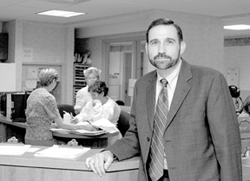
Hospitals’ CEO heads high-tech upgrades
H. John Keimig
Position: President and CEO of the two-hospital network St.
Joseph Health Services of Rhode Island since 1991.
Beyond Cash Donations: How New Forms of Giving Are Transforming Not-for-Profit Accounting
Evolving Funding Landscape for Not-for-Profits Not-for-profit organizations are being asked to do more with less,…
Learn More
Background: Keimig has been with St. Joseph since 1981 and held the
positions of executive vice president and vice president of corporate services
and planning. He is a certified health care executive, a diplomat of the American
College of Health Care Executives and past chairman and member of the board
of trustees of the Hospital Association of Rhode Island.
Education: A graduate of the University of Scranton in Pennsylvania,
Keimig received his master’s of hospital and health administration from Xavier
University in Cincinnati.
Residence: North Kingstown
Age: 48
Keimig oversees St. Joseph Health Services of Rhode Island, a two-hospital network including the 262-bed acute care facility of Our Lady of Fatima Hospital in North Providence and the 100-bed St. Joseph Hospital for Specialty Care in Providence. The service also operates the St. Joseph Living Center, a senior-sheltered care facility, as well as an urban primary care clinic system and an outpatient diagnostic/therapeutic network. In 1970, Our Lady of Fatima Hospital merged with St. Joseph Hospital.
The system saw a net gain of $429,013 out of total revenue of $132,581,807 in 2002. There were about 255,000 patients treated that year, including 33,587 emergency room visits and 11,847 admissions.
The CEO has led a 10-year, $30 million restructuring plan including the transition
of St. Josephs from a community hospital to a specialty hospital and Fatima
hospital from a “sleepy community hospital to a community medical center,” he
said. The $13 million in improvements made at Fatima include a new surgical
pavilion, an upgraded critical care unit and what Keimig describes as a state-of-the-art
laboratory. About 70 percent of the campus is either new or reconstructed, an
accomplishment highlighted on Fatima’s 50th anniversary.
Q. Tell me about the significance of the 50th anniversary of Our Lady of Fatima Hospital.
A. It’s a milestone for our organizations for a couple of reasons. One, we want to celebrate that we are one of the newer hospitals in the state of Rhode Island. Secondly, we are using the anniversary to highlight the completion of our 10-year renewal plan for Fatima.
Q. What did the renewal plan include at Fatima?
A. The renewal plan focused on three major areas: clinical, infrastructure and facilities. In the area of clinical we asked: ‘What does a state-of-the-art community hospital need, not just for the change of the new millennium but beyond?’ With the 10-year renewal plan, we looked at the basic clinical infrastructure changes that needed to be done, including keeping the radiology department up to speed. We completely rewired the institution with high-speed fiber optic cable, not only to transmit administrative data but also to make sure we are going to be state of the art for transmitting clinical data. We instituted programs we thought the community needed, from opening up a very modern breast care center to opening up what has really become the state’s, and southeastern New England’s, premier wound care center. There are a lot of elderly in our population and they are prone to develop wound issues. The third area – physical plant – has probably been on the timeline the longest. We built a new endoscopy center and last year we culminated our 10-year plan with the new surgical pavilion and we rebuilt three medical-surgical nursing units.
Q. How was the project funded?
A. The most recent project, which included the construction of the surgical pavilion and rebuilding of our major nursing units at Fatima, was $13 million. That was funded through a combination of a community capital campaign and tax-exempt bonds. It was our first entry into the bond market.
Q. How has the position of CEO and president changed over your tenure?
A. The CEO of 2004 versus the CEO of 1984 or 1974 has become more multi-dimensional. I think years ago, you needed to have a forte in hospital administration and hospital executive management. You needed that strong background in business – accounting, managing departments, a strong orientation to reporting regulatory information. Today, those attributes are still needed – financial discipline is paramount – but you have to be part psychologist, part politician, part clinician, too. You have to have an appreciation of how care is delivered. Also, we are becoming technology-focused.
Q. What are the biggest challenges your hospital system will face in the coming years?
A. In the next few years, we’ll be challenged by the aging baby boomer generation. As a major health care provider in the state of Rhode Island we have to make sure we are in a position to handle the bubble of the aging population.
Q. What has been done to meet this challenge?
A. The organization has been preparing for the past 10 years. For instance, you want to make sure your organization is equipped with technology. Also, a lot of health care is going to be delivered by an ambulatory basis and we want to make sure we have the ability to provide that. You want to make sure that your facilities are equipped to handle where medicine is going. We built our surgical “operatories” not only for how surgery is practiced in 2004, but how we project it will be practiced in 2010 and 2015. They are extremely large operatories, because we know a lot of surgery is going to be higher-end and often related to orthopedic medicine.
Q. Are you where you need to be now in terms of surgical infrastructure?
A. Yes. We built our surgical facility for different types of instrumentation. More of health care is going to be automated. Advanced robotic surgery is already in some of the large academic medical centers. I predict that within 10 years, parts of robotic surgery are going to be common in all community hospitals. We built our operating rooms to be able to handle whatever may come down the line.
Q. What is the biggest challenge facing hospitals in Rhode Island?
A. That would have to be the continued access to capital. Whether we like it or not, we have an aging infrastructure in Rhode Island. We’ve been fortunate that through restructuring and really aggressive financial discipline that we’ve been able to turn this organization around. In 1999, we qualified for investment-grade rating for a tax-exempt bond issue. Not every hospital in the state is in a position to go out to the debt market and get an investment-grade rating. Also, Rhode Island has one of the lowest rates of investment into capital infrastructure of hospitals of any state in the country. What you want to do is make health care as efficient as possible and provide much of it on an ambulatory basis or as short-term as possible.
Q. Tell me what works in the state’s health care industry?
A. We have been one of the leaders in the country in terms of hospitals working cooperatively with the state health department and creating knowledge-based medicine and best practices of how to care for patients with certain types of diagnoses. Rhode Island has been on the forefront in this respect. We’re going to see hospital reimbursements based on how you apply those best practices in the future. That’s clearly coming down the pike and it’s already started with Medicare.
Q. How do you interpret what’s happening to Blue Cross in the Legislature?
A. The General Assembly has focused on Blue Cross mainly because of cost. I’m an employer of almost 2,000 people and I’ve witnessed my health care premiums skyrocket over the past two years with little relationship to the rate of increase in my reimbursement from insurers. Actually, there is no relationship. We’ve recently concluded negotiations with Blue Cross for a new three-year contract in December of 2003 that did provide for what I’d call reasonable increases in our reimbursement. … In terms of the reform measures, I’m not privy (to) the inner working at Blue Cross or the General Assembly to have a strong view about the legislation, although I’ve been following what’s going on.
Q. What aspect of running a hospital is often overlooked by the public?
A. It’s important to remember that Our Lady of Fatima Hospital is a true community medical center and you can’t lose sight of its importance relative to the whole state’s health care system. A community hospital like Fatima creates balance in the state’s health care system in a couple of areas. One is access. We are the safety-net hospital for the areas we serve and we are focused on that community. We also balance the health care system financially. There is a tremendous cost that goes in to providing a tertiary service like open-heart surgery or organ transplant surgery. In the state’s community hospitals, you have the seasoned experienced physicians who are in private practice carrying out their profession at a much reduced cost and of equal quality to the larger academic hospitals and tertiary facilities. It creates a balance.