Foundation.
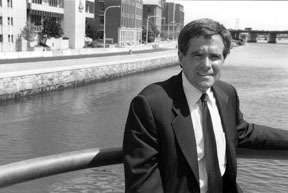
Name: Daniel Baudouin
Title: Executive Director, Providence Foundation, and Acting Director
of the Providence Department of Economic Development
Background: Member of the Rhode Island Public Transit Authority and
a member of the Transportation Advisory Committee of the State of Rhode Island
Beyond Cash Donations: How New Forms of Giving Are Transforming Not-for-Profit Accounting
Evolving Funding Landscape for Not-for-Profits Not-for-profit organizations are being asked to do more with less,…
Learn More
Dan Baudouin, executive director of the Providence Foundation, has been
appointed by Mayor David N. Cicilline to temporarily lead the city’s newly formed
economic development group. Baudouin has been in the position since April 1.
PBN: Did the mayor contact you about forming a city economic development
group or did you go to the mayor with this idea?
BAUDOUIN: It originated with the mayor’s discussions with some of my
board members. The mayor clearly recognized the importance of economic development.
The mayor has a lot of challenges and it became apparent if we could help the
mayor out in the economic development area it would be a worthwhile endeavor.
So we came together because of key discussions with board members and the mayor.
Has there been a formal structure to carrying out this role?
Well, the arrangement we have with the mayor is I’m a loaned executive for
50 percent of my time for three months and there are some very specific tasks.
The first task is to review what may make sense for a new economic development
organization for the city. So at the moment there’s no formal structure to decide
what kind of board or organization we may need. It’s myself working with a lot
of people and organizations to try to get their ideas and thoughts and look
at other communities around New England and around the country. And (I will)
work with other economic development professionals to come up with a report
for the mayor that he can digest and see what direction he may want to go in
with the future of the economic development organization.
Will it be members of the Chamber or community groups in general?
Community leaders, people from the foundation, people from the Chamber, people
from the state Economic Development Corporation, professional groups, neighborhood
groups, small-business groups, City Council people and some of the mayor’s own
people. So it’s a good mix of people who have given their thoughts and ideas
on how the city can better do economic development.
What are some of your other responsibilities aside from the report?
One is, beyond this report, to help with the recruitment process to find an economic development director or president for the city. It’s been clear from the beginning that I’m not a candidate for the job. So I’m going to help the mayor through the recruitment process.
A second job is to begin to compile all of the economic development reports
that have been done in the last four or five years – and there have been a lot
of them. And to try to create from those reports all of the recommendations
and bring them to a nice, digestible level so that the mayor and others can
start talking about what the best economic development strategy is for the city.
What kind of reports and who has conducted these reports?
There are all sorts of relevant reports. Some that the Economic Development Corporation produced. Some reports that the Rhode Island Public Expenditure Council has done over the years. Some of the reports that have been done for the city’s efforts on South Side of Providence. Our own “creative economy” study is part of that and a lot of neighborhoods have produced plans with economic development components – Olneyville, Smith Hill, West Elmwood, Broad Street. So there’s a lot of work that has been done to condense all of that and develop a cohesive economic development strategy for the city.
Other work is to try to set some framework for what I call “economic development
101” activities, which are the basic activities like what are the prospective
management systems and how does the city interrelate with the Chamber and Economic
Development Corporation when it comes to having a business prospect or a business
that wants to expand. We should have a good management system where everyone
is working together. Maybe a better information base (is needed) for economic
development so that a company that is here or looking at Providence could easily
get comprehensive information on everything that affects their business (and)…maybe
a more comprehensive and ambitious program to establish a list of available
inventory of land and buildings. People do that now, the city does some of that,
the state does some of that (and) the Chamber does some of that, but I think
if we bring everyone together we could create a much better, more comprehensive
system.
In the end, there were the tax breaks and several incentives for GTECH.
Do you think that set the precedent for other companies either looking to expand
in the state or other companies perhaps wanting to move into the city?
The ultimate tax treaty has to be reached. One of the reasons for it is if you look at the cost of doing business in Providence there is the cost of parking, construction and taxes. There are some issues that are more expensive to locate in Providence. The way to get around that in Providence is through tax incentive programs that make sense and has good economic development reasoning behind it.
I think the tax incentive strategy, in order to achieve economic development
goals and …to keep your city competitive with other locations, is a perfectly
legitimate strategy if it is structured right. You want other companies to use
it because ultimately you are achieving your economic goals, which in the end
will mean more revenues for the city. It’s very similar to what Fidelity did
in Smithfield.
What are the most pressing issues and short-term goals for you in this
position?
Setting up a good organization that has proper links, connections and partnerships with other groups working on economic development. If that can be set that’s a major accomplishment.
From the city’s side – and I know the mayor is keen on working on this – is
to make the city process more business friendly and at the same time we can
say more customer friendly. So if you need to get something done at City Hall
– permits, regulation or tax-incentive program information – there is a process
that is understandable, fair and predictable so people know what to expect when
they go into the process.
Is that currently in place?
No. It’s not the best system that it can be. I know that the mayor and his
team are working on that right now.
The mayor also mentioned a collaborative marketing campaign between the
Rhode Island Convention Center and the Dunkin’ Donuts Center. How will the city’s
economic development group fit into that effort?
I’m aware that there are groups working on that, but that is not part of my
task.
Can you talk a little bit about some of the issues moving forward and how
your group plans to tackle the issue of parking and new hotels?
With parking, maybe I should put on my Providence Foundation hat because we are more actively involved in that. Parking – the supply and cost of parking – limits the amount of redevelopment that can occur in the central part of Providence – downtown in particular.
If we don’t have a proper location for them served with adequate parking it becomes problematic … it also has to do with how the state should develop in the future. There are efforts to try to grow smart in the state and redevelop what we have as opposed to eating up green fields. Right now we do not have enough parking and the expense is a detriment. There is a committee that the foundation has formed with the city and a bunch of other people to look at parking once again, to look at two things: getting more parking constructed and trying to get people out of their cars. Stay tuned. You’ll see something in the next year on that.
Now, on hotels there are five or six proposed. We do need more hotels in order
to make full use of the convention center. The one that I’m most excited about
is a small boutique hotel, a 77-unit hotel that used to be called the Grace
Park Hotel, now called Hotel Providence, which is on the corner of Mathewson
and Westminster streets in the heart of Downcity. It’s being sponsored by Stanley
Weiss and is very close to groundbreaking, which will help revitalize the Downcity
area.
Will we see more than one hotel in the area?
Yes, I think you’ll see one other main hotel under construction in the next
12 months.
In terms of finding someone to lead the economic development effort on
a full-time basis, do you think it is helpful to have someone from the city
familiar with what’s going on or will there be a regional or national search
for the right person? Do you have someone in mind?
I don’t think there is anyone in mind. I think there will be a search – to
some extent a national search – by putting word out to economic development
organizations. There may be a search committee established to screen candidates.
(The right person is) someone who has the right education and 10 years of experience
in economic development.
You said earlier that you are not the right candidate. Is that something
you decided? Is there any interest on your part in taking over for good?
No, mostly because I like working for the foundation; it’s a great organization.
At the same time, I think that for the objectivity of the report I produce no
one can say that I’m trying to do this so I can get the job.
Any conflict of interest in wearing the two hats? Or is this a good fit
with your role at the foundation?
I think it’s a good fit. My main output to the mayor will be in reports and presenting analysis from other communities and to try to objectively present pluses and minuses. In that regard, I’m not the policymaker. I’m basically a researcher, an analyst, someone to make recommendations. But I’m not in any position to make any kind of policy decision. I’m here for information, advice and expertise. It’s worked out well.
For the complete current issue, visit our subscription Web site, or call (401) 273-2201, ext. 227 or 234.