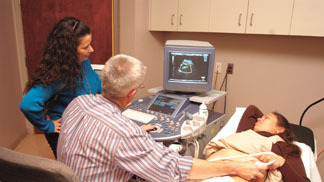
mother Carolyn Slack.
‘4-D’ ultrasound makes its debut in Rhode Island
Dr. Stephen R. Carr’s eyes are fixed intently on the ultrasound screen in front of him.
“This kid just does not sit still,” says Carr, director of Women & Infants’ Hospital’s Prenatal Diagnosis Center, as he gently rotates the transducer over Carolyn Slack’s belly. Slack, who works in the center as a genetic counselor, lies on the exam table, craning her neck to see the monitor.
Seifert Systems Invests in Energy Efficiency to Strengthen Operations
For manufacturers, energy is more than just another operating expense. It plays a critical role…
Learn More
After a few silent moments, there it is – a three-dimensional, in-motion image of Slack’s 23-week old fetus, fidgeting inside her womb. At first it’s an indiscernible, gold-colored mass. Then, a tiny, balled-up hand jerks. A mouth opens and closes. A button nose appears. The baby has “cute ears,” Carr declares.
“This is great,” he reassures Slack, patting her arm as she smiles broadly, tears welling up in her eyes. “Man, I love this machine.”
The machine is the Voluson 730 “4-D” ultrasound system, made by GE Medical Systems. And this was not a dry run.
Any expectant mother who comes to Women & Infants’ Prenatal Diagnosis Center does not want to be there, Carr explained later. It means there could be something wrong with her baby, and she was sent here for a closer look. Slack’s tears weren’t only tears of joy at seeing her unborn daughter’s cute ears. They were tears of relief. Her baby looks healthy.
Women & Infants’ last month became the first hospital in Rhode Island to begin using the new, $140,000 4-D system, launched by GE in May 2002. Although 3-D ultrasounds have been widely available for years, the new technology renders 3-D images in real time (the so-called “fourth dimension”), giving doctors and sonographers a sharper view of possible structural abnormalities.
A real-life peak at their unborn child is a titillating notion for any expectant mother. But Carr said it’s not entertainment – it’s good medicine.
Advances in medical technology often are blamed for driving up health-care costs. But Carr says the new 4-D ultrasound is an example of technology that ultimately will help keep a lid on costs. By diagnosing problems like cleft lip and cleft palate, dwarfism syndromes and spina bifida, physicians can better prepare parents for their baby’s treatment regimen after birth.
“This offers a better ability to be ready when that baby is born, so it gets the care that it needs in a timely fashion,” Carr said. “The earlier you catch a problem, the better your ability to address it, and generally the less expensive it is to address.”
Ultrasound advances also are enhancing doctors’ ability to perform interventional procedures on the unborn. For example, the National Institutes of Health is sponsoring several clinical trials of fetal surgeries, according to a report in OB GYN News. Doctors at three hospitals have surgically repaired spina bifida in unborn babies by closing a hole in the back to protect exposed spinal tissue.
Just a small fraction of Women & Infants’ patients will be referred to the prenatal center for 4-D ultrasounds – only if the risks warrant it, Carr said. For instance, a routine, 2-D scan may expose a potential problem. Other risk factors include an abnormal AFP test (alpha-fetoprotein test, which screens for birth defects), or a family history of abnormal pregnancies.
But the new technology’s emotional tug is a potent draw. Carr concedes that some patients with routine pregnancies have asked for 4-D ultrasounds, having either heard about the technology or seen a commercial for it.
“In those cases it takes will power on the part of the doctor to say ‘you know what…it’s not the right test for you,’” Carr said.
GE Medical Systems endorses the technology only for diagnostic use and only sells the units to licensed medical practices, according to Tom Beckman, a company spokesman. He said there now are more than 1,000 of the machines installed at hospitals and obstetrical clinics in the United States.
“We have a very firm stance that (the machines) are for diagnostic procedures only,” Beckman said.
A commercial for the product that began airing last year seems to directly target consumers. It shows a tearful woman viewing a crystal-clear, real-time image of her baby, set to the song “The First Time Ever I saw Your Face.”
“Almost immediately, I had my prenatal patients asking, ‘Do you have the 4-D?’” said Dr. Jeffrey Johnson, clinical director of labor at Beth Israel Deaconess Medical Center in Boston.
Johnson said the hospital uses a mobile 4-D unit, but only sparingly, to diagnose surface abnormalities such as cleft lip.
“As far as fetal anatomy, it really doesn’t add much,” he said.
The technology’s emotional appeal has led to a cottage industry of commercial ultrasound shops, often located in shopping centers and strip malls. With names such as “Womb With a View” and “Fetal Foto,” they typically charge $100 to $200 for keepsake 3-D photos or videos of 2-D ultrasounds, often set lullaby music.
GE’s Beckman, however, said these commercial ventures “are not using GE (4-D) equipment.”
Sound waves generally are considered safe for the fetus, but regulators and many clinicians have criticized the commercial ultrasounds.
In November, the American Institute of Ultrasound in Medicine, a group devoted to the safe and effective use of ultrasound, issued a press release “reasserting its opposition to the use of ultrasound for entertainment purposes.”
“This comes in the wake of a reemergence of companies capitalizing on the
business of providing fetal keepsake videos to expectant mothers and their families,”
the release reads. The U.S. Food and Drug Administration takes the same stance
on the issue.
For the complete current issue, visit our subscription Web site, or call (401) 273-2201, ext. 227 or 234.