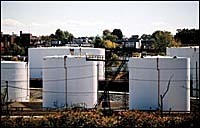
in Providence.
Despite the fact that the cost of home heating oil in Rhode Island is dropping and its supply is rising, state officials remain only cautiously optimistic.
That’s because for the last few years balancing supply and demand of home heating oil during the cold winter months has been one of the state’s greatest challenges.
Seifert Systems Invests in Energy Efficiency to Strengthen Operations
For manufacturers, energy is more than just another operating expense. It plays a critical role…
Learn More
It’s a challenge that this year will be fueled again by the inability of barges to travel on the Providence River and also by the increased security surrounding barge traffic from New York City to Providence.
“Everybody will tell you that the demand is up,” said Victor Allie-nello, chairman of the board of the Oil Heat Institute in Providence. “And it’s not that the supply is going down, it’s that our ability to store it is. It’s a concern that we have had for at least the last five years.” He referred to the reduction in the number of oil storage tanks in recent years because of development and environmental issues.
The state’s low supply of home heating oil and its increased costs created a real concern last year – a concern local officials are hoping won’t be repeated this year.
“Last year the state bought a three or four day supply because of the condition of the market,” said George Mason, Governor Almond’s energy adviser.
Because fuel was so expensive last fall and winter, local dealers were reluctant to buy it and build up an expensive inventory.
“Last year there was an economic disincentive to store heating oil. We were afraid that we just wouldn’t have it,” Mason said.
But it appears the state does have it, and in abundance. A recent inventory found that the state has a 38-day supply of oil – twice what it was a year ago.
“There has been a fundamental shift in the oil storage paradigm,” Mason said. “This year the market is placing a premium on storage. The overproduction of oil from OPEC and other economic factors have made it cheaper in today’s market.”
State officials are also feeling comforted by the decision of the U.S. Department of Energy to transfer and store close to 150,000 barrels of reserve home heating oil in Providence. The “emergency buffer” was set up last fall, when the decision was made to move the oil here from New Haven, Conn., because it gives the reserve program a third geographic location.
“This petroleum reserve takes away a lot of the risk,” Mason said. “It’s definitely not a negative thing.”
According to Allienello, who also serves as president of East Providence Fuel Company, using the reserve as a cushion could be misleading.
“It’s definitely nice having it here, but we can’t use it,” he said. “The reserve itself cannot be used until the President gives the order, then it goes out to bid. So, technically, Rhode Island might not get any of it. “
Although the fuel is stored here, it is intended to serve all of the Northeast, not just Rhode Island. Its availability is subject to Presidential decision, followed by a competitive bidding process.
Despite the federal reserve, Janice McClanaghan, chief of energy and community services for the state energy office, said the state’s oil supply is in good shape.
“Last year because of all the tightness in the supply and the demand, we stayed low (in supply) all year,” she said. “This year we have better inventories and supplies. Everything is in better straits this year compared to last year.”
One reason for that, McClanaghan said, is the dropping cost of home heating oil.
“During the winter months of last year we hit $2 a gallon, ” she said. “All summer long we were at $1.29 and we are now at about $1.28 a gallon, so we are certainly seeing lower prices. A couple of years ago the price was under a dollar a gallon, but we are definitely doing better than last year.”
Allienello noted that the situation could change quickly when the temperatures drop, and the weather limits ship travel along the Providence River.
In fact, he said the increased security surrounding barge traffic from New York to Rhode Island, and the constant threat of foul weather – both of which can cut off service to the port — serve as constant reminders of how fragile the state’s storage system really is.
“We are totally dependent on barge traffic,” said Allienello. “If we get a Nor’easter that prohibits traffic for three to four days, we could be looking at a situation. It’s that simple.”
Mason said he is more concerned about the impact of the weather on the supply, and not so much about the increased security.
“There is a short period of time every winter when barges can’t run because of the weather,” he said. “We just have to prepare for that. I think the security issues stopping the supply could happen, but more than likely they won’t.”
Because fuel was so expensive last fall and winter, local dealers were reluctant to buy it and build up an expensive inventory.
“Last year there was an economic disincentive to store heating oil. We were afraid that we just wouldn’t have it,” Mason said.
But it appears the state does have it, and in abundance. A recent inventory found that the state has a 38-day supply of oil – twice what it was a year ago.
“There has been a fundamental shift in the oil storage paradigm,” Mason said. “This year the market is placing a premium on storage. The overproduction of oil from OPEC and other economic factors have made it cheaper in today’s market.”
State officials are also feeling comforted by the decision of the U.S. Department of Energy to transfer and store close to 150,000 barrels of reserve home heating oil in Providence. The “emergency buffer” was set up last fall, when the decision was made to move the oil here from New Haven, Conn., because it gives the reserve program a third geographic location.
“This petroleum reserve takes away a lot of the risk,” Mason said. “It’s definitely not a negative thing.”
According to Allienello, who also serves as president of East Providence Fuel Company, using the reserve as a cushion could be misleading.
“It’s definitely nice having it here, but we can’t use it,” he said. “The reserve itself cannot be used until the President gives the order, then it goes out to bid. So, technically, Rhode Island might not get any of it. “
Although the fuel is stored here, it is intended to serve all of the Northeast, not just Rhode Island. Its availability is subject to Presidential decision, followed by a competitive bidding process.
Despite the federal reserve, Janice McClanaghan, chief of energy and community services for the state energy office, said the state’s oil supply is in good shape.
“Last year because of all the tightness in the supply and the demand, we stayed low (in supply) all year,” she said. “This year we have better inventories and supplies. Everything is in better straits this year compared to last year.”
One reason for that, McClanaghan said, is the dropping cost of home heating oil.
“During the winter months of last year we hit $2 a gallon, ” she said. “All summer long we were at $1.29 and we are now at about $1.28 a gallon, so we are certainly seeing lower prices. A couple of years ago the price was under a dollar a gallon, but we are definitely doing better than last year.”
Allienello noted that the situation could change quickly when the temperatures drop, and the weather limits ship travel along the Providence River.
In fact, he said the increased security surrounding barge traffic from New York to Rhode Island, and the constant threat of foul weather – both of which can cut off service to the port — serve as constant reminders of how fragile the state’s storage system really is.
“We are totally dependent on barge traffic,” said Allienello. “If we get a Nor’easter that prohibits traffic for three to four days, we could be looking at a situation. It’s that simple.”
Mason said he is more concerned about the impact of the weather on the supply, and not so much about the increased security.
“There is a short period of time every winter when barges can’t run because of the weather,” he said. “We just have to prepare for that. I think the security issues stopping the supply could happen, but more than likely they won’t.”
(Photo by Tom Croke)