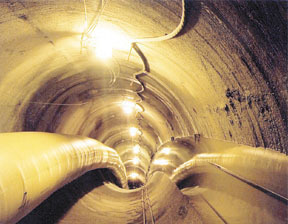
tunneling project and the one in Providence.
As Providence begins to scratch the surface of its $314-million Combined Sewer Overflow Project, Fall River is nearing the halfway point on its own CSO and could offer its neighbor insight into tunneling for a better bay.
“We have a lot to learn from each other,” said Robert Otoski, Fall River’s CSO project director. “Constant communication between the two (projects) could be beneficial. We’re almost halfway done, but we have a long way to go.”
While Otoski said no formal arrangement exists between the CSO project in Fall River and the one in Providence, tunnel workers, engineers and other staff have exchanged notes on their projects and Narragansett Bay Commission and Fall River officials have visited each other’s sites.
Rhode Island's Market Has Changed. Developers, Builders, Investors and Sellers Must Change With It.
By Emilio DiSpirito IV License Partner | Engel & Völkers Oceanside Leader | The DiSpirito…
Learn More
“Collectively, there are all kinds of experiences people take from present and previous jobs” and use them for future projects, said John Kaplin, Providence’s resident engineer with Gilbane/Jacobs, the company overseeing construction on the site. Each project is a lesson in dealing with groundwater, grouting and community mitigation (noise, local labor issues and insurance), he said.
The length of the tunnels being drilled is the same – three miles – and the fundamental goals of both are the same – to limit the amount of wastewater overflowing into their bays – but the two projects are very different, according to Otoski.
“We’re trying to accomplish the same thing and the technologists use the same approach,” he said. “The difference is the elevation of our city and what’s beneath it.”
Unlike Providence, which must use a pump cavern to move the water from the tunnel into the wastewater treatment facility, Fall River’s topography allows gravity to move the wastewater to the facility.
Fall River is situated on a plateau adjacent to Mount Hope Bay, and mostly differing grades of granite lie beneath the surface. Providence, in comparison, has a variety of rock, bedrock, soil and other materials below the dirt, making the tunneling process more complicated.
“You dig anywhere in Fall River and you’ll hit solid granite,” Otoski said. “Because we’re on a plateau 100 feet above the water, we can drill horizontally to get 100 feet down,” instead of drilling a shaft down and then drilling horizontally, as the workers in Providence must do to tunnel under the city.
In Fall River, the granite is consistent throughout the tunnel route (and the city), as the geo-technical engineers predicted, so the city has been able to cut down on budget costs by only having to tunnel through one material. In Providence, the ground is comprised of first 100 to 150 feet of soil, and below that is the rock called the “Rhode Island formation” – shale, sandstone and silt stone. All the stone and other material is relatively weak, making the tunneling a bit more difficult, according to Kaplin, who also worked on Boston’s Metro West tunnel.
The Fall River project’s price tag is at $55.9 million.
Raymond Marshall, deputy director of the Narragansett Bay Commission, said he and others visited the Fall River site last year and examined the tunnel boring machine and toured the area. What they came away with was “wishing we had the topography they had and wishing we didn’t have to build a pump station.”
A bigger tunnel (30 feet vs. 20), concrete supports, a pump cavern and the fact that the Providence tunnel doesn’t necessarily go directly under all of the combined sewer overflow points the project aims to divert have all led to the $314 million cost of the project, Kaplin said.
“The tunnel direction is controlled – you can’t snake it back and forth,” he said. “The tunnel boring machine can only turn so sharply. We’ve optimized the main spine with side tunnels going off of it” to the drop shafts. “We’re also trying to avoid certain types of rock.”
Fall River’s tunnel is already lined with granite, so it doesn’t require much more, with the exception of some sprayed-on concrete in places; Providence’s CSO tunnel must be supported with 4-foot-wide cast concrete segments that will make up the circumference of the tunnel. Kaplin said that the workers in Providence must dig a shaft down before continuing north horizontally because there must be a certain amount of rock cover over the tunnel. Otoski said the Fall River crew is working in desirable circumstances, which has kept the project on time and on budget.
Narragansett Bay Commission Chairman Vincent Mesolella Jr. has pledged publicly to keep the Providence CSO project from becoming Rhode Island’s version of the “Big Dig,” and Otoski stressed that Fall River’s CSO is progressing as planned.
“To date, we’re on time and on budget,” he said. “We feel very fortunate to be there, (being) this far into the project.”
For the complete current issue, visit our subscription Web site, or call (401) 273-2201, ext. 227 or 234.