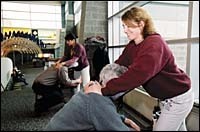
is provided by Stacia Lacroix of First
Class Massage.
Heightened security and long lines may be a headache for passengers, but for the shops located along the concourse at Warwick’s T.F. Green Airport, it has meant a surge in business at a time when others in the travel industry are struggling.
The increase, according to retail experts, is the result of more "dwell time" – a period between the time a passenger arrives at the airport and the time they depart on a flight.
"It’s kind of an interesting thing that has happened," said Patricia Anton, president of Anton Airfoods, the Washington D.C.-based company that provides the food and beverage at T.F. Green. "We have seen an increase in spending per passenger but a decrease in traffic."
Rhode Island's Market Has Changed. Developers, Builders, Investors and Sellers Must Change With It.
By Emilio DiSpirito IV License Partner | Engel & Völkers Oceanside Leader | The DiSpirito…
Learn More
In the months following the terrorist attacks, T.F. Green felt the affects of fewer travelers – down 28 percent in September, 10.6 percent in October, 7.8 percent in November and 1.43 percent in December.
"Historically what you will find is that concession revenues are tied to the passenger count," said David Cloutier, manager of property and real estate for T.F. Green. "There traditionally has been a correlation between the number of passengers and the concession revenues."
But that trend seems to have broken this time. While the airport itself is slowly recovering, the facility’s vendors report seeing increases in business as early as October.
"As the weeks progressed we just got busier and busier," said Stacia Lacroix, owner of First Class Massage. "Business has definitely increased even though the volume is down."
One reason many of T.F. Green’s businesses are seeing increases – most of them are located behind the security checkpoint.
"The first goal of travelers is to get through security," said Dan Clarke, director of property management at T.F. Green. "The airport is rebounding fairly well, but it’s the post screening concessions that are seeing the biggest jump."
Kimberly Mairs, president and owner of Nailport, a Boston-based company that provides manicure services to travelers utilizing T.F. Green agreed.
"What we are finding is that people just want to get behind the security so that they can relax," she said. "The lines to get through can be up to two hours long. You just can’t predict how long it’s going to take, so you want to get through."
For Anton, who has stores both in front of and behind the security checkpoint, the difference is obvious.
"We have definitely seen an increase in the casual dining areas located behind the security checkpoints," she said. "Our pre-security stores have definitely been affected. People don’t want to stop, they want to get right through. The lines at security are not only a deterrent for people to stop at the pre-security stores, but often times they can block the store entirely."
As a result Anton’s company has been forced to make some changes.
"What we are trying to do now is bring our menus to the security lines themselves, making meals more portable. It’s been difficult and we have to do all that we can," she said.
Nationwide, Anton said her company has lost anywhere between 15 and 50 percent depending on the airport – statistics she hopes will change by the end of the first quarter.
"All the industry data is saying the first quarter isn’t going to be good, and that we shouldn’t have high expectations," she said. "Probably after the first quarter we will see a real bounce back."
Anton and other vendors at T.F. Green agree the airport has bounced back much quicker than other airports across the country.
"Secondary airports like Providence’s T.F. Green have not been as drastically affected," Anton said. "There are a number of factors behind that including, problems at Boston’s Logan Airport and a good mix of airlines."
Mairs, who has shops at both T.F. Green and Logan, agreed.
"It’s hard to compare the two. It’s like comparing apples and oranges," she said. "Logan is so large it’s hard to get your arms around it. Providence seems to be a more manageable airport for the person that flies."
But it might not have the most to offer. With less than 20 stores on both sides of the security gates, there isn’t enough space to add more stores or restaurants.
"We are OK with food and beverage, but we could probably use a little more retail," said Clarke. "We are just about full, every square foot of the concourse and terminal is taken."
Larger airports like Pittsburgh International have more than 100 stores for passengers to peruse during dwell time, including major chains like Bath & Body Works, The Gap and Nine West – something it’s unlikely Providence will ever have. Cloutier said the services provided at T.F. Green are similar to what would be found at other airports of the same size.
And for those businesses that provide services in front of and behind the security gate at T.F. Green, business has always been, and will continue to be unpredictable.
"Working at the airport is precarious anyway," Lacroix said. "You never know how a given day is going to go. There are so many factors that affect the type of day that we are going to have, from the weather here to the weather across the country. Now with the political climate, it’s been difficult to figure out what is going to happen. I have faith, and what we do has always been appreciated by the customers so I think it’s going to be fine."