 better than a number
 of other states."" title="GOVERNOR ALMOND: "We are actually doing better than a number of other states.""/>
"We are actually doing
better than a number
of other states."
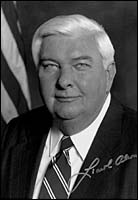
Name: Lincoln C. Almond
Age: 65
Position: Governor of Rhode Island
Background: Prior to being elected governor in 1995, Almond had served as a U.S. Attorney, as well as an administrator for the town of Lincoln.
Education: URI, Bachelor of Science degree. Boston University School of Law.
Residence: Lincoln
Family: Wife, Marilyn, two children and five grandchildren
(This is the first of a two-part conversation with Gov. Lincoln Almond.)
PBN: Economic times have changed. How does this impact plans for economic development?
ALMOND: One of the things I think government does a lot is that when we get into slowdowns, we cut economic development projects. This is not the time to cut these projects. This is the time to make sure that you are very strong in economic development, so when you come out of a recession you are prepared to go forward. You can’t wait for good times. We have done that. We weren’t prepared, in any way to do development in the 1990s. We had to ramp up, we changed the whole way we do economic development. At the time of the state’s last recession, we weren’t prepared. For example, we had no investments in the Slater Centers. I could go on and on with the number of things that we didn’t have that we should have had in the early 1990s to prepare ourselves to take advantage of the good times. I think that it would be a key error to take economic development and say, ‘Well, we have to start cutting, so here are the first things that we are going to cut out.’ If you do that, then you have to start again. It doesn’t make much sense to me because you lose good opportunities.
In addition to a slow economy, the state is facing one of the most difficult budget years in recent history.
The good news is that the budget crisis isn’t solely the result of the economic downturn. In this fiscal year, for instance, we are down about $70 million. About half of that is because of revenue estimates. The other half is because of under-budgeting in this fiscal year, or because of over expenditures with caseload. Even going into 2003, our problems are strictly economic in terms of the state of the economy, but we funded this year’s budget on a $130 million surplus. We also funded certain obligations of state government to the tune of $30 million. So that’s a total of $160 million. You have to make that up before you even start. So the 2003 budget has a $160 million hole that has nothing to do with the economy. We are actually doing better than a number of other states. I have read articles about the problems in our sister states and, for example, Massachusetts this year has had some serious problems, they are down over a billion dollars.
How important is a diversified economy?
Well, it’s nice to have companies with huge employment, but I don’t think we should depend on them. I will give you an example, I was reading about the State of Washington, which is having some real problems because they are losing 20,000 jobs as a result of Boeing. What that would mean to Rhode Island would be 12 percent of our economy with one employer. Sometimes when you have these large employers and you have the heavy cutbacks in a particular industry it can be very difficult. We are a small business state. I think the more diversified the small business base, the better.
Is it safe to say because of the current economic situation that agencies that have not received state funding in the past will not receive funding in the coming year?
First of all, I don’t think the budget crisis has sunk in to a lot of people yet. I don’t think they really view it as significantly as we do in my office and in the budget office. We look at next year, the 2003 budget as being some $200 million short. Then you have your normal growth. So this is not really the time to be adding new programs. This is the time to try and shore up what we have, and we have a lot of good programs. People view government differently sometimes, but I think that we have done a lot of good things in Rhode Island. I particularly want to see what we can protect of the children’s programs and the child health program. If we think those things are important then we need to protect them from other expansions that would take away money or new programs and programs that we don’t think we can afford. We are going to have to do some cutting. Hopefully, we can try and set some priorities.
Among the first cuts you proposed was to a housing program. It’s a decision that has sparked a lot of criticism. Do you still think it was the right choice?
It’s a good program and we would like to save it. What people don’t want to focus on is, first of all, that was a budget that for the first time would have meant $5 million coming from the 2002 budget. We don’t have enough money to fund the 2002 budget. So we have programs, but no money. So if you start saying that this new program is immune, then you are going to have to start cutting other programs. The reason I say that people aren’t really focused on this yet, is that I have gotten letters from other program advocates and they are in favor of the housing. I don’t think they realize yet that there are other programs that are going to be cut. I don’t have the power to cut the housing program. All I am saying is delay it, take a look at it, see what part of the $5 million is crucial. If it’s all, it’s all. That’s a decision that is going to be made by the General Assembly. But you have to put it in the context of other priorities. If you don’t freeze it, then it becomes a priority over other programs.
Have you told agencies what to expect in terms of cuts?
We are meeting with them now. The budget office has met with a couple of departments and they appear to be very cooperative. What we are saying to them is look, the reality is that you aren’t going to have this money so you need to tell us what needs to be cut.
Do you remain committed to your stance against the expansion of gambling?
I am absolutely opposed. What really gets me is that they see the state has a budget problem so they say we will solve your problem with all kinds of gambling. First of all, most of that revenue from an increase in gambling won’t have much of an impact until 2003 because as I understand it to accommodate those additional machines they have to do some building. So I don’t think it’s going to help the process, and I don’t think that we should rely on that to help the process. I think that we have too much gambling already. I challenged the last expansion in court. We lost, but we did challenge them. We have beaten back some expansions, we beat back video bingo in court and we have of course been opposed to casino gambling. I am going to continue on that route.
Do you see a contradiction between allowing some gambling to expand and not letting others be a part?
I just hope that we can keep what we have got and not expand any further. Then we can try and retract some of it. Another argument I hear is: ‘We have people waiting in lines to get to these machines.’ Well, if we hadn’t put the machines in, in the early 1990s we wouldn’t have any lines; people wouldn’t be waiting at all. It’s not good for the economy, it’s not good for the state. I just don’t like it. It’s very bothersome to me to see the amount of gambling that we have.
How would you describe your commitment now to developing a container port at Quonset Point/Davisville?
First of all I am very proud of what we have done at Quonset. I think Quonset was a lost child for years. We put a lot of capital in down there and have created a lot of jobs. There are a lot of good things going on today at Quonset — with the third-rail going in and the beginning of Route 403 being built, a lot of new high tech businesses, and Keifer Park is almost full. Sometimes I think back, and wish that we had done more with the port and the development of Quonset 15 or 20 years ago. But we didn’t. When I became governor in 1995, we had an agreement with a group on port development. I am not so sure that we should have done that, but I went along with that agreement for a couple of years. That didn’t work out, so we lost some time. Right now we are in the process of working toward a filing for permits early next year and going into the EIS (environmental impact study) process.
It seems that when even proponents of the port talk about it, they are more likely to mention a “small port.” That wasn’t the case a couple of years ago. What kind of port are you looking for?
I think that one of the problems, when we had the agreement, the initial proposal was for a 500-acre typical U.S. port. While that process was going on, I constantly spoke to the Economic Development Corporation and told them to look for something smaller. As soon as the stakeholders process was over and we terminated the agreement, we immediately came out within a few months with a plan for a smaller port. What we are talking about, at full development, is 4,000 feet. The actual depth of the port would be about 12,000 feet. So it would be much smaller. What I have always said is that we don’t want to build another U.S.-type port. Most of our U.S. ports are bulk cargo ports, which have been converted over to container ports. We don’t want that. I think what we want is to build a modern 21st century port. Instead of building the last of the 20th century ports, we want to build the first of the 21st century ports. I think that we can do that. I think it’s marketable.
Do you expect to have a foundation in place for the port’s development prior to leaving office?
I think we will be far down the road before I leave office. Once we file the applications, I am hopeful that I can spend time next year actually doing some personal marketing. Nothing says you can’t come to an agreement with a developer during the process. If a developer comes along tomorrow that I thought was the right developer, with the right financing, that was willing to do the right type of port, with the right type of agreement, we would start talking with that person right now. Don’t forget we own the land and we can control development through a plan. I would personally like to see a developer join us in the (environmental impact study) process.