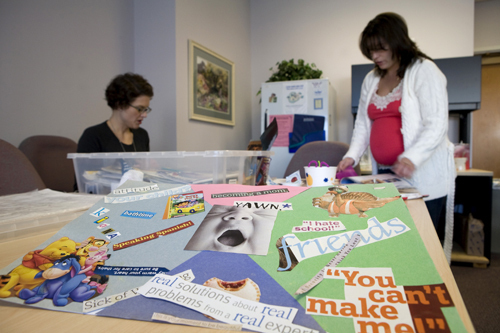
A group of mothers battling postpartum depression worked through a range of painful, complicated emotions by expressing them in a mural that was recently displayed in the lobby of Women & Infants Hospital.
The mural they created was an example of a type of art therapy that doctors and health care professionals are increasingly using in hospitals throughout Rhode Island and the nation.
Art therapy encompasses everything from the work of a certified art therapist, to use of a patient’s art work as a diagnostic tool, to a nurse simply putting a paint brush in the hands of a bored patient sitting in a hospital bed, said Paula Most, coordinator for the arts at Lifespan, the hospital group that includes Rhode Island Hospital, Hasbro Children’s Hospital, The Miriam Hospital, Bradley Hospital and Newport Hospital.
In recent years, more hospitals are introducing or increasing their art, music and theater programming to offer patients creative outlets, a chance to personalize and beautify the hospital environment and a break from the monotony of a hospital stay, she said.
“It has become very important as medicine has changed drastically, dramatically in the past 30 years,” Most said. “Bringing something to the patient while they’re in a very stressful situation – offering them the opportunity to create something or to listen to something or to participate in a performance – I think adds a whole new dimension to their hospital stay, and we think it’s positive.”
The arts-in-health care movement started in the mid-1970s, when individual pioneers who were experimenting with art therapy at institutional health care settings across the country began to organize and share information, Most said. Today, the field is represented by the Society for the Arts in Health Care, an international organization with more than 2,000 members.
Lifespan launched its own art program in 1994. That’s when Most joined the hospital group to expand an outreach program she had begun while working in the education department at the Rhode Island School of Design Museum that brought together local artists and young patients at Hasbro Children’s Hospital.
As part of Lifespan’s art programming, a team of four professional artists visits Hasbro’s oncology unit every Tuesday to work on art projects with young patients. In addition, a professional musician circulates throughout the hospital on a weekly basis, handing instruments to young children for impromptu music lessons and jam sessions.
“Art Cart,” a newly launched initiative at Rhode Island Hospital, enables patients admitted for extended periods to adorn their room with a famous work of art during their hospital stay. Another program brings mimes, puppeteers and other performance artists into the hospitals two or three times a week, Most said.
The art-therapy program that produced the mural that hung in the lobby at Women & Infants Hospital, which is in the Care New England hospital network, was created by Grace Farris, a fourth-year medical student at The Warren Alpert Medical School of Brown University.
Over the course of six weeks in August and September, about 30 mothers in the day program created collages that channeled their experience of pregnancy, motherhood and postpartum depression. The collages were then combined in a large mural to form “Postpartum Depression in the Ocean State,” a work of art that was displayed in the hospital’s lobby from Nov. 21 to 23.
Farris, a hobby painter and art lover, conceived the idea for the project while working at the hospital’s postpartum day program during a community health clerkship required as part of her medical studies.
Sitting in on group therapy sessions held twice a day in the program, Farris said she was struck by the common experience of mothers who came from a wide range of ethnic socioeconomic backgrounds. They included homeless women who had lost custody of their newborns and mothers whose babies were being cared for by nannies at home.
“Because they’re from such different backgrounds, you would think that it would be hard to have a group that is very productive. But actually, when they come together, they talk about very similar themes – you know, problems around being a woman, the changing role when you become a mother – so those sessions were very powerful for me,” Farris said. “I thought of having them do individual art projects and putting them together to make a larger picture that would echo group therapy, where they offer different perspective but there are resonating themes.”
The project took longer to complete than Farris anticipated – in part a result of the loss of concentration that is a common symptom of depression, she said.
But working on collages enabled some of the women to express an aspect of their experience that they were unable to share in their more-traditional verbal therapy sessions, Farris said.
“A number who didn’t participate in group very much – some of them were just soft-spoken or not as verbal – they came out with some beautiful collages that were very personal and kind of communicated more than what they were communicating in group,” she said. •