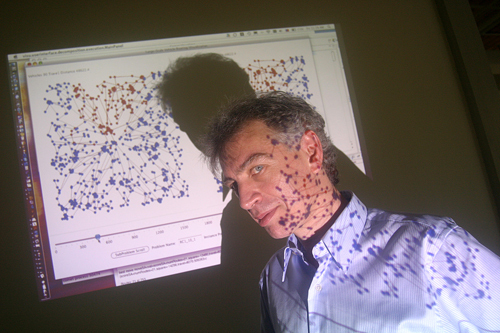
Mention a tech startup, and for many people the image that comes to mind is of one or more young geniuses in a basement turning a nerdy idea into a multinational. (Think Google or Facebook.)
But not all startups flow from the insights of 20-something wunderkinds barely out of college. Take Dynadec, a Providence firm that formally launched its marquee product, a business software platform called Comet, this month.
Dynadec is short for Dynamic Decision Technologies Inc., and Comet is designed to let companies make more effective use of the massive amounts of data they now collect in the course of doing business each day – from inventory levels to delivery routes to customer counts. In corporate-speak, the process is called optimization.
As an example, Dynadec’s founders say managers at a company like UPS could install Comet in their internal computer system, and then use it to analyze and optimize their drivers’ itineraries in real time – not only before they leave the warehouse, but even when they are out on the road.
Comet can rapidly weigh a range of variables – for a delivery service, that could include trip distance, wind speeds, weight loads, fuel costs and safety concerns – and then offer the itinerary that best fits their preferences.
Dynadec’s founders say part of Comet’s appeal is its flexibility – not only can it do complicated analyses of reams of data quickly, but it also can be installed inside the proprietary enterprise resource-planning systems, or ERPs, that many large firms use internally.
Comet is the brainchild of Pascal Van Hentenryck, a software engineer and professor of computer science at Brown University, and it is based on ideas he has been exploring for a quarter-century. (Dynadec’s Web site describes Comet as his “life’s work.”) The idea behind Comet may sound simple, but the system uses more than 800,000 lines of code.
Van Hentenryck, who was born and raised in Belgium, said his parents urged him to study business, and when he arrived at his college’s economics department he was given the option of incorporating computer science into his studies. “I had no idea what computer science was, but [I figured] an option was better than no option,” he said. “I checked the box, and then after two years this just became my passion.”
After working at a European computer-research institute, Van Hentenryck in 1990 joined the faculty at Brown. He now leads the university’s Optimization Laboratory. There he began work on the platform that became Comet eight years ago.
“The world in the last 10 years has changed very substantially, essentially because of telecommunications technology,” he explained, “so now you have RFIDs, sensors, networks, GPS – and all of this technology has made it possible for all enterprises to collect massive amounts of data on their operations.” The trick, he said, is finding a way to make good use of that information – and that, he hopes, is where Dynadec and Comet can come in.
Brown provided Van Hentenryck with backing to start Dynadec in 2007 – he serves as the company’s chief technology officer and plans to continue teaching – but it has taken until now for the firm to find enough workers with the necessary expertise in both mathematics and computer science to ramp up.
“There are a lot of people with a lot of problems out there, and optimization has only addressed, in the past, a fraction of the problems that could be addressed,” Van Hentenryck said. “So I think there are great opportunities.” •