Anyone who visited Bryant College in the early 1990s saw a school badly in need of a new direction.
Some campus facilities were looking old and run-down. Enrollment had dropped below 2,000 students, and five of the 16 dormitories sat empty. The school had a deficit of $1.7 million.
Today, the Smithfield campus is a vibrant, bustling place, with nearly 4,000 students. There are new buildings, including an athletic center, a library, a communications and IT complex, and residences. The deficit is gone, replaced by a $4.3 million surplus. And with the addition of graduate programs and a new college of arts and science, the school is now known as Bryant University.
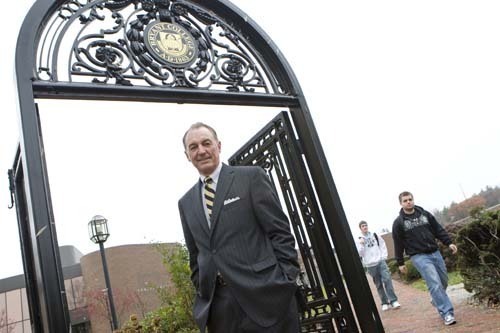
Much of the credit goes to President Ronald K. Machtley, who took the reins in 1996.
“Back in ’96, if someone had said, ‘You’re going to have a U.S.-China Institute, or some of the best technology in the country,’ it would have been difficult to believe,” said Machtley, who is being recognized for Business Leadership in the 2008 Providence Business News Business Excellence Awards.
“Sometimes a crisis is what you need to make people move out of their comfort zone,” he said. “When I came here, we had fundamental problems. We had a deficit. Even though our programs were good, we were not a place where students wanted to come. We had to make the appearance of the school meet the quality of our programs. … We needed more activities, like sports programs and weekend events on campus.”
Machtley – known in addition to his current position as a former congressman and Republican candidate for governor – credits the work of advisers and faculty in facilitating the campus rebirth. To execute his plan, he assembled a team of higher education veterans, from within Bryant and beyond.
“In higher education, you’re surrounded by many intelligent people,” he acknowledged. “If you’re willing to say you don’t understand something, they’re always ready to help you.”
Machtley brought an impressive and varied career resume to the job. A graduate of the U.S. Naval Academy at Annapolis, Md., he served as an officer in the Navy and the Naval Reserves. He holds a law degree from Suffolk University. During his three terms in Congress, he was a member of the House Armed Services Committee and the Small Business Committee, and co-chaired the New England Energy Caucus. He has also served on the boards of a number of corporations and charitable foundations, and today is the president of the Rhode Island Public Expenditure Council.
“All of my experiences collectively have been the ideal background for what I’m doing now,” he said. “In the Navy, I learned how to make decisions and treat people fairly. As a lawyer, you learn to look for facts, and to work with people to reach equitable solutions. In politics, you learn that if your initial way of getting something done is not the right one, you move on and don’t take it personally.”
Along the way, he has listened to advice from a long list of mentors, from hometown friends to national leaders. Among them: Kati Machtley, his wife of 37 years and a 2008 PBN Business Women honoree for her role in the annual Women’s Summit at Bryant(READ MORE); his junior high school principal and coach; Navy officers; Washington power brokers; business leaders such as former General Electric Co. CEO Jack Welch; and board members at Bryant.
“You watch how successful people get things done,” Ron Machtley said when prodded for advice. “Success is a function of having good people around you, and minimizing the mistakes.”
Folks at Bryant point with pride at the milestones they have reached during Machtley’s tenure. Annual revenue has doubled to $110 million. The endowment has jumped to $170 million today from $96 million in 1998. The number of tenured and tenure-track faculty members has grown 31 percent, and the percentage of faculty with doctorate degrees has climbed to 99 percent from 88 percent.
New facilities and staff are just part of the story. There has also been a vigorous effort to build a campus community. Bryant’s athletic teams have moved into the NCAA’s Division I, allowing students to participate in 22 sports at the highest collegiate level. Students and employees participate in a number of volunteer programs aimed at giving back to the community, including Habitat for Humanity, Northern Rhode Island Special Olympics and the American Cancer Society’s Relay for Life.
Recent cultural events have included campus visits from former Presidents George H.W. Bush (READ MORE) and Bill Clinton; lectures by documentary filmmaker Ken Burns, TV journalist Jane Pauley and historian David McCullough; and performances by jazz vocalist Freddy Cole, saxophonist Lou Donaldson and baroque violinist Martina Day Martinson. And next year’s Women’s Summit will be the 12th in the perennially sold-out series.
Beyond that, Bryant has launched several unique academic programs, including a freshman-year examination of character. “As Aristotle suggested, success is not about money, power, or fame, but how you develop and choose the character traits that ultimately contribute to a successful life,” Machtley said.
There are also several programs aimed at introducing students to the global marketplace, from an international business major to expanded foreign-language programs. The Sophomore International Experience allows students to study abroad for two weeks; eventually, the school plans to have every student participate.
And in March 2005 the U.S.-China Institute was founded, focusing on academic, business and cultural partnerships between the two countries. In 2006, the school received grant money from the government of China to launch the Confucius Institute, dedicated to the promotion of Chinese language and culture. (READ MORE) And this May, entrepreneur Fan Jianchuan announced he would help the university construct a replica of the Shu Fang Zhai, a well-known building from Beijing’s Forbidden City. (READ MORE)
Meanwhile, the university has been honored for its emergency-preparedness efforts. (READ MORE) It has been included, for the past eight years, in The Princeton Review’s list of America’s best colleges and universities. (READ MORE) And the number of applications it receives each year have tripled.
When pressed for his secrets to success, Machtley points to the process of communication, consensus and execution. “Develop consensus about the direction of the organization, and then execute your strategic plan,” he said. “Communicating with internal constituents, listening to their ideas and then building a sense of purpose helps the entire organization move in the same direction.” •
Seifert Systems Invests in Energy Efficiency to Strengthen Operations
For manufacturers, energy is more than just another operating expense. It plays a critical role…
Learn More