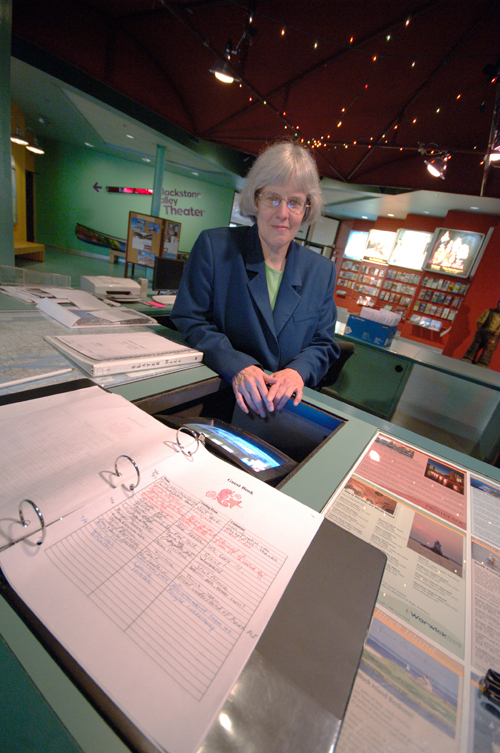
If tourists are running late and don’t make it to the Pawtucket Visitors Center on Main Street until after 4 p.m., they will find no one there to tell them about the Blackstone Valley.
The center, formerly open until 5 p.m. seven days a week, now closes at 4 p.m. every day, in one of many changes altering the business landscape in Rhode Island as a result of reductions in state Community Services Grants. All 350 grants, without exception, were cut in half to save the state approximately $9 million this year.
An employee of the Center for Women & Enterprise (CWE) in Providence is leaving to attend graduate school and, according to Director Carol C. Malysz, odds are good that person won’t be replaced.
Leslie A. Gardner, chairwoman of the Capital Center Commission that oversees development in the area around the state capitol, wonders where her agency will find the funds to pay the rent, the director’s salary and the fees for legal and design consultants in the face of an $18,028 cut.
At the R.I. Small Business Development Center (SBDC) at Johnson & Wales University, Executive Director John Cronin expects that engaging expert consultants to assist existing businesses “will become the exception rather than the norm.” Instead, the SBDC will look to online resources, the university and other partners such as local Chambers of Commerce for more services than before. He faces a $63,510 cut from a budget now at about $750,000.
Business groups across Rhode Island are assessing the impact of the cuts in Community Services Grants, recommended by Gov. Donald L. Carcieri and enacted last month without revision by the General Assembly. Some $17.9 million worth of grants that partially fund 350 organizations, agencies and events statewide was slashed by 50 percent to help avert an estimated $400 million deficit in the coming fiscal year.
Business-support professionals such as Cronin maintain the state funding they receive is critical to their mission of maintaining and growing the Rhode Island economy, particularly in light of rising unemployment, now at 7.2 percent. “Budget decisions that consider economic-development line items as an expense rather than an investment are not wise,” Cronin said. The end result, he says, will be a weakened economy and less tax revenue.
Understanding the state’s fiscal troubles may ease the sting of the cuts for some, but they are still tough to swallow.
“Everyone is feeling the pinch,” Gardner said. Social service agencies, for instance, were cut the most, but they receive the most in community grants.
Ray Fogarty, director of the John H. Chafee Center for International Business at Bryant University, must make do this year with $104,736 less for the R.I. Export Assistance Center and $68,865 less for the World Trade Center, both at Bryant. That’s approximately 40 percent of the Chafee Center’s overall budget, Fogarty said, which was at roughly $800,000 last year and will “probably end up somewhere in the $500,000 range.”
Fogarty is working with three colleagues – Malysz at CWE, Cronin at SBDC and Leslie W. Taito, chief executive officer of the R.I. Manufacturing Extension Services (RIMES) – to prepare a written report for state officials and lawmakers, laying out the case for increased state financing for business-support groups. The intent is not confrontational, he stressed, but rather “a plea for more resources.”
Every state dollar devoted to economic development, he said, is used to leverage federal and private funds, so the effect of state cuts is actually greater than the dollar figure. Each of the four agencies has been recognized for running successful and lean operations, he noted, and they work together collaboratively “without duplication.”
The Chafee Center, which has been operating for 20 years, works with about 2,000 companies every year, he estimated, doing market research, offering advice and linking local businesspeople with resources in about 150 foreign countries. In today’s sluggish economy, international trade remains “one of the bright spots,” he said, particularly for many Rhode Island businesses “whose only avenue of growth is international.”
He was reluctant to discuss in detail the “strategic cuts” that will have to be made at the Chafee Center because he said “sensitive issues are involved.” At least two full-time positions and one part-time job are in jeopardy, he indicated. A full-time consultant has been dismissed, and training programs that currently serve 1,200 people a year will be cut back.
Malysz recently got some good news. Since the cuts were proposed a few months ago, CWE has received two new grants, $10,000 from office supplies giant Staples Inc. and $25,000 from the City of East Providence. “But we still need that [$28,500] that was cut,” she said.
With a budget of $135,000 before an $18,028 cut, the Capital Center Commission has one staffer, Executive Director Deborah Melino-Wender. The commission has at least seven parcels of land left to be developed at Capital Center (depending on how the sites are divided), about one-third of the total, Gardner said. She fears that developers will go elsewhere if, due to the budget cut, they cannot be assured of “the predictability of the [design review] process.”
“They are investing millions” of dollars, she said. “They have choices outside of Providence.”
At the Pawtucket Visitors Center, Manager Wendy Jencks has cut back her hours of work every week from 40 to 36 to help make up the $22,500 cut in the state grant. The center can be busy in the summer and into October, she said, with an estimated 100,000 people coming through every year. Jencks spoke of recent visitors from France, New Zealand, Australia, Turkey, Denmark and Italy.
“As long as we have good weather in the fall, they will come,” she said of the tourists. Whether someone is there to greet them is another matter. •