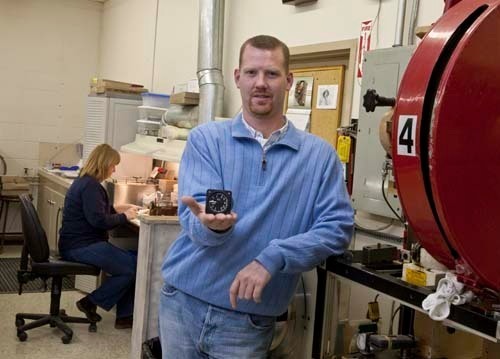
Next time you take a flight, think of this: Your safety could depend on a small part that was likely manufactured in Warwick.
Kearflex Engineering Co. makes sensors for the aerospace industry that measure things such as airspeed, altitude and air pressure. And the company also makes the device that controls the drop-down air masks in the passenger cabin.
“Our sensors monitor if the pressure in the cabin drops, and if it does, that makes the mask automatically drop,” explained Thomas Kearney, president of the family-owned Kearflex.
Kearney figured about 90 percent of the passenger jets flying in the United States contain Kearflex products. And they are elsewhere, too.
The company’s sensors – disk-shaped alloy diaphragms that measure miniscule changes in their shape to determine changes in air pressure – have been installed in F/A-18 fighters, Longbow attack helicopters and B-1 bombers.
Kearney has no delusions of grandeur when it comes to his company’s products, particularly when considering the high-tech complexity of an airplane such as the B-1, which cost hundreds of millions of dollars.
“We’re a little fish,” he said.
It may be little, but Kearflex has been around a while.
Kearney’s father, Robert, started the company in 1963 after working as an engineer at Speidel in Providence, designing sensors for rockets in the early stages of space exploration.
After Speidel began producing the wildly popular and profitable Twist-O-Flex watchbands, the company phased out the sensor division. The elder Kearney ventured out on his own, manufacturing specialized pressure sensors for defense contractors.
Although Thomas Kearney had ambitions to become a school teacher, he got a business degree from the University of Rhode Island in the early 1970s and returned to the family business, overseeing the books. The company was busy enough to need the help.
The Cold War and then the Vietnam War had defense contractors working overtime, and Kearflex was no different.
Kearney says McDonnell Douglas was producing Vietnam-era F-4 fighters by the thousands, each one of them containing Kearflex sensors. The company grew big enough to move to an industrial area off Jefferson Boulevard in Warwick, where it is still located.
“I’m not an engineer by trade, but I really got an understanding of it,” he said.
That knowledge was vital when his brother left to launch his own business, and then his father died in 1984.
While Kearflex’s sensor technology hadn’t changed much since the company began, the technology in the aircraft certainly was evolving, with development of computerized, digital cockpits. Still, Kearflex found a niche, producing traditional analog flight instruments that serve as a backup for the pilot if the high-tech systems fail.
Kearney, however, realized another change in military aircraft could cause problems for Kearflex. The exorbitant cost of newer fighters and bombers would force the government to purchase fewer, which in turn meant a diminished demand for flight instruments.
“The challenge for us was to maintain the sales volume,” Kearney said.
Kearflex has since diversified, finding commercial and industrial uses for its pressure sensors, such as measuring flow through pipelines at fuel-processing plants. The company has also patented a high-tech transducer that can allow pumps to more accurately maintain water pressure from wells.
For many years, aircraft instrumentation represented 85 percent of Kearflex’s production mix. Now it’s less than 50 percent, Kearney said.
The company – Kearney’s son Matthew is a vice president – now produces thousands of types of sensors, and doesn’t shy away from small, custom orders. In fact, the company’s experience and the willingness to take most any job has been the key to Kearflex’s survival, Kearney said.
Business has slowed as customers are delaying projects, but Thomas Kearney believes it is only a matter of time before things bounce back. That’s why he’s building a 6,000-square-foot addition to his existing 9,000-square-foot facility. Kearney acknowledged he doesn’t have the business to justify the addition yet.
He figured it was a good time to build, when contractors’ bids would be low. “And I am hoping that if we build it, they [customers] will come,” he said. •
COMPANY PROFILE
Kearflex Engineering Co.
OWNERS: Thomas Kearney, president; Keith Kearney, treasurer and secretary; Matthew Kearney, vice president
TYPE OF BUSINESS: Pressure-sensor manufacturer
LOCATION: 66 Cypress St., Warwick
EMPLOYEES: 24
YEAR ESTABLISHED: 1963
ANNUAL SALES: $4 million in 2009
Seifert Systems Invests in Energy Efficiency to Strengthen Operations
For manufacturers, energy is more than just another operating expense. It plays a critical role…
Learn More