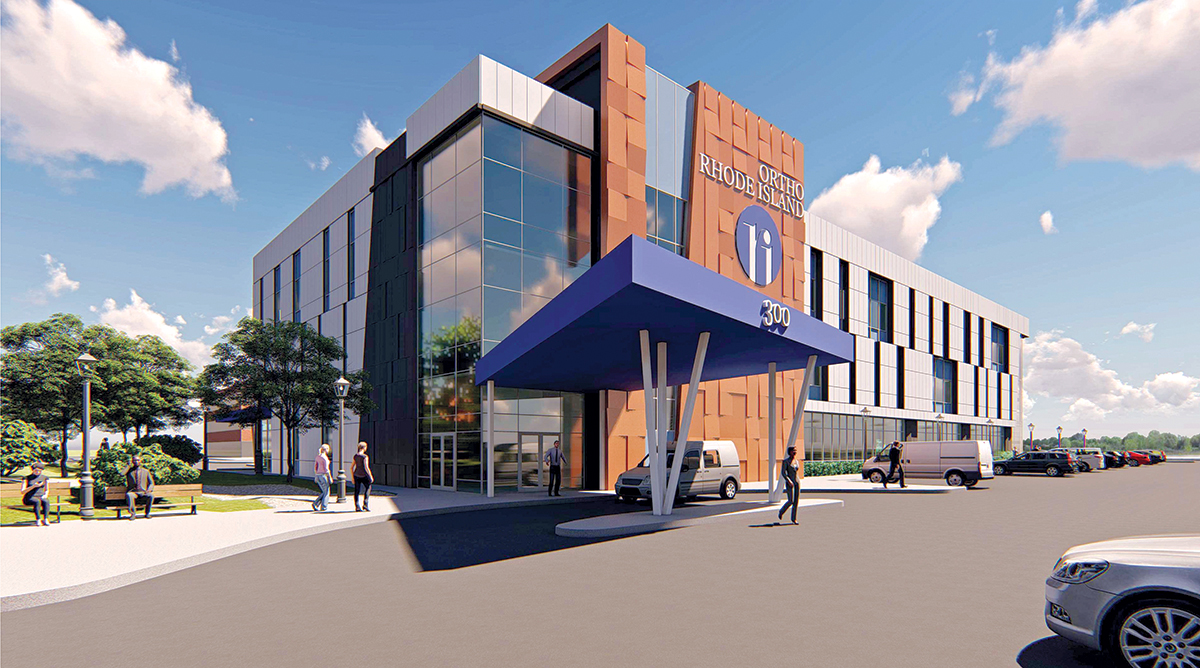
RHODE Island is poised to capitalize on medically inspired travel between cities and countries, with Ortho Rhode Island Inc.’s pending three-story building next to Crowne Plaza Providence-Warwick, the prospect of a spinal-care practice interested in building nearby and legislation allowing them to avoid the state certificate-of-need process.
Kelly Coates, president of the Carpionato Group, which owns the site of Ortho Rhode Island’s new building along Crossings Boulevard in Warwick, would not identify the spinal-care practice but said the company is interested in moving to the office park, in part so it can take advantage of the Rhode Island Medical Technology Innovation Act, legislation drafted by Rep. Joseph M. McNamara, D-Warwick, and signed into law in 2014.
McNamara said his original intent with the legislation was to ease the location of Laser Spine Institute in Rhode Island in 2014, but that deal fell through. The law creates an exemption for medical tourism-themed development from the R.I. Department of Health’s certificate of need, shortening the time it takes to approve new projects geared toward medical tourism. Medical practices that have more than 50 percent of their clients or patients from out of state are exempted from the certificate-of-need process, McNamara said. That makes sense, he said, because the certificate-of-need process is based on local need, while medical tourism is based on demand from outside the state.
Coates said Carpionato Group is in advanced negotiations with the spine-treatment practice.
Meanwhile, Coates said, the new Ortho Rhode Island building, when finished, will be the first site in the state to take advantage of McNamara’s law. The new site will allow Ortho Rhode Island to house specialists and to perform procedures all under one roof, allowing it to attract the interest of patients from out of state seeking comprehensive care in a single spot.
Coates said people needing surgery from across New England will be able to visit the office park for their procedures, stay nearby at the Crowne Plaza and enjoy local attractions. Coates said the convenience of the location, situated with near-immediate access to Interstate 95, local train service and T.F. Green Airport, makes it an ideal center for medically inspired travelers.
“That’s our intent,” said Mary Ellen Ashe, executive director at Ortho Rhode Island. She said Ortho has already been drawing interest from people seeking its care from other cities throughout New England. “We think with the new facility that it really positions us to develop that medical-tourism activity,” Ashe said.
Medical tourism is a term originally coined for travel to European spas, according to “Under-Regulated Health Care Phenomena in a Flat World: Medical Tourism and Outsourcing,” by Nicholas Terry in Western New England Law Review 2006-2007. More recently, the term has been used to describe travel from less-advanced areas to access medical advances abroad, and was soon applied to the practice of people from industrialized countries pursuing more-affordable or -accessible medical services outside their countries. Medically inspired travelers seek to avoid waiting lists for procedures, to gain access to treatment under regulatory review in their home countries. Since 2007, interstate medical tourism has grown more frequent.
At the time the legislation was passed, McNamara said, Laser Spine Institute, with locations in seven states, was considering opening a location in Rhode Island. While the company didn’t locate here, the state remains poised to attract companies with similar business models.
In addition to the eased regulatory hurdles, McNamara said, companies are also seeking quick access to transportation, such as trains and airports, hotels and cultural attractions, elements that Ortho Rhode Island’s new building will have going for it.
“It’s great for so many reasons,” said Rep. K. Joseph Shekarchi, D-Warwick, who co-sponsored McNamara’s legislation. He noted medical tourism promises high-paying jobs and tax revenue with little burden on police, fire or school services.
“It’s a small step today, but maybe it can grow to a regional opportunity,” Shekarchi said.
Stephen Zubiago, an attorney with Nixon Peabody LLP who has worked on medically oriented development deals, said the state’s legislation sets the stage for medical tourism to flourish, though the apparent lack of interest from other practices since Laser Spine Institute canceled its plans causes him to wonder if the legislation alone is enough to draw more medical-tourism-oriented companies.
Providence’s I-195 Redevelopment District also has access to local medical services, transportation and attractions that could entice practices relying on medical tourism, said Peter McNally, executive director of the I-195 Redevelopment District Commission. Providence boasts ready access to hotels, transportation, cultural institutions and attractions, and an existing infrastructure of hospitals, medical and biotech businesses. Also, McNally said, while the distance between Providence and Warwick may seem significant from a Rhode Islander’s perspective, visitors aren’t likely to notice much difference.
Steve DeToy, director of government affairs at the Rhode Island Medical Society, said the Rhode Island Medical Technology Innovation Act, combined with the ease of transportation access throughout the state and Rhode Island’s location near medical resources in the biomedical hub of Boston, make the Ocean State a competitive location for future medical-tourism-inspired companies.
“They clearly thought there was something here,” DeToy said of Laser Spine Institute’s initial interest.
Rob Borkowski is a PBN staff writer. Email him at Borkowski@PBN.com.