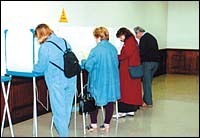
voters in Cranston.
(As of our deadline last week, there remained some question as to the official
outcome in the tight race for the White House. Look for a reaction from the
business community in next week’s Providence Business News.)
In the Rhode Island Congressional races, there were no surprises. Incumbent
U.S. Senator Lincoln Chafee easily defeated his challenger, U.S. Rep. Robert
Weygand by a margin of 56.1 percent to 41.3 percent.
Beyond Cash Donations: How New Forms of Giving Are Transforming Not-for-Profit Accounting
Evolving Funding Landscape for Not-for-Profits Not-for-profit organizations are being asked to do more with less,…
Learn More
Chafee, son of the late U.S. Sen. John H. Chafee, capitalized on his father’s
name, his ability to work on both sides of the political fence during his first
nine months in Washington, D.C., and his record as mayor of Warwick.
During a victory speech at the Providence Marriott, Chafee thanked family, friends
and dedicated campaign workers. He congratulated Weygand on a good race and
promised to remain an independent thinker in Congress.
"Times are good," said Chafee. "But with good times come not
only opportunity, but obligation. I look forward to all we can accomplish together."
Meanwhile, the popular Weygand was hurt badly by a divisive Democratic primary
against former Lt. Gov. Richard Licht and the fact that his fellow Democrats
did not actively campaign on his behalf. In his speech to supporters in the
ballroom at the Providence Biltmore, he went out of his way to thank the voters
who supported him, including various labor unions, his family and his fellow
Democrats.
Weygand praised those Democratic colleagues who many political pundits criticized
for having abandoned him.
Asked by media members about his future plans, Weygand said only that it was
time to spend some restful days with his family. But his name has already surfaced
as a potential gubernatorial candidate in 2002.
Secretary of State James Langevin will slide into the congressional seat being
vacated by Weygand. Langevin garnered 62 percent of the vote in defeating three
opponents.
U.S. Rep. Patrick J. Kennedy also won handily, defeating Republican challenger
Steve Cabral by a margin of 66.7 percent to 33.3 percent.
Bond issues sail — with exception of museum
Rhode Island voters’
history of support for environmental issues continued at this year’s ballot
box.
By a 49 percent margin voters approved Question 1 — the $34 million Environmental
Management Bond. The approval will provide funds to the state Department Environmental
Management for the purchase of land, development rights and easements to protect
the state’s natural resources.
More than $11 million of the funding will be awarded through DEM to communities
and local land trusts for the purchase of land. Just over $10 million will be
used for DEM to purchase property and $1.3 million will be used by the Rhode
Island Water Resource Board for the acquisition of land.
"We are very pleased with the margins of support for this," said Sally
J. Spadaro, spokeswoman for DEM. "Rhode Island is clearly continuing its
commitment to the preservation of open space."
Last month, the state awarded close to $2.4 million in open space granting funding
from a previous bond issue to 25 communities around the state, and Spadaro said
it’s the hope of DEM that this round of funding could be dispersed in a shorter
amount of time.
"The governor is firmly committed to spending this money and has made it
a goal to preserve 35,000 acres by the year 2010," she said.
Ronald Dwight, director of development at the Nature Conservancy said the support
of this bond shows a commitment to open space preservation on behalf of Rhode
Island residents.
"I think it’s sunk into people’s consciousness that they used to drive
by this beautiful corner and now there is another development there," he
said. "They are starting to realize that if we don’t act now to save what’s
left there won’t be anything to save."
Spadaro said it’s important to remember the open space preservation means different
things to different communities and that all can benefit from this approval.
"This is not just for buying big tracks of land out in the country,"
she said. "This includes farms, forests, ball fields and all open space."
Despite concerns by a local government watchdog group that the language of the
bond Question 2 was vague, Rhode Island voters voiced overwhelming support for
the measure
Seventy-five percent of voters approved the $60 million bond that will help
combat the pollution of Narragansett Bay, though as of press time the mail -in
ballots had not yet been counted. According to Anthony Simeone, executive director
of the Rhode Island Clean Water Finance Agency, the funding will be leveraged
with federal and state grants, and invested in the state’s revolving fund. In
all, Simeone said, the state could see close to $215 million over the next three
years as a result of the bond’s approval.
"This funding is important in two ways," said Curt Spalding, executive
director of Save The Bay. "First it will reduce fecal contamination in
the bay, which means that less sewage will be released into the bay. When this
happens we will see the reopening or more shellfish beds."
Spalding continued. "Secondly, this funding will help pay for additional
nitrogen removal from the sewage that has in effect been over-fertilizing Narragansett
Bay. By stopping the over-fertilization in the long term we will see a much
healthier bay."
Under the proposal half the money would be used for an unsubsidized loan to
the Narragansett Bay Commission to help build and three-mile underground piping
system to collect storm runoff and sewage before it enters the bay.
"People have tied their roof drains to their storm drains and those are
then tied into the sewer lines," Simeone said. "When that runoff is
combined with the heavy rain it overwhelms the ability of wastewater plant to
treat and therefor it’s released untreated into the bay. Last year that untreated
waste totaled close to 2 billion gallons."
Though Operation Clean Government and DOT Watch, both government watchdog groups,
had threatened to file suit in court if the measure was approved because they
don’t think the language of the referendum was specific or clear enough, proponents
of the bond said it means good things for the bay.
"These two organizations wanted more line items in the bond wording itself,"
said Jeffrey Kos, president of the Environmental Council of Rhode Island. "But
by nature of the bond, and the fact that it is leveraging more than $216 million,
it is going to be open to many projects. I doubt that line items could have
been given because it encompasses so many individual projects."
Question 3, approved by a two to one margin, paves the way for road and highway
improvements.
The state is now authorized to issue general obligation bonds up to $62.5 million
for transportation projects, including $12 million for the beginning of a new
Route 195 bridge and connection to Route 95 in downtown Providence.
Rhode Island Department of Transportation Director William Ankner pleased with
the outcome.
"The indications were that it would pass," he said, "but we’re
delighted to see that it passed two to one, and I think this gives us a strong
endorsement that the ‘Fix It First Program’ that the governor has initiated
is being perceived as working."
Ankner said the roads in Rhode Island still have a long way to go. He said that
six years ago, 34 percent of the state’s roads were in poor condition. This
year, he said, only 25 percent are in poor condition, and at the end of this
program, the numbers will be down to 13 or 14 percent.
"The philosophy is working, but it’s going to take time," he said.
"We’re very grateful that the public has given the DOT and the Governor’s
philosophy support."
"It’s always very humbling to have that kind of support."
The University of Rhode Island, Rhode Island College and the Community College
of Rhode Island emerged as big winners last Tuesday when Question 4 was approved
by a margin of 67 percent to 33 percent.
Part of Question 4’s $36.9 million in higher education bonds will be used to
build a new 65,000 square-foot facility for CCRI in Newport. The college currently
offers classes at Middletown High School, Newport Hospital and the Newport Navy
Hospital. The new facility will be built on 16 acres of land donated by the
Navy.
"It’s absolutely good news for Newport," said Newport Mayor Richard
Sardella. "It’s good news for Aquidneck Island. It’s good news for Jamestown
and Middletown and Portsmouth. Anyone going to the community college right now
has to make a trip to Warwick. It’s reassuring that the state of Rhode Island
has a commitment to higher education. It’s all very good news."
"I hope we have some input into the curricula that will be offered,"
he said. "It would be nice to see some courses geared toward industries
prevalent in Rhode Island, especially Newport County."
The passage of Question 4 also means good news on the campuses of URI and RIC.
Both schools are in need of improvements, including bringing dormitories into
compliance with the federal Americans with Disabilities Act and the installation
of sprinkler systems. Most of the dorms at URI and RIC do not have sprinkler
systems, having been built before they were required.
"[The passage of the bond] gives us the opportunity to take care of some
big ticket items and bring them up to current standards and still keep tuition
down," said RIC president John Nazarian. "It’s a vote of confidence
for higher education. We’re just delighted."
Nazarian said that some minor work on RIC’s dorms was begun last summer, but
that the college plans to do the major rehabilitative work – one dorm at a time
– over the next three summers.
Heritage Harbor misses $25 million opportunity The only referenda defeat was
the controversial bid under Question 5 to spend $25 million for a proposed $59
million interactive Heritage Harbor Museum at the former Narragansett Electric
South Street Station power plant.
By Wednesday morning, with 598 out of 606 precincts reporting, the bond was
narrowly defeated by 50.28 percent to 49.72 percent – or 163,317 to 161,475,
a mere 1,842 votes. Board of Canvassers officials said that could change by
late Wednesday because they still had mail ballots to process.
Museum Executive Director Albert T. Klyberg said Wednesday morning that with
about 16,000 absentee ballots left to count, "mathematically it’s not impossible"
that the bond could still squeak through, although they’d have to capture those
votes at a ratio of about 2 to 1. Klyberg also mentioned the possibility of
a re-count.
But ultimately, he said, "we’re not going to over analyze. We have to deal
with the reality, and we’re prepared to go ahead."
As originally intended, Heritage Harbor eventually would have housed 180,000
square feet of museum space in 25 themed exhibits. The nonprofit organization
has already raised $27 million for the project from private, federal, state
and local sources.
Klyberg said, "we do have alternative plans" to build the museum without
the $25 million, but it was too early at this point to know "the actual
shape and size of the program." He said one option would be creating total
museum space of about 60,000 or 70,000 square feet versus 180,000 square feet,
but again, that would be a decision made by the entire Heritage Harbor Museum
board.