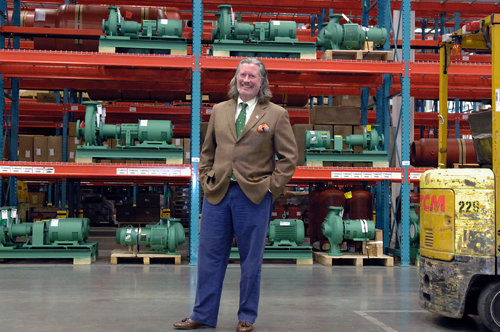
In a recession, local manufacturers are finding that their survival now more than ever depends on their ability to control inventory costs.
At a time when orders are slow, manufacturers say they cannot afford to tie up whatever precious capital they have in building an inventory that may not be sold. Four-day workweeks and layoffs are among the methods manufacturers use, not only to reduce costs but also keep inventory low.
“A piece of inventory is no use to me until I’m paid for it,” said John Hazen White Jr., president of Taco Inc. in Cranston, manufacturer of circulators, controls, pumps and valves for heating, ventilation and air-conditioning systems that employs approximately 500 people.
About 350 of those employees have been working four-day workweeks since mid-March. They are compensated for the time off by unemployment payments through the state’s WorkShare program. This is not a new practice for Taco. White said his company has used four-day workweeks for several years to save money.
But this year, it is “not an issue of saving [on production] costs,” White told Providence Business News. It is avoiding spending altogether.
“I do not want to spend money building an inventory I do not need,” he said.
Dan Shedd, president of the Taylor Box Co. in Warren, agreed that “nobody wants to hold inventory.”
Shedd has been running the third-generation family business for 30 years.
Current economic times present “the biggest challenge my company has ever faced,” he said. “It’s catastrophic, and I am not seeing it get any better.” One of the oldest businesses in Rhode Island, Taylor Box Co. was founded in 1885.
Like White, Shedd is cutting back on what his company is producing. In the past, he said, he would receive orders from customers one year early. Now, those “longer commitments are out the window,” he said. Clients are reluctant to order that far ahead, he said, and he’s reluctant to spend his capital on goods that may not sell. “I have to pay for the labor and the materials and my line of credit,” Shedd said, to produce goods that “then I would have to put into a warehouse, which I have to pay for and heat.”
At Taco, the early months of the year usually are slower than other periods, so this is the time the company typically would be working to build its inventory, White explained.
But now, if Taco were to manufacture 100,000 circulators before they can be sold, then “a couple of million dollars” would be tied up, he said. “I’d rather keep the money in liquid cash,” White said.
He said he now intends to build his inventory as the orders come in. White said he does not know how long his employees will remain on a four-day workweek, but he has no plans for layoffs. As another cost-avoidance measure, most of his plant will be closed for one week later this month, he said.
At Hope Global in Cumberland, a textile plant that relies on the auto industry for about 85 percent of its business, the goal is to maximize capital and minimize daily costs, said Cheryl Merchant, president. Because sales were sluggish with a diminished demand for inventory, “we had excess capacity,” Merchant said. That has led to a reduction in the number of machines that need to run every day, for example, along with a drop in the number of workers needed to run them.
The work force has been reduced from 350 to 190 as a result of layoffs in December and February, according to Merchant. Layoffs were the most drastic cost-saving move the company could make, and virtually every other alternative was explored before this step became necessary, Merchant said.
Salaries were reduced across-the-board, employee-recognition programs suspended, bonuses postponed, the company picnic was canceled and no Thanksgiving turkeys were distributed last year, according to Merchant. “For us to keep these kinds of things and have layoffs is wrong,” she said. “[Those laid off] were hard-working, dedicated people who got the company to where we are today, but we just had no choice.” She reported that Hope Global is “absolutely in a stable mode” right now, with no further layoffs planned. “We’re very lean,” Merchant said.
Roland H. Snead, executive vice president and co-owner, said Banneker is receiving more inquiries and more business in recent months from companies seeking alternatives to managing their own inventories. A client company can even transfer employees to Banneker, he said.
Snead noted that, particularly in manufacturing, a company’s “core competency” might not be managing a warehouse operation. By letting Banneker do its inventory work, a company is free to focus on what it does best and “if we can generate a savings, more and more companies are looking at us,” Snead said. “Companies right now are searching for ways to be more profitable” any way the can.
In Banneker’s case, that means developing new markets. During a recent interview, Snead revealed that he is heading to China later this month with the goal of creating a marketing and sales department, as well as a distribution center, in that country. Banneker also will attend a business expo in China during the summer. “If we can sell them great products, we’ll help the Chinese and build a manufacturing base here,” he said. “The key is being able to sell our products to the Chinese and other countries, while creating jobs here.” •