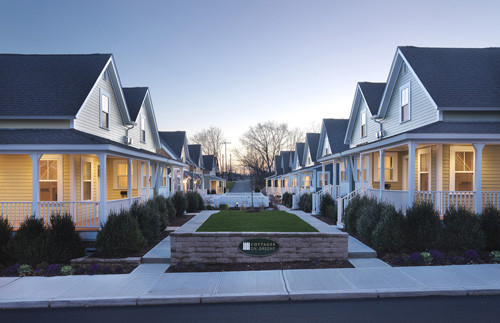
Homeowners in Rhode Island are giving momentum to the recent trend of forgoing mini-mansions in exchange for smaller, more efficient homes that promote a walkable, affordable green community.
Cottage-type living is gaining traction across the country as people trade in size for a community that is closer to amenities, costs less and needs less maintenance, said Donald Powers, principal of Donald Powers Architects in Providence.
“These cottage communities have sprung up as a way to get smaller units into smaller land [lots] and to create this sense of community by giving up some of your private space in favor of a common court or garden or courtyard,” Powers said.
While some people still want the colonial-style homes, more and more there’s a demand for living smaller.
An unscientific August 2011 study for Harris Interactive by Trulia, Inc. found that 6 percent of those surveyed said their ideal home size is more than 3,200 square feet – a 36.5 percent decrease from 9 percent in 2010. And when asked what would be the most important neighborhood amenities if they were in the market for a new home, 56 percent of Americans aged 55 years or older said they would be near more restaurants and shops, while shorter commutes would be a higher priority for 57 percent of young adults, aged 18-34 years, the survey found.
The survey sampled 2,207 adults, of whom 1,392 were homeowners and 758 were renters. San Francisco-based Trulia Inc. is an online real estate resource for buyers, sellers and renters.
“Given the strong intent to buy a home among today’s renters and homeowners, I am optimistic that long-term housing demand will recover – even though today’s prices tell a different story,” said Jed Kolko, Trulia’s chief economist.
Retiring baby boomers won’t want big suburban houses: they care more about easy access to restaurants and retail and will be willing to trade down, Kolko said. High gas prices are expected to accelerate this trend, as would changes to the mortgage interest deduction that reduce demand for expensive homes, he added.
Powers agrees with Kolko, but believes there are other factors. The economy, coupled with the demographics of people craving relief from urban sprawl are key reasons, Powers said. But people also are looking at the smaller environmental footprint cottage-living brings.
The Shannock Village Cottages will be 11 units of affordable rental housing within five buildings in a historic mill village. One building is historic and the remaining four will be new construction. The new building units are mostly under 1,000 square feet.
The project is currently in pre-development stages getting ready for master-plan submission. The town granted $50,000 for pre-development funding and is getting ready to approve another $250,000 for land acquisition, Powers said.
He calls the cottage community in East Greenwich inherently green, because the houses are constructed with building techniques that are relatively accessible.
“They’re construction techniques that all the trades really know how to do and are not really much more expensive,” Powers said.
For example, the cottages have more insulation than required by code, contain EnergyStar appliances and have recycled materials, such as bamboo flooring. There’s also what they call “green swell.” Typically, with stormwater management developers collect overflow in catch basins and pipe the water underground until it perks out a few days later in another area.
With the East Greenwich community, the designers installed bioswells and bioretention, where the rainwater is collected in planted swells and planted depressions, which collect the water and filters it back into the ground where it fell.
“The progressive thing about Greene Street is that we made that the whole landscape theme rather than just being a technical solution to a problem, it became a real feature of the place,” Powers said.
Footbridges are constructed over the depressions and people use them to get to their units, creating a world of pathways and bridges.
What they learned about Cottages on the Greene is that they were probably a little too small, Powers said. The two-bedroom houses range from 860 square feet to 1,100 square feet. The price range is $167,000 to $279,000.
Even so, “they’ve been selling almost in spite of the size of the unit … that they’re slightly too small or not arranged the way people would have liked,” Powers said.
That just proves that people are starved for this type of living.
“Once you create a community that people really want or haven’t seen before, you stop getting buyers who are comparing on the basis of square-foot cost.”
Design work for the cottage communities currently make up about 30 percent of Donald Powers Architects’ work since they began a little more than three years ago.
It’s not just homeowners who are interested either, he said. There’s a lot of interest from municipalities.
It was a no-brainer for Gina Calderone, who bought a cottage at Cottages on Greene in December 2010 because she lives by herself, besides her animals.
Despite the convenient location, which is off Main Street near fine restaurants and bars, Calderone says she likes not having to worry about maintenance.
“I didn’t want anything on a big lot,” the apparel designer said. “A lot of these homes are huge and too much for one person to take care of, especially when you look at things like mowing the grass. I’d rather go play.”
Calderone said when she began looking at houses she was looking for a smaller house or a condo. She looked at historic mill lofts, but didn’t like the idea of taking her dog out at midnight. She also likes socializing with her neighbors.
“We have a little community,” she said. “We have an organic garden in the middle and we take turns watering and pruning and going through the learning curves of a garden. It’s a lot of nice people who are the same as me.
“We’re active, social people who don’t want to be tied down by our homes,” she said. •