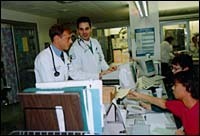
of Miriam Hospital.
Their team status is denoted by color – the “Blues” and the “Golds” — but unlike your basic athletic line-ups these Miriam Hospital Emergency Department workers aren’t adversaries but true cohorts in the ongoing fight to prevent medical mistakes.
And since beginning a system called MedTeams on Oct. 3, Miriam ER doctor Andrew Nathanson said there are already reports from patients and personnel that improvements have been significant.
Rhode Island's Market Has Changed. Developers, Builders, Investors and Sellers Must Change With It.
By Emilio DiSpirito IV License Partner | Engel & Völkers Oceanside Leader | The DiSpirito…
Learn More
“At the Miriam it’s worked out very well. We have definitely seen an efficiency improvement,” Dr. Nathanson said, with shorter waiting and processing times, as well as vast improvements in communication between staff members. “Communications aren’t always that great. As a matter of fact, sometimes they’re pretty lousy,” Dr. Nathanson said.
MedTeams, a concept developed and tested at 12 different hospitals in 1998 (including Rhode Island Hospital), transfers techniques used in high stress industries such as aviation, nuclear power and space to reduce the chances for medical errors.
The initial study showed MedTeams reduced observable clinical errors by 80 percent, according to Dr. Nathanson, 36, assistant clinical professor of emergency medicine at Brown University and Miriam’s director of quality improvement and quality assurance.
Because MedTeams takes the focus away from an individual practitioner and places it on the shoulders of a team it’s more open, “more of a business model,” Dr. Nathanson said, removing the moral stigma in medicine that restricts better prevention practices. It is a more practical approach, akin to “if our steering wheels fall off our Toyotas nobody’s going to buy Toyotas.”
The MedTeams product was developed by Dynamics Research Corporation of Andover, Mass., which supplies the course and course materials.
According to DRC research leader Daniel T. Risser, more than a decade of aviation research has shown effective teamwork is essential to flight safety, to reducing the risk that crews will make a fatal error or permit a fatal chain of errors to unfold.
U.S. Army research, Risser said, shows that aircrew coordination training improved mission performance by at least 20 percent and reduced safety related task errors by more than 40 percent, a projected annual savings of 14 lives and $28 million.
The high stress and demanding ER, with its needs for quick decisions often using incomplete information, and its high-risk demand for effective coordination and complex tasks has a lot in common with aviation, Risser said.
Using MedTeams, ER doctors, nurses and support staff help each other avoid clinical errors – that in the extreme can cause death and in less extreme form do no permanent harm but waste time and valuable resources.
This is 180 degrees from the traditional approach in medicine, where “we’re trained to act as individuals,” Dr. Nathanson said of himself and fellow doctors, adding that this emphasis on personal responsibility not only denies the truth that all people make mistakes but leads to a shame-based persistence of error in medicine that’s higher compared with other high-hazard industries.
The MedTeams approach goes against the standard God-like attitude toward doctors and encourages team members to not only communicate with but “even question authority,” Dr. Nathanson.
“It’s called a two-challenge rule,” he said, and not only is an ER nurse or other caregiver required at Miriam to repeat a physician’s order once, they have to do it again, actively encouraging behavior among health professionals that has never before been taught. “I think that nurses were definitely more enthusiastic about it than doctors,” he said, probably because nurses are “more used to working as a team. For the doctors it’s definitely a bigger change in culture.”
No question with MedTeams that there’s better communication, said Miriam ER nurse Teri Linton, as well as “more opportunity for teaching.”
The MedTeams system stops errors from happening in an environment sometimes so noisy “you might not hear so well,” she said, and because everyone knows the check-backs are mandatory, even inexperienced nurses are learning not to be timid.
“We’re really trying to learn from businesses,” Dr. Nathanson said, citing the way any upscale coffee shop would repeat a customer’s order before turning around to make it. “It’s a verbal confirmation of a verbal order.”
Risser’s retrospective study of ER malpractice incidents found that in 54 emergency room error incidents between 1985 and 1996 that were judged preventable, an average of 8.8 teamwork failures occurred per case, and more than half of the deaths and permanent disabilities that occurred were avoidable.
The study also bound that eight of 12 deaths reported were deemed preventable if there’d been better teamwork, and that better teamwork could save nearly $3.50 per ER patient visit.
Emergency room personnel are always multi-tasking, and it doesn’t help that sometimes patients don’t speak English, or are unable to speak because of injury, Dr. Nathanson said. “The list is ugly. Humans make errors,” he said. “So you have to build a system that realizes” that and builds in safety checks to “minimize or catches the errors before they do harm.”
Right now MedTeams is used solely in emergency departments, although “it certainly has applications” in other high-stress medical environments like ambulance workers or operating rooms, Dr. Nathanson said.
The course by itself costs about $20,000, which was paid by the hospital’s medical malpractice insurer, R.I. Risk Management. The hospital hired no new staff.
Dr. Nathanson, another doctor and two nurses took a five-day course in August, and in September provided eight days of training for the rest of the ER staff.
The MedTeams approach at Miriam was also developed with help from Greg Jay, M.D., Ph.D., a former member of the R.I. National Guard, Dr. Nathanson said.
By splitting Miriam’s E.R. into two halves cared for by respective teams, MedTeams has also made the environment less chaotic, Linton said. “You’re not running around the E.R. looking for which doctor saw what patient,” she said. “A lot of it is common sense.”
“It’s a pretty simple, low-tech behavioral model,” instead of high tech computerized models, which aren’t always as easy or effective as the salesmen would lead you to believe, Dr. Nathanson said. “Our most high tech piece of equipment is an erasable board.”