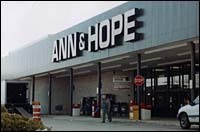
Ann & Hope store in Seekonk.
With recent announcements of closings, restructurings or worse by Bradlees, Ann & Hope, Mongomery-Ward, Apex and others, it is becoming increasingly clear that national retail chains are eclipsing their smaller regional counterparts.
“It’s a shakeout period of time right now in retailing,” said Ronald Kuntze, Ph.D., assistant professor of marketing at Northeastern University. “Those that haven’t clearly defined themselves are being squeezed by Wal-Mart on the bottom and Target on the top of the discount spectrum. Some of these old-line, middle-of-the-road stores have been surviving because of the economic boom.”
Rhode Island's Market Has Changed. Developers, Builders, Investors and Sellers Must Change With It.
By Emilio DiSpirito IV License Partner | Engel & Völkers Oceanside Leader | The DiSpirito…
Learn More
Now that that boom seems to be over, the media has been flooded with negative announcements from retailers since before Christmas.
Braintree, Massachusetts-headquartered discount chain Bradlees filed for Chapter 11 bankruptcy in December and is liquidating assets. The company has 9,800 employees, primarily in the Northeast.
After 128 years in business, Chicago-based Montgomery Ward & Company will cease operations in 30 states, closing 250 stores and displacing 28,000 workers.
In May, Ann & Hope will close its stores in Seekonk, Danvers, North Dartmouth, and Watertown, Massachusetts and significantly downsize operations in Cumberland and Warwick, Rhode Island.
Most recently, it was announced that Apex was closing its Warwick and Swansea facilities and consolidating operations in Pawtucket, where perhaps 20 or 30 employees will remain. The shakeup means releases for close to 400 Apex workers.
Even national retailers have run into trouble: Sears Roebuck & Company has announced the closing of 89 stores and the elimination of 2,400 jobs, and J.C. Penney Company Inc. has reported same-store sales at its department stores fell 1.6 percent during the month of December.
In fact, J.C. Penney Co. followed those sales numbers with news that it would close 50 department stores throughout the country. It is also shutting down several Eckerd drug stores. The two J.C. Penney stores in Rhode Island, in Warwick and Westerly, will not close, according to a company spokesperson.
Meanwhile, Kmart’s same-store sales for the month of December rose 0.7 percent, and between the two of them, Wal-Mart and Target will open 82 new stores this year.
Northeastern’s Kuntze said attracting the young shopper is essential.
“I think in retail, especially in clothing, it’s necessary,” Kuntze said. “They’re the people in the malls. These young people shop more than any other generation. They grew up in malls. You don’t have to give up the older group, but you have to include the younger group. Penny’s has not positioned themselves to the younger audience at all.”
Specialty stores like the Gap, department stores like Neiman-Marcus and Macy’s and superstores like Bed, Bath & Beyond have done a good job at cultivating image and courting younger consumers, Kuntze said.
Whereas shoppers once would have gone to a department store such as Sears or Penny’s for a lower-priced suit, today’s more relaxed office atmosphere demands only a trip to Structure, Banana Republic or the Limited, Kuntze said.
Paul DeRoach, executive director of the Rhode Island Retail Federation, sees it like this:
“In the state of Rhode Island for many, many years, Ann & Hope and Apex were the places where people went to buy a birthday gift, get a television, whatever,” he said. “Then Kmart, Wal-Mart and Target moved into Rhode Island, and they’re beautifully-lit stores with modern fixtures.”
“In the meantime, Ann & Hope and Apex were just drifting along year after year. They just couldn’t match what these larger retailers were doing. It’s all about competition. Competition has a lot to do with whether you stay in business or not.”
“I think they were overwhelmed by Wal-Mart, Kmart and Target. They just couldn’t handle it anymore.”
Outlet shopping in nearby Wrentham and the addition of Providence Place has posed still more competition, according to DeRoach.
“We found that during the Christmas holidays, the specialty stores — Talbots, the Gap, Victoria’s Secret — they did well,” he said. “There’s definitely a market now for specialty shops.”
Apparently, consumers have changed — and that’s not all:
“They’ve given up that Rhode Island parochialism where they had to shop at Apex, they had to shop at Ann & Hope,” said DeRoach. “What does the future hold? No more little guys. The world is changing.”