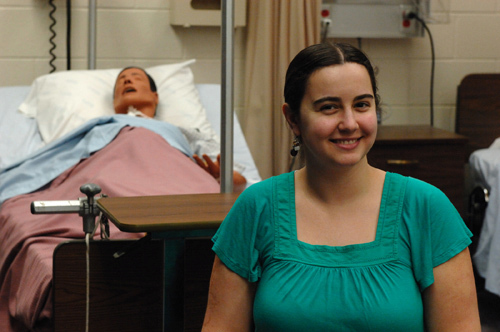
Leanne Schmitt thought she had done everything right.
The Rhode Island College nursing student interned and volunteered at Women & Infants Hospital; she was elected president of the school’s Student Nurses Association; she was part of a student delegation that visited South Africa to study its health care system.
But as she prepares to graduate, those accomplishments have not helped in her search for a job. Nothing has.
After years of hearing about shortages of nurses, about how the health care profession was recession-proof, about how it was a sector that would only grow in the coming years, Schmitt and most of her classmates are struggling to find job openings they believed would be there when they graduated.
“I had these hopes and dreams,” said Schmitt, who has wanted to be a nurse for as long as she can remember. “I’m trying to be optimistic and hope that this is going to lift.”
The lack of jobs available to nursing grads this spring seemingly has caught everybody by surprise, not just the students themselves.
State officials long have said the health care sector in Rhode Island was primed for growth, with many aging employees reaching their retirement years just as an aging population would need more care. Local schools lamented the lack of classroom capacity to feed the need.
Those in the nursing industry emphasize that none of those factors have changed in the long term, noting that shortages are still expected five years from now.
But it’s a different story in the short term.
Health care professionals are blaming the stalled economy for forcing older nurses to stay on the job instead of retiring. For the same reason, part-time and per-diem nurses have been soaking up the hours that hospitals have long struggled to fill.
The result is a shift in how nursing grads are viewed by hospitals and other medical facilities.
For the last several years many graduates had their pick of positions, with little worry about having to clock in on weekends or on third shift if they didn’t want to.
Now cash-strapped hospitals are less likely to hire nurses fresh out of school who will need additional training once they are on the payroll.
The situation at the nonprofit hospital group Lifespan highlights the change in the job market.
Now there are just 30 openings, and almost all are going to seasoned nurses.
Even the number of contract workers – nurses hired temporarily from other parts of the country – has been reduced dramatically from a high of 200 just a few years ago to 25 now. And those remaining are filling in specialized areas.
An additional factor: More patients are deferring elective surgeries, either because they can’t afford to miss the time from work to recover or they don’t have the health insurance coverage anymore.
Lifespan’s hospital census – the number of patients in the hospitals on any given day – has been lower than year-ago levels, Melton said.
“The economy is providing us a brief reprieve from the nursing shortage,” Melton said.
Lynne Dunphy, who focuses on work force issues as the Routhier Chair of Practice at the University of Rhode Island’s College of Nursing, said that in previous years, most of the graduating class of nurses at URI would have job offers by May. Not now.
The job searches for many of the 60 or so URI nursing grads have come up empty.
That said, Dunphy noted that graduates in all fields are facing a tough job market right now, but new nurses will find that they have it a little easier, if they don’t get so picky.
Rosanna Boucher isn’t being selective.
Boucher, who graduates this month from the Community College of Rhode Island’s nursing program, said she wants to work in “end of life” care but realizes that it likely won’t happen right now.
Last week, she was preparing for a job interview with a company that operates a dialysis unit. In the meantime, “I’m looking at hospital Web sites for job [postings] every day,” said Boucher, 40, who was a stay-at-home mom before returning to school.
There are jobs out there, according to Ruth Ricciarelli, executive director for the Center for Health Professionals at the Hospital Association of Rhode Island.
The center’s records showed about 100 help-wanted ads for registered nurses last week, she said. The problem is many openings are at long-term care facilities, community health clinics or for undesirable hours – positions that some students might be reluctant to take after hearing for several years that jobs were plentiful.
Yet people such as Jane Williams, dean of the School of Nursing at Rhode Island College, want to make it clear: “This is not the end of the nursing shortage,” she said.
There is still a need to increase capacity at RIC, as well as at CCRI and URI, Williams said. And offering incentives to attract new nursing faculty is crucial, too, she said.
The R.I. Department of Labor and Training still is projecting major growth for the health care sector, noting a study released last year that indicates the number of jobs in the sector will increase 19.7 percent – from 76,081 to 91,100 – between 2006 to 2016.
That job growth, combined with an aging work force – average age of an RN in Rhode Island is 49.8, Ricciarelli said – adds up to a desperate need in the future.
As several people in the industry said last week: A recession doesn’t stop people from getting older.
Still, that doesn’t make it easier for those new graduates on the job hunt now.
At RIC, Williams reported last week that the 61 nursing graduates are landing few job interviews, never mind jobs. Students now are broadening their search.
One member of RIC’s Class of 2009 recently got a nursing job offer in Texas.
For her part, Schmitt had dreams of working in the neonatal intensive care unit at Women & Infants Hospital, where she had interned. But there’s little chance of that right now.
So Schmitt has applied to a long-term care facility.
If she can’t find a job in the region, Schmitt, a Rhode Island native, said she will look elsewhere. But she admits she doesn’t want to leave the state.
People such as Lifespan’s Melton don’t want her and other nurses to leave, either, because they’ll be needed eventually.
And Melton is fearful that this tough job market may divert potential nursing students into other fields of study.
“This is not a trend,” Melton said. “For people to think that the nursing shortage is over, that’s very short-sighted.” •