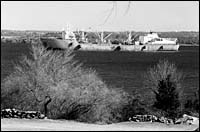
anchor off Jamestown.
Local fishermen selling their catch to Russian processing ships formerly anchored in Narragansett Bay might have a permanent place to unload next year.
Two European companies are negotiating with the Rhode Island Economic Development Corporation to build a land-based freezer operation at Quonset Point/Davisville.
According to Bill Quinby, owner of the Boston-based Mayflower International, which is partnered with the owners of two of the Russian vessels that were recently anchored in Narragansett Bay, lease negotiations are currently being finalized.
“My company is not going to make the investment, but two European candidates I know very well are finalizing the process as we speak,” he said. “My company will get involved with marketing and managing the site.”
Rhode Island's Market Has Changed. Developers, Builders, Investors and Sellers Must Change With It.
By Emilio DiSpirito IV License Partner | Engel & Völkers Oceanside Leader | The DiSpirito…
Learn More
Quinby would not provide the names of the two companies.
And while the RIEDC is remaining tight lipped about the possible development of a processing plant at Quonset Point, officials at the Rhode Island Department of Environmental Management said a new plant, or plants, could be opened by this time next year.
DEM has become increasingly involved in the issue after residents of Jamestown raised concerns about the ships, primarily because of the din from their generators which run all night long. In addition, DEM ordered one of the three ships to either repair its engines or leave the bay as a result of its smoke emissions.
“We received complaints and the pollution concerns were valid,” said Bob Ballou, chief of staff at the DEM. “It is conceivable that a processing facility in the Quonset area would replace, or likely replace, these (current) operations. I think that the shore site processing plant will obviate the need for the current operations. And it’s our sense that it might be in place by next year.”
The Russian ships are allowed under federal fishing laws to buy surplus fish stocks from local fisherman, Ballou said, when it is deemed that the local processors don’t have the means or the desire to process the large volumes.
“In these situations the government of each state are given the authority to enter into agreements,” Ballou said. “This is an opportunity for local fisherman to sell their catches where there wouldn’t normally be a market. Apparently there is $1 million in economic activity as a result of these operations this year.”
One reason for such a high level of activity, Quinby said, is that the American market isn’t fond of mackerel and herring, while European markets are.
“It’s an economy of scale,” he said. “There have been some reductions on the other side of the Atlantic, and so more Europeans are coming here.”
According to Ballou, there has been talk of a land-based system for some time.
“These operations were deemed from the get-go to be interim operations,” he said of the current water-based system. “The point was to assess the prospects of a shore-based facility. Essentially, it was like testing the water – finding out if there was enough interest with local fisherman, and the answer was yes.”
Quinby agreed.
“This was sort of a stepping stone to considering the validity of a shore-based operation,” he said. “We hadn’t done this for four or five years to give the shore side markets a chance to make this investment and it hasn’t happened so there is renewed interest.”
It’s an interest that isn’t solely in Rhode Island, said Quinby.
“An Irish group has made an investment in Gloucester (Mass.),” he said. “I know that a British and a Norwegian group is looking to make investments – looking in New Bedford, Connecticut, and Rhode Island.”
But Quinby said wherever it goes, it can only benefit the local fishing community.
“This provides a good alternative for harvesting a sector that is over populated, and for the fisherman that are really caught with restrictions,” he said. “The whole reason for this is that there isn’t sufficient capacity on shore when the fish is available.”