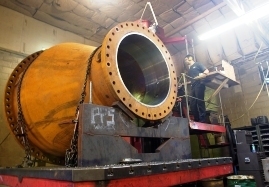
PRIMARY FLOW SIGNAL makes venturi and other meters to measure water, beer, gas, steam and even concrete. Above, a worker inspects half of one of their larger meters.
Primary Flow Signal Inc. started 25 years ago, with three employees supplying flow meters to various municipalities to measure municipal and waste water. Today, it has more than 100 employees who measure everything from beer to tar sand to gas.
In four weeks, the company will become even larger, as it moves to the 70,000-square-foot CI Hayes building in Cranston and doubles its manufacturing space.
Rhode Island's Market Has Changed. Developers, Builders, Investors and Sellers Must Change With It.
By Emilio DiSpirito IV License Partner | Engel & Völkers Oceanside Leader | The DiSpirito…
Learn More
“It’s been amazing. I hear doom and gloom about the economy, but we are extremely busy,” said Bruce Briggs, president and CEO of the company. “We’re moving to CI Hayes because our current manufacturing is limited. This move is imperative, based on the backlog that we have and the increase of new business.”
The company was founded by Dezsoe Halmi, an inventor, engineer and mathematician with 35 years of experiences with flow meters.
For its first four years, Primary Flow Signal sold existing flow meters as Halmi finished designing his own line of venturi-type meters.
“The art and science of flow meters goes back hundreds of years,” Briggs said. “It’s a fully hydraulic measuring device … The venturi concept is to take the flow moving through the pipeline and to sense pressure at two spots – and that pressure can be related to a flow rate.”
Halmi held a patent on a number of venturi meters, Briggs added, and in 1982, he developed a nozzle-tube venturi meter that had a wider range of measurement, was more accurate and consumed less energy.
As the company has grown, it has also expanded geographically, with business relationships throughout South America and the Middle East, and more being developed. In fiscal 2006, 30 percent of its total sales volume was international.
But it was Halmi’s next advance that allowed the company to begin producing products for Anheuser-Busch, Dow Chemical and other industrial companies. In 1986, Halmi made an even more accurate device that could measure gas, steam and substances as thick as cement.
“That invention opened up the opportunities in the industrial market,” Briggs said. It has paid off, he added – in fiscal 2006, 55 percent of the company’s business was related to industry.
“The municipal water business has always been our hardcore business, but by expanding into other areas, we’ve protected ourselves from the ups and downs in any one area,” Briggs said. “Right now, our oil and gas is booming. With oil at $50 a barrel, it needs to be measured properly.”
In the late 1980s and early 1990s, Halmi secured three more patents, two relating to venturi meters and one for an open-channel meter for canals.
In 1996, the company moved from Lincoln to Warwick, but it also suffered a loss, as Halmi died.
But Briggs said carrying on the inventor’s approach to his work has allowed the company to continue to thrive.
“We were fortunate he had a philosophy like he did,” Briggs said. “His philosophy was to do things correctly; pay attention to details; and be contributors, not predators, by providing something of lasting value to the community. When he died, because of all the work he had done, we were able to overcome the loss.”
Today, the founder’s son Dezi Halmi is the executive vice president of the company and Briggs’ partner.
And the company has continued to move forward.
In addition to the two Rhode Island sites, which soon will be combined in Cranston, the company purchased Turbines Inc. in Oklahoma, and now manufactures turbine flow meters there. It has offices in Tulsa, Houston and Canada. It recently started doing more business in Europe, and is looking into business opportunities in China.
“At this point in our evolution, we’re at the point of major international opportunities,” Briggs said. “The opportunities with this move are going to greatly expand the markets we are in now, and the new markets that have a need for accurate flow measurement.
“We’re on the upside of the curve, and we’re trying to do what Mr. Halmi intended.”