(Editor’s Note: This piece is adapted from the Spring 2009 New England Economic Partnership forecast, delivered May 21 at the Federal Reserve Bank of Boston.)
While Rhode Island was among the first states to experience the economic downturn, starting in the first half of 2007, the state shows little sign of being able to pull out of the negative spiral soon. In fact, there are still barriers to overcome before it can get back on a sustainable growth path.
First, the state faces enormous budget shortfalls, which limit the capacity of the government to stimulate the economy. The governor and General Assembly are still attempting to balance the fiscal year 2009 budget while simultaneously addressing a projected revenue shortfall of more than $500 million for fiscal 2010.
Second, job growth in Rhode Island faces many challenges, including an unfriendly business environment, noncompetitive tax structure, a poorly funded education system, an aging work force, population decline and the exporting of college graduates to other states.
A report issued in April by a committee appointed by Gov. Donald L. Carcieri found that economic development in Rhode Island has been “unsatisfactory for well over a decade.” For example, Rhode Island’s investment in economic development is among the lowest in per capita expenditures in the United States, namely, $5 per person based on the budget of the R.I. Economic Development Corporation (EDC). (This amount does not include programs such as tax credits and the dollars spent by cities and communities.) As evidence, the report cited a job loss of 20,000 in the last two years.
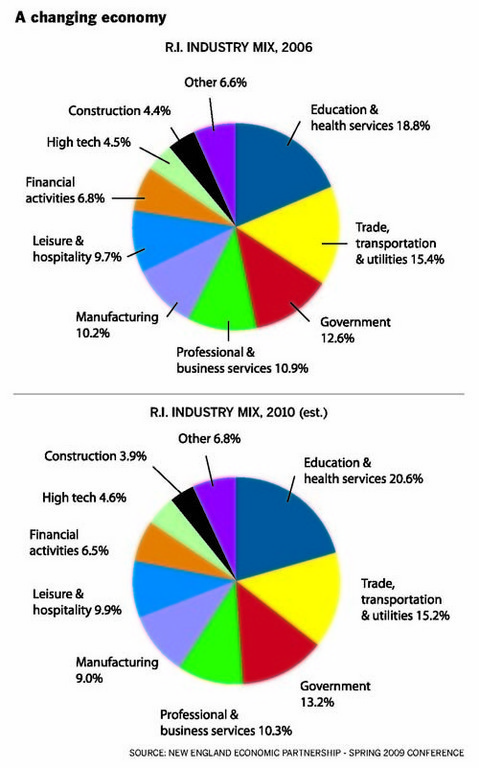
Historically, Rhode Island’s economy was dependent on manufacturing, but 25 percent of the manufacturing jobs disappeared between the late 1980s and 2000. Today, Rhode Island’s economy is primarily based on government, health services, business services, tourism and education. Therefore, any new development strategy should focus on sectors where the state has a competitive advantage, such as tourism, manufacturing leading to exports, professional and business services, education and health services.
In addition, the state needs to put more emphasis on industries that pay higher wages, such as marine, distribution, alternative energy, defense and biotechnology, which all can take advantage of the state’s location and institutions of higher education.
At the same time, local municipalities must cut their expenditures and look for savings. A county structure for city and town services would collapse more than 30 school, police and fire districts into five systems and should result in savings of millions of dollars a year.
In the end, however, job creation is the long-term solution for balancing the state budget. Jobs will be created by establishing a friendly business environment and competitive tax structure, improving education at all levels, and making Rhode Island’s colleges and universities more affordable and accessible.
FORECAST ANALYSIS
Recent state and national data suggest that Rhode Island’s economy might not have reached the bottom yet, but is stabilizing, although the recovery will be gradual and slow.
In 2009, the state’s gross domestic product (GDP) is forecast to be $36.7 billion, roughly the same figure as in 2001 ($36.9 billion). At an annualized rate, that represents a real GDP decline of 3.1 percent in 2009 compared with a decline of 2.7 percent in the other New England states, and it follows a 2008 GDP decline of 2.1 percent in Rhode Island as compared with an increase of 0.4 percent in the other New England states. In 2010, Rhode Island’s GDP is forecast to increase 2.9 percent.
Employment in Rhode Island is expected to decline to 461,500 jobs in 2009 from 481,800 in 2008. And while no jobs are expected to be created during the first two quarters of 2010, nearly 4,000 jobs are expected to be added during the third and fourth quarters of 2010. Subsequently, an increase of 8,300 jobs is forecast for 2011.
Unemployment is forecast to be, on average, 10.7 percent in 2009 and 2010, reaching a peak of 10.9 percent in the first quarter of 2010, and not falling below 10 percent until 2011. (According to the state Department of Labor and Training, Rhode Island’s unemployment rate reached 11.1 percent in April.)
The median price of homes continues to decline. In 2008 it was $246,100 and is expected to be $193,000 in 2009, a decline of more than 20 percent. But from the peak of the median price of homes in 2006, prices have declined by $90,000. By 2010, the median price of a home is expected to reach $181,700.
Housing sales have increased as a result of the lower prices, as well as lower mortgage interest rates and the federal stimulus program encouraging first-time home owners to purchase and receive a tax credit.
Job losses and declining household equity have contributed to increased delinquencies of loans (mortgage and nonmortgage loans) and foreclosures, with the delinquency rate increasing from an average of 6.3 percent in the first quarter of 2008 to about 9 percent in the first quarter of 2009. Delinquency rates are expected to stay around 9 percent in 2009, and then will slowly recede, reaching 7 percent in the fourth quarter of 2010 and staying the same in 2011.
Personal bankruptcies are forecast to increase to 4,700 in 2009, compared with 3,600 in 2008. Bankruptcies are expected to grow to 5,800 in 2010 and 7,300 in 2011. From 2008 through 2013, the annual growth rate in bankruptcies is expected to be 8.6 percent, compared with an annual decline of 5 percent from 2003 to 2008.
Companies have been slow to add jobs, and that will not change over the next 18 months. Only as consumer confidence increases as a result of the federal stimulus programs and the easing of credit markets will job growth reappear. The creation of higher-paying jobs will take even longer.
For instance, despite receiving a great amount of attention, the biotechnology field will take years to develop significant numbers of new jobs, in large part due to the competition from other states.
In reality, Rhode Island’s economic future is tied to small business and the development of new businesses through entrepreneurship. There was a 12 percent increase in new business incorporations in the state from April 2007 to April 2008. Small business creates two out of every three new jobs and accounts for more than 90 percent of Rhode Island businesses.
The state needs to make it easier and less expensive to do business so that small businesses can grow, and these are important issues to address:
• Personal income and corporate taxes.
• Capital gains and estate taxes.
• Too many and confusing contacts for information on loans, tax credits and business opportunities.
In addition to these business-specific initiatives, the state’s education infrastructure – critical to job creation – needs to be upgraded. The state’s community college must be kept affordable so that it can prepare individuals for jobs currently in demand and for the skills required in the future. In fact, for training related to federal stimulus infrastructure projects, tuition at the Community College of Rhode Island should be eliminated.
Rhode Island needs to be branded as a good place to do business. A good start to creating that impression would be to have bold, aggressive steps originate from a single public agency in the state that support the creation of new companies with higher-paying jobs. •
Seifert Systems Invests in Energy Efficiency to Strengthen Operations
For manufacturers, energy is more than just another operating expense. It plays a critical role…
Learn More
Edward M. Mazze is the distinguished university professor of business administration at the University of Rhode Island. Edinaldo Tebaldi is an assistant professor of economics at Bryant University. Additional information is available at www.neepecon.org.