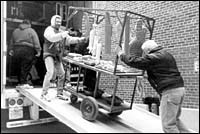
of Miss Saigon. (Tom Croke)
The following are quotes from Providence Performing Arts Center staffers who
have been at the theatre at least 10 years — the time has flown, so much has changed.
“My first day at PPAC was May 2, 1983 and within the first month of my arrival the Wall Street Journal ran a column calling Providence “a smudge on the way to Cape Cod,” further reinforcing an already prevalent lack of self-esteem in the state’s general population.
Rhode Island's Market Has Changed. Developers, Builders, Investors and Sellers Must Change With It.
By Emilio DiSpirito IV License Partner | Engel & Völkers Oceanside Leader | The DiSpirito…
Learn More
The most notable change I’ve seen in my 18-year tenure is a trend-line toward reversing that attitude in our citizens, our institutions, and the media. Local and national media has come a long way toward being a proponent of the state. For example, six months ago Money Magazine voted Providence the best medium-sized city to live in, and this spring it listed South County as one of the best places for a summer vacation.
Hopefully, through its growth and development, PPAC has been a part of that collaborative
effort to elevate Rhode Islanders’ attitudes about themselves and their state.
— J. L. “Lynn” Singleton, President, 1983 — Present
“I was the first ‘new’ staff member recruited by Lynn Singleton and after I went
through a series of interviews with Bruce Sundlun (who was then chairman of the
Board of Trustees) and other Board members, I remember thinking how closely knit
and interested everyone here seemed to be — the theatre was held in great esteem,
and I think everyone recognized its potential even though there was a great deal
of work ahead.
When I first saw the outside of the theatre, I didn’t know what to think – the building seemed low-key. When I was shown the inside, I was stunned to see how magnificent the interior was and I immediately fell in love with it – a depth of feeling which has motivated me to develop the box of 700 “customer cards” I was given back then into a subscription base that has, at its highest, surpassed 13,000 and has been consistently averaging in the 10,000 – 12,000 range.
For an average full-week Broadway engagement, we have 16,000 – 24,000 attendees.
PPAC runs on earned income from shows; I am pleased to have played a significant
part in not only its survival, but its major growth in terms of patrons. In addition,
I have had the privilege of working with our in-house staff to produce the five
Gospel Fest events we have presented and to spearhead the Community Outreach Scholarship
program and our high-school greeter program. — P.J. Prokop, Director of Marketing,
1983 – Present
I have experienced many changes in my 17 years at PPAC; I chose to focus on the marquee, which is a focal point on Weybosset Street heralding upcoming events at the theatre.
When I arrived at PPAC in the mid-eighties, the method of changing the information
on the marquee was an “A frame” ladder, 10 or 12 inch metal letters and numbers,
and a broom handle to center them. In the late eighties, the theatre invested
in a scaffolding unit that was erected to change the marquee letters. In the early
1990s. a “Genie” person lift made changing the marquee less of a problem, although
bad weather or a show ending ahead of schedule might prevent a timely change from
taking place. Finally, in the fall of 2000, the new LED Marquee with its ability
to program 16.7 million colors and a programming schedule that can be set years
in advance brings us right up to date. — Alan J. Chille, General Manager,
1984 – Present
I remember when I first started with PPAC in August of 1985. Lynn Singleton and
Alan Chille met with me on the first day to orient me to the organization. I had
come on board as corporate controller after having done a two-year stint with
a big eight accounting firm in Providence (E & W). Lynn and Alan discussed
all the linguistics of the industry such as stagehand terms, show deal terms,
theater operational language. It was all quite interesting and impressive to a
guy who had been spending most of his time auditing hospitals. At the end of the
discussion, Lynn casually looked at me and used one last term. He said that PPAC
was experiencing what was called a cash flow deficit. It was one term he didn’t
have to give any more information on. I fully understood that it meant PPAC was
broke. I am proud to be part of an organization that has invested over $12 million
in capital improvements over the last 10 years to make PPAC the glorious palace
and entertainment destination it is. — Norbert Mongeon, Director of Finance
& Programming, 1985 – Present
I can relate to the Providence Business News’s15-year anniversary, because this year it is also my 15-year anniversary here at Providence Performing Arts Center (PPAC). In the last 15 years our staff has increased thanks to PPAC & PFM’s growth. To accommodate this growth in the early 1990s and then again in the mid 1990s PPAC went through the administration offices to remodel and expand them. We also had to improve our simple four-line phone system and upgrade to our present modern day integrated digital phone system with a voice mail messaging system.
But my fondest memory is when I had my wedding reception in the theatre lobby
which included 140 guests for dinner and dancing to a live band, 10 years ago.
It was really beautiful here in the theatre, I’ll never forget it. Back then two
men had to physically change the marquee to announce my wedding reception and
now it’s just a press of a finger and our new, state-of-the-art marquee just dazzles
you with its array of colors, pictures and audio sound. —Rosemary Sienko –
Koehler, 1986 – Present
For me, the reward to fund raising for PPAC is seeing what has been accomplished with the monies raised. Since 1978 the Providence Performing Arts Center has been a 501(c)(3) non-profit organization. During its early days, restoration and renovation projects were accomplished one at a time, as dollars were raised from foundations and government sources. The building’s infrastructure was secured from top to bottom with the installation of a new roof, scrub-coating the exterior walls, upgrading the HVAC system, and pumping out the groundwater seeping into the basement. General operating funds along with show revenues paid the operating expenses. e
Then came the first capital campaign, which raised $7.2 million for the stage house expansion and the arrival of the successful touring Broadway mega-shows. Monies from the Restoration Fund (surcharge on each ticket sold) paid for the sparkling restoration of the Lobby and Auditorium; a Federal grant paid for the new marquee. An Annual Fund contributed income that now goes to support community outreach programs and events instead of the general operating fund.
PPAC’s first chairman, Bruce Sundlun, always insisted on the theatre paying its
own way, and that’s still the way it is today. The theater receives no annual
subsidy from any source; fortunately, it can depend on revenues from shows and
ancillary activities to cover the budget. Public support for this magnificent
facility has been wisely invested in the preservation of its historic beauty and
the diversification of its programming schedule, making it a performing arts center
for Rhode Islanders of all ages and interests. — Sue Taylor, Director of Special
Projects, 1987 – Present
The changes in the box office the last 14 years have definitely been dramatic. When I arrived, the office was utilizing Ticketron to sell tickets. Ticketron was then bought out by Ticketmaster so the building changed to that system. These were both national database companies. At this point, I reviewed the situation and felt that customer service should be PPAC’s main objective.
To accomplish this a corporate decision was made to change to an in house system
which we could control completely and therefore manage our own destiny. This has
been extremely successful. We maintain a staff of approximately 20 people, and
provide patrons with all the information necessary for a wonderful experience
of Theater. Through the use of modern technology we are able to tell the patron
where their seats will be located, and a brief synopsis of the show so they can
make an educated decision to purchase tickets. In 1977 we had 2300 subscribers;
today we have a base in excess of 10,000 for a week of a show. Annually we have
400,000 patrons attend performances. — Donna Santos, Director of Ticketing,
1987 – Present
I was hired in the fall of 1989 and was told that I would more than likely get
bit by the “entertainment bug”. I indeed got bitten by this “bug.” Being a non-profit
company with not a lot of money, PPAC’s computers were few and far between when
I first started. Most calculations were performed by hand and the General Ledger
was one gigantic book. Not long after I started, we did computerize the entire
accounting department. We now have E-mail, DSL Internet access, a Web page, and
a computer terminal on every desk. In 1985, Providence Performing Arts Center
had 81 performances with a total attendance of 124,650. In 2000, we had 223 performances
with a total attendance figure of 354,913. Total Box Office sales for 1985 were
$1,715,857 versus $10,323,238 for 2000. We had approximately 150 employees in
1985 and we now have close to 400 people working throughout the year at Providence
Performing Arts Center. — Judy Ferreira, Controller, 1989 – Present