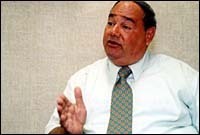
president and CEO,
Uncas Manufacturing.
(Brian McDonald)
Name: John M. Corsini
Age: 57
Position: Owner, president and chief executive officer, Uncas Manufacturing
Company.
Background: Corsini arrived at Uncas in 1966. He was involved in sales
and marketing, later serving as liaison between the Canadian and U.S. operations.
Corsini became vice president of sales and marketing and then president in 1991.
That year, he purchased Uncas from the Sorrentino family.
Education: University of Rhode Island (1965)
Family: Married; three children, four grandchildren
Residence: Narragansett
In 1911, Vincent Sorrentino, an Italian immigrant, founded the Vincent Sorrentino Ring Company in Providence.
Rhode Island's Market Has Changed. Developers, Builders, Investors and Sellers Must Change With It.
By Emilio DiSpirito IV License Partner | Engel & Völkers Oceanside Leader | The DiSpirito…
Learn More
Four years later, he renamed the company Uncas Manufacturing Company as a tribute to Uncas, a legendary American Indian whose exploits formed the basis of James Fennimore Cooper’s famous novel, The Last of the Mohicans.
In 1961, Stanley Sorrentino, Vincent’s son, succeeded his father as president. In 1967, Uncas installed one of the first computers in the jewelry industry for controlling inventory. Also that year, automated barrel plating machines became operational and increased production by 75 percent.
In 1991, John M. Corsini succeeded Stanley Sorrentino. The first non-family member to lead the company, Corsini has turned Uncas into his own family business working with his son, and two daughters.
PBN: Often, we hear about Rhode Island jewelry manufacturers moving operations,
downsizing or shutting their doors for good. That has not been the case at Uncas.
What are the keys to 90 years in business?
CORSINI: Uncas has been a very flexible company. We manufacture in all metals. We do precious metals, gold and sterling silver. The fact that we manufacture in all metals allows us to provide our customers with whatever the trends are in the marketplace. Prior to the1970s, Uncas was strictly a ring manufacturing company. We decided to become a full-fledged jewelry manufacturer. We embarked on developing all types of products; pendants, earrings, charms, bracelets – whatever our customers needed. That is part of the flexibility. And we were not a company that was involved in one channel of distribution. Over the years we have been involved in direct response field, the direct-mail catalog field, the electronic media field and the mass merchandise field. This gave us the flexibility to work with all different channels of distribution. When you look at 90 years, it’s also important to talk about the people. We have had a tremendous opportunity to work with great people. That is going to continue. It’s been the catalyst for making the company what it is today.
What are your primary products — have they changed in recent years?
They have changed based on the markets and the new markets we have been developing.
Today, there are labor-intensive products — handset merchandise with many, many
stones. That’s primarily because we have had tremendous expansion in the electronic
media market. That is one of the requirements, in terms of the trends in that
market.
What exactly is the electronic media market?
Predominantly the television market. It involves developing a product for a celebrity
for television on a monthly basis.
And they obviously have to change what they are wearing on a regular basis?
Absolutely. That’s where the design aspect comes in. We have to be constantly
moving into new products, new concepts.
Many companies find it difficult to get qualified workers in this tight labor
market. Has Rhode Island’s rich manufacturing history helped you in terms of finding
qualified people?
Yes, it has. We are also international. So we have people all over the world that
provide information and input with regard to design. That helps us broaden our
base and provide our customers with what they need. We just opened a Hong Kong
office, where we have seven very qualified people. We also opened a warehouse
in Florida to service the amusement parks there, and we have three very qualified
people. In Rhode Island we do some outsourcing, so when there are peaks we can
bring together a lot of product.
You have enjoyed dramatic growth — and remained in Rhode Island. What keeps
Uncas here?
The biggest thing is the quality of life in Rhode Island. I have always said it
is second to none. That’s important and I will always feel that way.
The company started in 1911, before so many new high tech capabilities. How
have you tapped into technology in recent years?
Everything is quick response, in almost any industry. You have to get the product
to the consumer as quickly as possible. Our customers are very demanding. They
are looking for a delivery schedule of about two weeks as it relates to new product
development and maybe a few weeks for manufacturing. So that’s four or five weeks,
overall. In order for us to accomplish that, the old techniques just won’t cut
it. So today you have CAD (Computer Aided Design), you have some very sophisticated
casting equipment that eliminates problems in manufacturing. You can get your
product out with the quality expectation that you want and there are no re-works.
You have to keep up with technology in terms of manufacturing and as well as with
the front end of your business.
Are your customers more concerned about price or timeliness?
All of the above. Timeliness is very important, especially in the electronic media
market. There may be a television show and you’ve made a commitment. You have
to have the product there on time.
Who are some of your customers within the electronic media market?
Suzanne Sommers is one of the celebrities with whom we do a lot of business. That’s
the Home Shopping Network. We also provide products for Joan Rivers, Value Vision
and a few other shopping channels.
How many employees do you have?
One hundred and seventy.
In general, what are the latest trends within the industry — for example,
are people wearing jewelry to the same degree as in the past? Are young people
a market of their own?
In fact, the children’s market is a very big market, especially in one segment
of our company, parks and amusements.
How significant is the design component of your business?
When you get into the amusement park field, you have to offer new lines at
least eight times a year. That means a whole new program every six to eight weeks.
It’s important that you have that look, that feel — whatever is trendy. My youngest
daughter, Tisha, does quite a bit of design work. She is astute as it relates
to the amusement parks. She travels internationally and she gets the pulse of
what is going on all over the world. She can see trends.
Where do trends get started?
They can start in Europe. They can start in the United States, in California.
Wherever the fashion industry is.
Does the fact that trends tend to start in Europe or on the West Coast give
you an opportunity to get out there and stay up to date with them? You can’t wait
for them to come to Rhode Island?
Oh no. You have to be ahead of the trends. You have to know the fashion industry
— the clothes, the colors. You have to see whether skirts are high or low. We
make jewelry belts today, tailored with all types of stones. That was a trend
and we had to be on top of that.
Early in 1998, you acquired Vargas Manufacturing and moved operations from
Atwells Avenue to Niantic Avenue. Has that acquisition and move accomplished what
you had hoped it would?
The problem with Atwells was that it was a four-story operation, which did not
lend itself to any flow or efficiency. First, the building here was perfect and
ideal for what we were trying to accomplish. Second, they were also a little bit
more advanced in CAD than we were at the time. So that became very interesting
to me, especially regarding the quick response and the front end of the business.
And third, Vargas had some good people. It’s always nice to merge with good people.
In 1998 Uncas opened a showroom on Fifth Avenue in New York City. What went
into that decision and what have been the results been?
When we purchased Vargas, they were in some markets that we were not. That
showroom was one of their requirements. It was a natural fit for us to continue
with that showroom and develop the markets we are currently in. In fact, one of
those markets was the electronic media market. That’s the pulse in New York —
you try to be there and all of your buyers are there.
The economy has slowed in recent months. Has that softening impacted your business
— changed your approach?
It’s only made us more aggressive. We hired a director of new business development.
We said there have to be more markets, newer markets that we should be pursuing.
Within the channels of distribution that we currently have, there have to be more
accounts that we could be cultivating. We’ve decided to understand that this is
a perfect opportunity to develop new markets.
Tiffany’s recently opened a manufacturing plant in Lincoln. Is that something
you like to see, or would you just assume avoid such competition?
I would rather see the competition. I think it’s great to have Tiffany’s
in Rhode Island. I would like to see Rhode Island as the jewelry capital of the
world. The more that we have, the better it is.
You have a son, Christopher, and two daughters, Daryl and Tisha, working for
the company. How important is it to you that Uncas has emerged as your family
business?
It’s very important. It’s so good to see my children make the business grow. All
of them contribute immensely and work very hard. Chris (executive vice president)
is doing a real nice job. He just opened the Hong Kong office. Daryl is selling
internationally and doing an excellent job. She handles Japan, Hong Kong, Australia
and Euro Disney. Tisha is unbelievably good at designing.