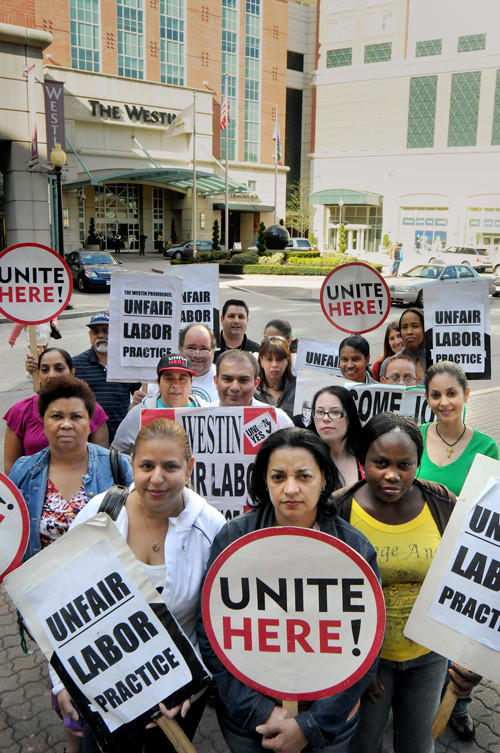
Representatives from The Westin Providence and its labor union will spend their Valentine’s Day together: in front of an administrative law judge.
The judge from the National Labor Relations Board will hear arguments about whether the hotel’s management firm, TPG Hospitality Inc., engaged in unfair labor practices against members of the Unite Here! Local 217 union. The union representing hotel staff such as housekeepers and kitchen workers has battled publicly with TPG since its contract expired in October 2009.
Four months later TPG, part of the Cranston-based The Procaccianti Group, raised workers’ health insurance premiums and, according to the union, unilaterally reduced vacation time, increased workloads and arbitrarily fired union members.
The hearing on Feb. 14 could add a new wrinkle to the debate that has already included vocal picket lines in front of the downtown hotel, a union request that event planners boycott the hotel and public finger-pointing by both sides.
“This is not a nonevent,” said Michael Yelnosky, a law professor at Roger Williams University who studies labor issues.
Yelnosky said the hearing would shed light on how far apart the two sides remain in negotiations. It may also indicate just how far the union and The Procaccianti Group are willing to take the fight. An appeal by the loser would suggest a desire to play hardball but also carries the risk of steep legal fees and months without a contract, Yelnosky said.
And for The Procaccianti Group, appealing a decision in favor of the union may make the company look bad in the eyes of the public in a state where labor unions counted 80,000 members in 2009.
The hearing stems from charges filed by the union in 2009 and 2010. But the judge has granted multiple delays at the request of both sides. Eventually the delays became too many and the judge has ordered no more postponements, a spokeswoman for the National Labor Relations Board said. The hearing, she said, will go on unless both sides reach an agreement beforehand.
Representatives of the union and The Procaccianti Group both declined to be interviewed for this story.
Yelnosky said the multiple postponements suggest a deal is near and neither side wants to jeopardize their position by going public.
Backing down now may lower the union’s standing in the eyes of its members, Yelnosky said.
The Procaccianti Group also has a lot at stake. A ruling by the judge is not binding, and neither would be one made by the full labor board on appeal. But the full board could ask a federal court to enforce the decision. Those decisions can include ordering an employer to reinstate workers with back pay. The board has also ordered employers to return to previous contract terms and compensate employees accordingly.
“There can be a lot at stake in these cases both in terms of real money and in terms of a real showing [by the union] to the employees that “We’ve got power here,’ ” Yelnosky said.
The path of the fight between Unite Here! and The Procaccianti Group is hardly unusual, said Diya Das, an assistant professor of management at Bryant University. Labor negotiations, especially in down economies, often drag on for months. She pointed to hotel workers at a Chicago Hyatt. The workers, also part of Unite Here!, have been without a contract for more than 16 months and the dispute has spilled over to YouTube and public acts of disobedience.
The disputes, however, more often than not play out behind the scenes and away from the public eye.
Few hotel guests, Das said, decide where to stay based on the relationship between the hotel’s workers and management. Few guests even know when negotiations are occurring.
Das said such knowledge is just not relevant for guests who interact little with staff.
“If you can continue to deliver on the product even if there are problems with the process, most customers will ignore it,” she said.
There are few outward signs The Procaccianti Group has suffered financially.
The union’s call for a boycott of the hotel has caused a few events to move elsewhere.
The hotel, however, received a boost recently when it served as the unofficial headquarters for the New York Jets for their Jan. 16 playoff game against the New England Patriots. •