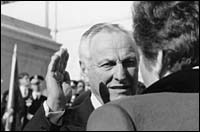
governor before the fall of the
credit unions. (File photo)
On his first day in office, January 1, 1991, Gov. Bruce Sundlun decided to close the state’s credit unions in response to the collapse of the Rhode Island Share & Deposit Indemnity Corporation (RISDIC), a private insurer.
Ten years later, Sundlun is unsure of what lessons the Ocean State reaped from the experience.
Rhode Island's Market Has Changed. Developers, Builders, Investors and Sellers Must Change With It.
By Emilio DiSpirito IV License Partner | Engel & Völkers Oceanside Leader | The DiSpirito…
Learn More
“I don’t know what the state learned,” he said. “I hope the state learned how the credit union crisis came about. The credit union crisis was the biggest crisis in the U.S. caused by the failure of a financial institution.”
News accounts at the time, in the local and national press, were quick to point to other banking crises in states like Maryland and Ohio, but noting that those crises happened during better economic times. In Rhode Island, the state was facing a large budget deficit, impeding the possibility for a quick bailout.
Overall, 45 state chartered credits unions and banks closed, with seven to reopen within a couple of weeks and others to phase-in as they were able to acquire federal insurance. Fifteen credit unions didn’t survive.
When the 45 financial institutions closed, some 300,000 accounts, worth $1.7 billion, were frozen. Some customers gained access to their accounts as their financial institution gained federal insurance.
After the crisis, the legislature mandated that all credit unions that operate in Rhode Island have federal insurance.
At year’s end 1990, 58 credit unions were in operation in the Ocean State, compared to the 14 in operation today. Of the 15 credit unions that didn’t survive, one voluntarily closed. The the rest were either acquired, already had federal insurance, or merged with other credit unions or banks.
The Rhode Island Depositor’s Economic Protection Corporation (DEPCO) was created by legislative act in 1991 to acquire the assets and deposit liabilities of the affected credit unions. Repayment – in full and with interest – to the 211,000 Rhode Island accounts affected was completed in October 1993, through the passage of state bond issues totaling $697 million.
“(DEPCO Executive Director) John McJennett deserves a tremendous amount of credit,” Sundlun said, and called DEPCO “a neat operation by a dedicated public servant.”
As of August 3, 2000, the DEPCO debt is zero, a feat completed 23 years ahead of schedule. The debt was resolved at this accelerated pace because of the liquidation of assets, among which are real estate loans and litigation.
“As of today our focus is upon completing the effort to reduce the cost of repaying the bonds through litigation and negotiation of settlements for the remaining collection and malpractice suits,” said McJennett.
This litigation — which includes approximately 20 different matters — is the only remaining activity related to DEPCO.
McJennett estimated that by resolving the debt so quickly, Rhode Islanders saved over $800 million in future sales tax.
DEPCO and McJennett are not in the state’s budget for 2002 — the former banker hopes to contribute his skills to the business community next, but he feels that he’s learned a lot.
“DEPCO provided all of us the opportunity to break new ground in municipal finance as we used synthetic securities to defease the special obligation bonds,” he said.
McJennett said he thinks Rhode Island is in a better position than it was 10 years ago.
“Not only is the economy much sounder and much more diverse, but the financial institution landscape has been fundamentally changed,” he said. “All of the institutions in the state are subject to regulation and inspection by national entities such as the National Credit Union Administration and the Federal Deposit Insurance Corporation (FDIC) It is likely that the next economic downturn will bring some difficulties, but nothing like the firestorm that resulted from RISDIC’s failure in December of 1990.”