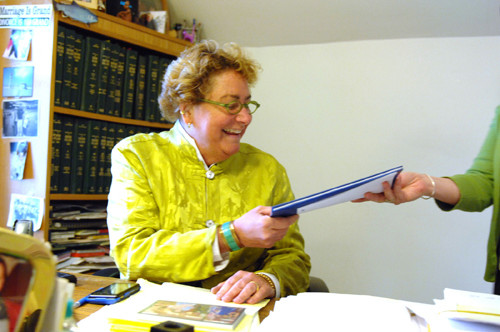
Lawyer Jane Howlett stands ready to give any of her 4,000 colleagues in Rhode Island a helping hand.
A fellow lawyer is in need of emergency transportation? She may volunteer to give that person a lift. Another attorney is desperately seeking a dog sitter before undergoing an unexpected surgery? Howlett might be available if it’s close by.
Fire destroys a sole practitioner’s law office? Howlett could check her network of acquaintances to see if they know of any available, inexpensive office space.
And she’s not the only one looking to help.
Bristol-based Howlett is one of about 270 Ocean State attorneys who have signed on to a new Rhode Island Bar Association program designed to match lawyers and legal personnel who have suffered catastrophic problems with local colleagues who can lend assistance.
“There are so many ways the legal community can reach out and help each other,” said Howlett, whose legal practice deals largely with Family Court and bankruptcy cases.
It’s called SOLACE – Support of Lawyers/legal personnel All Concern Encouraged – an initiative that got its start in Louisiana in 2003 and was launched in Rhode Island a few months ago at the director of South Kingstown’s Lise Iwon, the Rhode Island Bar Association president.
Iwon learned of the program at the National Conference of Bar President’s annual meeting in August when she attended a panel discussion of the effectiveness of SOLACE in helping lawyers and their family members in need in Louisiana, particularly in the aftermath of Hurricane Katrina in 2005.
The program was inundated with requests for help after the storm and flood waters ravaged the Gulf Coast. Through SOLACE, displaced attorneys received offers of housing, law books, furniture and other forms of help.
Among the stories Iwon heard was one in which a close relative of an attorney needed a kidney transplant at a distant hospital, but the family members had no place to stay. When word spread on the SOLACE network, one lawyer volunteered to let the family borrow an RV and a second found an RV park near the hospital where they could stay for free.
“It blew the shoes off my feet,” Iwon said, recalling some of the SOLACE success stories. “I thought, we have to start this here.”
But lawyers needing help? They’re the ones who typically get the call for assistance at times of crisis. And usually they don’t come cheap.
Yet Iwon says many lawyers perform countless hours of pro bono work, and for some – particularly younger attorneys – it can be a struggle to make ends meet.
Iwon envisions a program that can help with something as lofty as helping a legal professional who is battling cancer – say, giving him or her a ride to chemotherapy treatments – to providing law books to a lawyer who is just starting out with an individual practice.
Or it could be a disaster such as the historic floods that struck Rhode Island last year. Iwon hasn’t heard of this happening, but if a law office was destroyed by floodwater, others might be able to step up with donations of furniture, equipment or other assistance.
The service could even be used to provide help for a bar member’s family member out of state, Iwon said. “There would be nothing too small or nothing too large,” she said.
Iwon has been working hard to get the word out about SOLACE before her term ends in June. She made the rounds to the association’s subcommittee meeting and has placed notices in the Rhode Island Bar Journal.
She has also fielded calls from bar associations from other state looking to set up a SOLACE program and is investigating ways to connect the various out-of-state networks.
So far, 270 have signed up for SOLACE in Rhode Island through the bar association’s website. That means they’ll be placed on an electronic mailing list to receive requests for assistance.
Frederick D. Massie, the association’s communications director, said those requests should be either emailed – or someone can call – to the bar, which will edit the message, particularly if it needs to remain anonymous. Then the request will be sent to SOLACE participants.
The network allows lawyer to let others know that they may have items or services that could be useful to someone else. Bar officials said in one recent case, a lawyer had law books to donate.
“It’s an option to help or to be helped,” Massie said.
So far, there have been no requests for help, and that’s OK with Iwon. “I wanted to get the program in place before we had an [influx of requests] to deal with,” she explained.
The program is simple, but Iwon said its eventual impact could be significant, particular since Rhode Island’s legal community is small.
Indeed, Howlett said she is very familiar with most legal professionals who deal with the state’s Family Court. Even outside that system, she either knows many of Rhode Island’s attorneys, or knows of them.
Word can travel fast through the legal community, and SOLACE will provide a way for people to offer help, Howlett said.
“I think [the small size of Rhode Island] will work to this network’s advantage,” she said. •