Pawtucket Finance Director Ronald Wunschel hates to see a great bargain slip by – especially with the city in such fiscal straits – so he says it’s killing him that Pawtucket can’t capitalize on one aspect of the $787 billion federal stimulus package: Build America Bonds.
The sale of these bonds, which feature federal subsidies that lower borrowing costs for state and local governments, are designed to finance construction projects such as building schools and repairing roadways.
The problem for Wunschel: The city doesn’t have any projects on the horizon, and officials don’t want to start planning one just for the sake of getting a discount while piling up unnecessary debt.
“As much as I hate to see this go by the wayside, it just doesn’t make any sense for us,” Wunschel said last week. “The whole thing boils down to timing.”
Pawtucket isn’t the only municipality that hasn’t taken advantage.
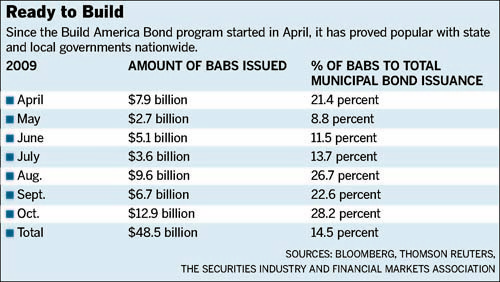
While the use of Build America Bonds (BABs) has risen dramatically nationwide since the program was first launched in April – cities, towns, states and public agencies issued $48.5 billion worth of the taxable bonds in the first seven months of their existence – the subsidies have gone largely unused in the Ocean State so far.
Only Providence has taken advantage, issuing $12 million worth of BABs in July for unspecified road improvements, with the federal government promising to pay 35 percent of the interest payments over the 12-year term.
Savings to the city: $325,000 over the life of the bond, according to Richard Kerbel, the city’s director of administration.
The lack of local use of Build America Bonds isn’t an indication of a lack of interest, according to Maureen E. Gurghigian, manager director of First Southwest Co., a financial firm that advises the state and numerous local communities.
Gurghigian said a growing number of cities and towns are asking First Southwest for advice on the bond program.
But like Pawtucket, many governments have not been poised in recent months to take advantage, in some cases because of an uncertain financial situation that additional debt could make worse.
Gov. Donald L. Carcieri must submit a revised tax-and-spending plan for 2009-10 by Jan. 21 that would bring the state’s budget back into balance by the close of the fiscal year next June. The governor recently ruled out raising taxes to maintain services, and instead suggested state aid to cities and towns will be cut again.
“It’s about the opportunity,” Gurghigian said. “[Are the cities and towns] in a borrowing mode? Many weren’t.”
Also, some borrowers have shied away from Build America Bonds as the market adjusts to the new investment vehicle.
To pay for capital projects, municipalities typically sell tax-exempt bonds that allow for the seller to make prepayments or refinance after a set amount of time.
But the taxable BABs expose those who issue them to a “whole different universe of investors” accustomed to different bond provisions, Gurghigian said.
Early on, investors were looking for large blocks of taxable bonds with “bullet” maturities, where the principal is paid at one time – something that many municipalities couldn’t accommodate. In the months since, the provisions have shifted to allow for things such as installment payment of principal so it more closely resembles the provisions of tax-exempt bonds.
“This is all very new,” Gurghigian said. “And now [the Build America Bonds] are becoming increasingly popular.”
In fact, she predicted that more local cities and towns will turn to BABs for their borrowing early next year after the end-of-the-year, bond-market doldrums.
“We have several [Rhode Island] communities that are now considering issuing them,” Gurghigian said.
Financial experts say Build America Bonds so far have been a success, breathing new life in the muni-bond sector and lowering borrowing costs for cash-strapped governments.
The downside: The program could end up costing the federal government as much as $90 billion in the coming years, some estimate.
The program was launched earlier this year after skittish investors exited the municipal bond market because of concerns about bond insurance companies, which in turn raised bond interest rates for state and local governments. BABs have brought borrowing costs back to a more attractive level.
In October alone, sales of BABs reached $12.9 billion – 28.2 percent of the total municipal issuance, SIFMA said.
The increased Build America Bond activity has had a side effect on the traditional tax-exempt municipal bonds: It has reduced the supply of those types of investment vehicles, which had lowered interest rates on those bonds.
“Anybody looking for a tax-exempt bond is really anxious to buy,” Gurghigian said. “And the more people looking to buy, the better the interest rates for the borrower.”
Because of fluctuations in the bond market, First Southwest is recommending to its government clients that they prepare bond issues to allow for last-minute decisions on whether to go the traditional tax-exempt route, or with BABs, or a mixture of both.
That’s what Providence officials did in July when the city issued $12 million of BABs in a negotiated private placement with Bank of America.
The bank set a 4.46 percent interest rate if the city issued traditional tax-exempt muni bonds, and a 6.25 percent rate if it issued BABs.
Factoring in the 35 percent federal subsidy, the city would pay a 4.06 percent interest over the 12-year term, Kerbel said.
The city went with the Build America Bonds, with an estimated saving of $325,000.
For a city such as Pawtucket, the program provides little relief. Wunschel said he’s talked with the school department to see if there were any construction or improvement projects in the pipeline.
There weren’t, and officials said they were concerned about saddling the city with additional debt as it – along with most other communities – struggles to make ends meet.
“In better times, [Build America Bonds] would have been wonderful,” he said. “But right now, we don’t need this type of help.” •