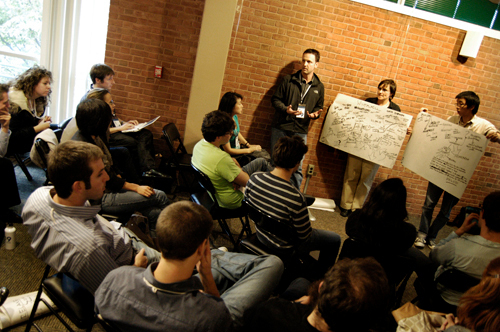
The idea of a bunch of Brown University and Rhode Island School of Design students making international connections to change the world through innovative design and technology might sound farfetched to some.
But it is actually happening, and Providence is at the core of the movement.
More than 500 people registered to attend the three-day “A Better World by Design” conference Oct. 2 through Oct. 4, the second-annual convention held on both university campuses to consider how design can make Rhode Island and the world better places to live.
Taking part in this year’s conference were scholars, students, designers and other business professionals who gathered to discuss in workshops and panel discussions such issues as medical design, affordable housing, transportation and green building. Jan Chipchase, principal engineer at the Nokia Research Center, was the keynote speaker. Nokia has 10 research centers around the world, from China to Cambridge, Mass.
“Art and design have a powerful role in this universe – to take all the complexity in our world and make sense of it on a human scale,” RISD President John Maeda said in a statement prior to his closing remarks at the conference. “This collaboration between RISD and Brown is just one example of the difference we can make as a community.”
The result of informal discussions among Brown and RISD students about two years ago, the partnership has led to Maker Faire Rhode Island, held in September, the second-annual design conference and creation of what is intended to be a longstanding collaboration between the two schools aimed at international change, Revolution by Design, a recently formed nonprofit.
“The mission of Revolution by Design is to foster and support a new educational environment, connecting students with communities in order to solve meaningful, real-world problems,” said Kipp Bradford, an engineering professor who teaches design and entrepreneurship at Brown and is an adviser to the student design groups.
“By making these connections and building these bridges, students can see the impact of their work and its relevance, and their education is put in context,” Bradford told Providence Business News during a break in the Oct. 2 sessions. “So the problems students are working on are real problems rather than theoretical ones.”
Steve Daniels, 20, a native New Yorker in his senior year at Brown studying technology for emerging markets, spent two months in Kenya last summer, working with village farmers on improved irrigation techniques and crafting “solutions that can actually transform lives,” he said.
Tino Chow, 24, a Singapore native who graduated from RISD this year with a degree in industrial design, recently opened his own business, Big New Ideas. He spoke about the work done at Classical High School in Providence. Educators and students there, Chow said, “are really forward-thinking, but they’re stuck in this old space.”
To make that space more conducive to creative thought and discussion, the design students devised a relatively simple solution: adding pieces of furniture to unused spaces to create conversation centers where teachers and pupils can gather for discussions outside the classroom.
Daniels has been a leader in the design initiative between the two Providence universities since it started two years ago. Revolution by Design, he said, will help incorporate aspects of the initiative into the curricula at Brown and RISD. He also would like to see Revolution by Design eventually become a grant-giving organization so students at all Rhode Island colleges and universities can become involved.
An important goal of Revolution by Design, Daniels said, is to find ways to “embed [college] students in the community so they stay here” in Rhode Island. “We lose a lot of students in Rhode Island and in the country as a whole,” Bradford said, referring to high school dropout rates. “How do we engage these students who may not be excited about the way they are taught now? How can we teach differently to reach these students?”
A key difference between Rhode Island and neighboring states, he suggested, is that “we don’t have the skilled work force that Massachusetts and Connecticut have. How can we create that through better educational opportunities? To me, long-term business sustainability in the state will come from long-term improvements in our educational system,” Bradford said. Local educators, particularly in Providence, are among those working with the student group.
When students a few years ago began discussing how design could be used to improve the world, Daniels indicated that they were a bit surprised to realize that the “mindset” already existed locally.
“Providence is actually a great place to start,” Chow said. “It’s small, so you can make things happen quickly, and there are so many people doing cool things.” The challenges that Rhode Island and Providence face are representative of other national and international problems, Daniels suggested, so the city and state are “a good breeding ground” for solutions that can be replicated elsewhere. •