With a legal battle and legislative delays surrounding the so-called E-Verify system, many local business owners and human resources professionals are befuddled about what is required of them when it comes to the controversial employment-verification program.
“Unless you follow it closely, it can be very confusing,” said Cynthia Butler, a human resources consultant and director of government affairs for the Rhode Island Council of the Society for Human Resources Management (SHRM). “Different branches of government are doing different things. [The companies] are not sure what they need to comply with.”
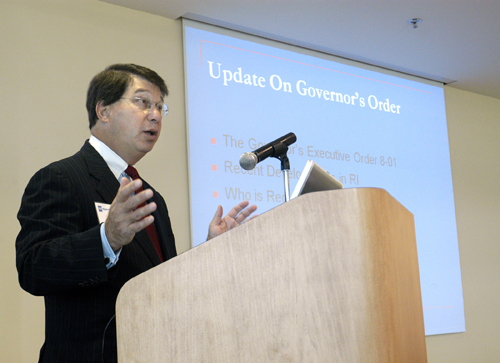
Butler and other SHRM officers have fielded so many questions, the organization held a workshop on the issue last week to inform local businesses how they should deal with E-Verify.
Another seminar has been scheduled for Nov. 5 at New England Institute of Technology.
Some of the confusion stems from an executive order issued by Gov. Donald L. Carcieri in March, requiring that vendors doing business with the state enroll in the E-Verify program, a system that uses a federal database to check the legal working status of new employees.
Things became more complicated when the Rhode Island chapter of the American Civil Liberties Union filed a lawsuit in September seeking to overturn Carcieri’s order.
While Rhode Island Superior Court Judge Mark Pfeiffer last month rejected the ACLU’s request for a temporary restraining order, he ruled that the Carcieri administration had to hold public hearings before the new rules could be added to the state purchasing guidelines, and enforced.
Steven Brown, executive director of the local ACLU, said the ruling also exempted – at least temporarily — companies that have already been awarded contracts from having to enroll with E-Verify.
A Carcieri administration spokeswoman acknowledged recently that enforcement of the executive order, which was initially intended to begin last month, has been “put on hold.”
The spokeswoman, Amy Kempe, said state administrators are drafting the rules and expect to hold public hearings in the coming weeks.
Despite the initial ruling, the ACLU is pushing forward with efforts in Superior Court to permanently block the mandatory use of E-Verify. Brown said legal briefs are due next month.
The ACLU is acting on behalf of the Rhode Island Coalition Against Domestic Violence and Rhode Island College professors Marie Mumm and Daniel Weisman, who have contracts with the state and object to being forced to participate in the program.
Lawyers for the ACLU contend that the system, run by the U.S. Department of Homeland Security in conjunction with the Social Security Administration, is riddled with inaccurate information and can make is easier for employers to discriminate against minority jobseekers.
Participating employers enter an employee’s information — such as date of birth, Social Security number, and proof of identity – into the program’s Web site to see if everything matches up. Employers typically receive an instantaneous verification or a tentative non-verification. Opponents have complained of a high error rate, particularly among those who are not U.S. citizens but can work here legally.
“We believe that the program has a discriminatory impact on lawful, foreign-born workers,” Brown said.
Nonetheless, the use of E-Verify has grown in Rhode Island, according to numbers released by the governor’s office.
Kempe said about 1,233 Rhode Island businesses and organizations have a “memorandum of understanding” with E-Verify – meaning they have already gone through the system’s Web-based tutorial and test — and many others are in the process of signing on.
The system had also handled 11,500 employee checks in 2008, as of the end of September – up from 7,366 in all of 2007 and 3,583 in 2006, according to Kempe.
Some officials attribute the increased usage to the publicity from Carcieri’s executive order as well as a much-discussed bill that would have required all Rhode Island businesses to use E-Verify. That legislation, which drew protests from immigrants’ rights advocates, was easily approved by the House but died in the Senate in the waning hours of the legislative session in June.
Supporters have vowed to bring the bill back next year.
All of this action at the state level nearly became moot recently when federal legislation to extend the E-Verify system for five years – it was set to expire in November – stalled in the Senate after getting approval in the House with little opposition.
With lawmakers preoccupied with the $700 billion financial-industry rescue and election recess looming, the Senate voted just ahead of the deadline to reauthorize E-Verify until March 6.
Michael Aitken, director of government affairs for the national SHRM, said he is hopeful an alternative to E-Verify can be found before Congress votes on the issue again.
Both SHRM and the Human Resources Initiative for a Legal Workforce, an advocacy group for HR professionals, oppose mandatory use of E-Verify because of doubts about its accuracy and reliability, and because of the inconsistency of requirements from state to state.
Aitken points to cases in which new hires have used stolen IDs to evade detection by E-Verify. The system does not provide employers “safe harbor” from prosecution in those situations, he said.
Instead, Aitken said, SHRM and the HR Initiative are supporting legislation (HR-5515 “the New Employee Verification Act”) that would provide legal protections for companies, would allow for the use of biometrics – such as fingerprints or eye scans – to confirm identifications, and would use an existing child-support registry in which 90 percent of U.S. employers are already participating.
Aitken said the federal government must develop a better solution than E-Verify because the focus on illegal immigrants in the work force is only going to grow more intense as jobs get scarcer.
“Immigration is one of those issues that gets more attention in a down economy,” Aitken said. •