During 2003, the year after Maryland imposed a $30 million cap on its historic preservation tax-credit program, developers Struever Bros. Eccles & Rouse started operations in Rhode Island, which had just instituted a similar program without a cap.
“The cap basically just squashed any historic-preservation work that could be done down there, especially within Baltimore,” said John Sinnott, SBER director of Providence operations, citing Rhode Island’s 30-percent Historic Preservation Investment Tax Credits as a major factor in coming to Rhode Island.
Now, with seven Rhode Island projects – including American Locomotive Works and Rising Sun Mills – SBER has more than $500 million invested in the state.
But a proposed cap on Rhode Island’s tax-credit program has led to uncertainty about whether some of those projects will continue, Sinnott told Providence Business News last week.
“Because of the commitments we’ve made with investors, that [cap] would probably cause us to close our doors here,” Sinnott said. “It would basically cause the [300,000-square-foot, $150 million Providence waterfront] Dynamo House project to come to a screeching halt.”
The cap is part of Gov. Donald L. Carcieri’s proposed supplemental budget that is rife with cuts to state employment and health care in response to a projected $151 million deficit for FY 2008 and a projected $400 million deficit in FY 2009. The proposal includes a retroactive cap for total 2007 tax credits at $20 million and an annual cap at $40 million for 2008 through 2017.
Following 2017, no credits will be available, according to the proposed changes.
The proposal has caused an uproar from affected developers. The House Finance Committee has scheduled a hearing on the proposed cap for Tuesday, Feb. 5, at noon.
The program supplies Rhode Island tax credits worth 30 percent of qualifying construction costs, which developers can sell to investors for construction equity. Only costs that preserve the project’s historical integrity, such as renovations to facades and window repairs, qualify. While the state loses tax revenue, the program was initiated to create more economic output through new jobs, construction spending and wages.
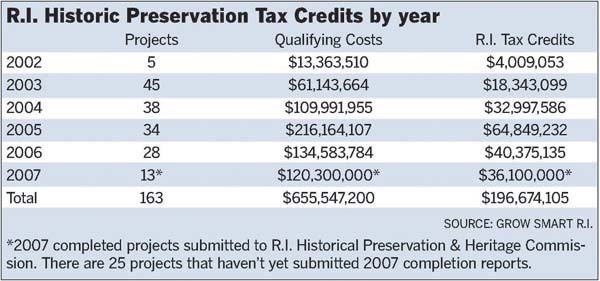
The problem with capping the credit for 2007 work, say proponents of the program, is that there already have been much more than $20 million in credits approved. So far, R.I. Historical Preservation & Heritage Commission Executive Director Ted Sanderson has approved $36.1 million in credits for 13 projects. And there are still 25 projects – with potential credit totaling $21.6 million – that were scheduled for 2007 completion and haven’t yet filed reports with Sanderson.
“I’m told by many developers that that’s just really hard,” Sanderson said. “Markets change. Financing changes. Tenants change.”
Church Community Housing Group’s Mumford Manor project is one of the developments that have been approved for 2007 credits.
Stephen Ostiguy, executive director of the Newport-based nonprofit, said that if he had known the $1.2 million in state credits for the project wasn’t a definite source of equity, CCHG would have done things differently on its $7.6 million project.
First, it would have replaced the building’s 99-year-old windows, which are far from energy efficient. (To receive the tax credit, CCHG had to renovate them instead.) And second, it would not have counted on selling state historic tax credits to finance the project, he said.
Because CCHG is having trouble selling the credits – due to Carcieri’s proposal, Ostiguy said – it might not be able to afford the project’s “large” construction mortgage.
Urban Smart Growth Principal Lance Robbins never would have come to Rhode Island if it weren’t for the historic tax credit. His development company started during the 1990s in Los Angeles, but now has more projects and employees in Rhode Island than anywhere else in the country.
Its four projects in the state, including Hope Artiste Village, the 650,000-square-foot, $35 million mixed-use Pawtucket redevelopment, total more than $152 million in current and future investments by Urban Smart Growth. Each project relies heavily on tax credits, Robbins said.
Michael Corso, principal of Providence’s Orb Development, previously worked for 13 years as general counsel with Cornish Associates LLC and was integral in drafting the initial statute for the credit.
“Going back into why this program was adopted – it was because it made projects, that otherwise wouldn’t happen, feasible,” Corso said. “There’s a big gap of funding in historic projects that banks won’t lend to.”
As a lender, most banks will only back 40 percent of total development costs, “but this program allowed funding to come in through private investment,” he said.
There was a reason that the program’s designers didn’t put an annual cap on it, Corso said. “If you look at other states, every time a cap was introduced the program deteriorated,” he said. “It created uncertainty in the market.”
Rhode Island’s program has clearly expanded, Sanderson said. While only five projects were completed during 2002 – the first year during which credits were available – there were 145 projects completed during the following four years.
In total investments, including estimates for 2007, the state has invested almost $200 million in the program. Grow Smart Rhode Island estimates that that investment comes back to the state at a rate of $5.35 in “total economic output” for each invested dollar, according to a September 2007 report.
During construction of each project, the state gets back new tax revenue that’s equivalent to about half the tax credit, Sanderson said.
But for some developers a cap would act as a deterrent, keeping them from pursuing projects.
And it might lead some to default on their loans, said Grow Smart Executive Director Scott Wolf. For Church Community Housing Group’s Mumford Manor, that possibility is real.
“This is an affordable-housing development for seniors. And we got financing and approval on all of our various sources based on these tax credits being available,” Ostiguy said. “So we’re a little worried at this point.” •