For 33 years, Leona Bailey has toiled away as a machine operator on the factory floor at Concordia Fabrics in Coventry. It’s the only job she’s ever known. She even dropped out of high school to work, never getting her diploma.
That’s about to change.
Bailey is part of Concordia’s effort to train its workers in basic reading, writing and mathematics as the revitalized company shifts its focus from making fibers for industrial uses to developing fabrics for the biomedical industry.
Instead of firing employees who don’t have enough basic knowledge to handle the high-tech manufacturing – some can’t even speak English – and hiring anew, Concordia executives have made what has been initially an expensive decision to stick with their current work force.
“We have loyal employees,” CEO Randal Spencer said last week. “So we’re taking the whole plant through this transition.”
Bailey, for example, will soon move to working in the sterile facilities where Concordia’s biomedical materials are manufactured. And at 59, she’s prepared to obtain her GED.
“If I had to do this on my own, I would have never attempted it,” Bailey said.
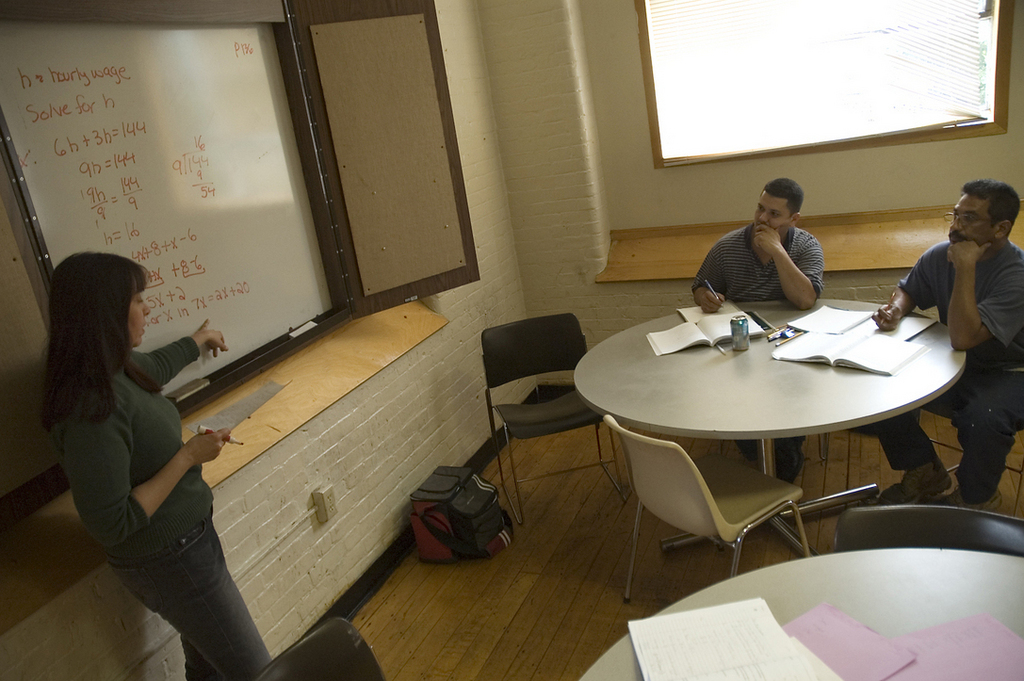
Right now, 33 of Concordia’s 55 employees are spending three hours a week on company time taking math and English as a second language courses. Basic English and writing classes have been offered as well.
Instructors from the Community College of Rhode Island are teaching the classes, funded in part through a biotechnology training grant administered by the Tech Collective, a nonprofit alliance of local industry groups.
Despite the use of grant money, Nancy Rodericks, Concordia’s human resources manager, figures the training has cost the company at least $200,000 in wages paid to workers off the production floor.
To Spencer, however, there will be a long-term payoff: keeping workers who have decades of hands-on experience. “The people we have are not educated in the schooling sense,” he said. “But they’re bright people, and they have what I call ‘finger smarts.’ They’ve been working in the textile industry for their whole life. … That’s hard to train.”
Eighty-six-year-old Concordia is indeed a company in transition.
In the late 1990s, the fibers maker was able to rely on strong orders for its carbon-based fiber, used to make tennis rackets. But demand for those rackets waned and more of Concordia’s core business was lost to Asian competitors.
Just seven years ago, Concordia’s payroll numbered 170. Now it’s down to 55.
But thanks to the company’s focus on developing fibers for the biomedical industry, there hasn’t been a layoff in three years, Spencer said, and Concordia has returned to profitability.
Inside its existing factory, the company has constructed special sterile facilities where it manufactures “Biofelt,” a material that can absorbed by the body. It is made of polymers that enable cells to grow on it, allowing living tissue to eventually replace the Biofelt. Researchers have already used the material to create new arteries.
Boosted by the success of Biofelt, the biotech segment now accounts for about 40 percent of the company’s revenue, up from 3 percent just two years ago. And that number continues to rise.
“There’s a lot of need in the medical-device community for people who understand how to construct things out of fibers, particularly out of resorbable fibers,” Spencer said.
But the new sector requires some basic skills that his workers didn’t necessarily have.
In biomedical manufacturing, federal regulators and customers demand a level of documentation unheard of in making industrial fibers. Accurate record-keeping by workers is essential, Spencer said.
“Just making it isn’t good enough,” he said. “Because if there is an issue, in order to diagnose what the problem is, you need to have full traceability all the way back to the beginning of the product. What machine it was made on, what operator touched it, and for how long.”
With that in mind, company executives now require new workers to have at least a high school diploma. “There’s no way we can maintain these quality systems without people with at least that level of skill,” Spencer said.
But Spencer had no intention of giving up on the existing work force, which has an average age of 46 and average experience of 16 years.
So far, it’s been a success.
Suzanne D’Onofrio, director of work force training and corporate education at CCRI, said an assessment of the employees before the reading and writing courses showed that they were at a third- and fourth-grade level.
Now tests show that they’ve jumped to seventh- and eighth-grade levels.
And Concordia is also encouraging employees to obtain their GEDs, which six employees – including Bailey – are close to doing.
“We’re all in this fight together,” Spencer said. “That’s part of the reason why Concordia is still alive, because we’ve managed to work together to survive.” •